If you’re new to Medicare, you may have opened a premium bill and wondered why the number was higher than you expected. The extra charge might be the IRMAA surcharge, a Medicare add-on tied to your income. It affects a smaller share of enrollees than most people assume, but if your income crosses a certain line, it can add hundreds of dollars to your monthly Part B and Part D bill. Most people never see it at all, since it only kicks in above a specific income line that resets every year. Here is what the IRMAA surcharge is, how it is calculated for 2026, and how to find out if it applies to you.
What Does the IRMAA Surcharge Actually Cover?
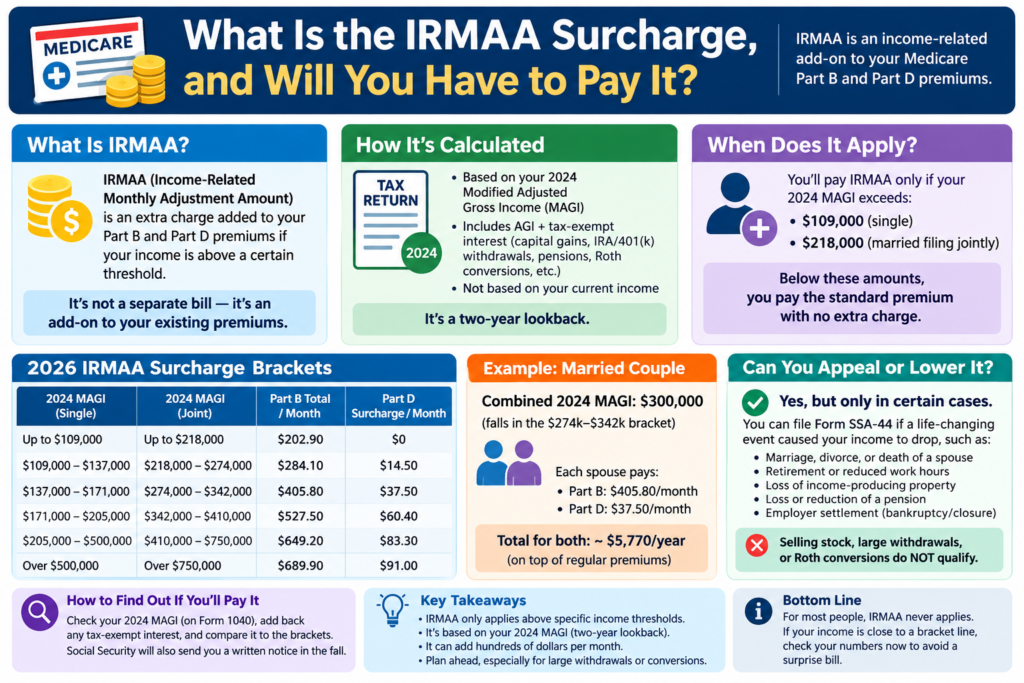
IRMAA stands for Income-Related Monthly Adjustment Amount. It is not a separate bill. It is an add-on to the Medicare premiums you already pay for Part B (medical insurance) and Part D (prescription drug coverage).
Most people pay the standard Part B premium, which is $202.90 a month in 2026, and no extra amount for Part D beyond their plan’s own price. If Social Security determines you owe the IRMAA surcharge, that amount gets added on top, and a smaller amount is also tacked onto your Part D drug plan premium.
Both pieces are billed the same way your regular premium is. If you already have Social Security or Railroad Retirement payments deposited each month, the surcharge is simply withheld from that deposit before it reaches your bank account. If you’re not yet drawing benefits, Medicare bills you directly instead, usually on a quarterly schedule.
How the IRMAA Surcharge Is Calculated
Social Security does not look at your income today. The IRMAA surcharge for 2026 is based on your Modified Adjusted Gross Income, or MAGI, from your 2024 tax return. That two-year lookback is standard for every Medicare enrollee, and it applies the same way whether you’re newly enrolled or have been on Medicare for a decade.
MAGI includes your adjusted gross income plus any tax-exempt interest. Capital gains, IRA and 401(k) withdrawals, pension income, and Roth conversions all count toward the number that decides your IRMAA surcharge. Non-taxable Social Security benefits and income you were never required to report do not factor in.
It works as a cliff, not a gradual phase in. Go one dollar over a bracket, and your entire MAGI gets priced at the next tier’s full surcharge amount. There is no partial charge for the sliver of income over the line.
2026 IRMAA Surcharge Brackets for Part B and Part D
For 2026, the IRMAA surcharge begins once your 2024 MAGI passes $109,000 for single filers or $218,000 for married couples filing jointly. Below those numbers, you pay the standard premium with no add-on at all.
| 2024 MAGI (Single) | 2024 MAGI (Joint) | Part B Total/Month | Part D Surcharge/Month |
|---|---|---|---|
| Up to $109,000 | Up to $218,000 | $202.90 | $0 |
| $109,000–$137,000 | $218,000–$274,000 | $284.10 | $14.50 |
| $137,000–$171,000 | $274,000–$342,000 | $405.80 | $37.50 |
| $171,000–$205,000 | $342,000–$410,000 | $527.50 | $60.40 |
| $205,000–$500,000 | $410,000–$750,000 | $649.20 | $83.30 |
| Over $500,000 | Over $750,000 | $689.90 | $91.00 |
IRMAA Surcharges for a Married Couple: A Worked Example
Say a married couple filed jointly with a combined 2024 MAGI of $300,000. That lands them in the bracket running from $274,000 to $342,000.
Because IRMAA surcharges are billed per Medicare-enrolled spouse, not per household, each spouse who is enrolled in Part B and Part D owes their own amount at that tier. Each spouse’s Part B bill would run $405.80 a month, plus a $37.50 monthly charge on Part D. Together, that’s roughly $5,770 a year in combined costs for the household, on top of what they’d normally pay.
Why Your IRMAA Surcharge Is Based on Old Income
Retirees are often caught off guard because a large one-time event, like selling investments or a Roth conversion, can trigger an IRMAA surcharge two years later, long after the transaction is finished. A drop in income today will not lower this year’s bill, because Social Security is still working off your 2024 return.
That lag is also why this can catch newly retired people by surprise. Your final working years often show higher income than your retirement years will, which can trigger a surcharge you no longer have the earnings to match.
How to Find Out If You’ll Pay the IRMAA Surcharge
Social Security sends a written notice if it determines you owe an IRMAA surcharge, based on the tax return the IRS shares with it. You do not need to calculate anything yourself, but you can check your own numbers ahead of time. These notices typically go out in the fall, ahead of the new premium year, so you have a few months to plan before the higher amount takes effect.
Start by pulling your MAGI from your most recent filed return, usually two years behind the current year. Your AGI appears near the bottom of the first page of Form 1040. Add back any tax-exempt interest, then compare the total against the bracket table above for your filing status. If your MAGI sits above the entry threshold, expect a surcharge notice from Social Security before your Medicare premiums are deducted. Keep in mind that the thresholds themselves move a little each year with inflation, so being close to a line one year doesn’t guarantee the same result the next.
You can run your own IRMAA surcharge numbers with our Medicare Premium Calculator before your official notice arrives, which is especially useful if you’re planning a Roth conversion or a large withdrawal and want to see how it might affect your premiums two years out.
Can You Appeal or Lower Your IRMAA Surcharge?
This surcharge is not always permanent. Social Security allows you to request a new determination using Form SSA-44, but only if a specific life-changing event caused your income to drop. Qualifying events include:
- Marriage, divorce, or the death of a spouse
- Retirement or a reduction in work hours
- Loss of income-producing property beyond your control
- Loss or reduction of a pension
- An employer settlement tied to a bankruptcy or closure
Selling stock, taking a large IRA distribution, or a Roth conversion does not qualify for an appeal, even if your income genuinely dropped the following year. Those are considered choices rather than life-changing events, so the IRMAA surcharge stands as originally calculated.
To file, submit Form SSA-44 along with documentation of the event, such as a retirement letter or a death certificate, to your local Social Security office. Most decisions come back within a few weeks, and if approved, the adjustment applies going forward rather than as a retroactive refund of premiums already paid.
Bottom Line on the IRMAA Surcharge
The IRMAA surcharge only applies once your income crosses a specific threshold, and for most Medicare enrollees, it never comes into play. If your MAGI is close to a bracket line, checking the numbers now can help you avoid a surprise bill and plan withdrawals with the two-year lookback in mind. And if a life change genuinely lowered your income, Form SSA-44 is worth filing before you assume the higher bill is permanent.
This is for informational purposes only and isn’t financial, tax, or legal advice

Raghu Shekar writes about personal finance, banking, Medicare, and retirement planning at SimpleUSAFinance. His goal is simple: break down the numbers people actually need — no jargon, no sales pitch — so readers can make their own decisions with confidence. When he’s not writing, he’s usually digging through the latest rate changes, tax brackets, or Medicare updates to keep the site’s calculators and guides current.