A recent call into The Dave Ramsey Emergency Fund Show has a lot of people rethinking their savings account, and it’s a good excuse to revisit Dave Ramsey’s emergency fund rule. A caller and his wife were sitting on $150,000 in cash while still carrying a $60,000 car loan. Ramsey didn’t hold back. He told them the setup had already cost them $50,000 in lost growth.
If you’ve built a large cash cushion and aren’t sure whether it’s smart saving or expensive hoarding, this breakdown walks through the numbers and the thinking behind them.
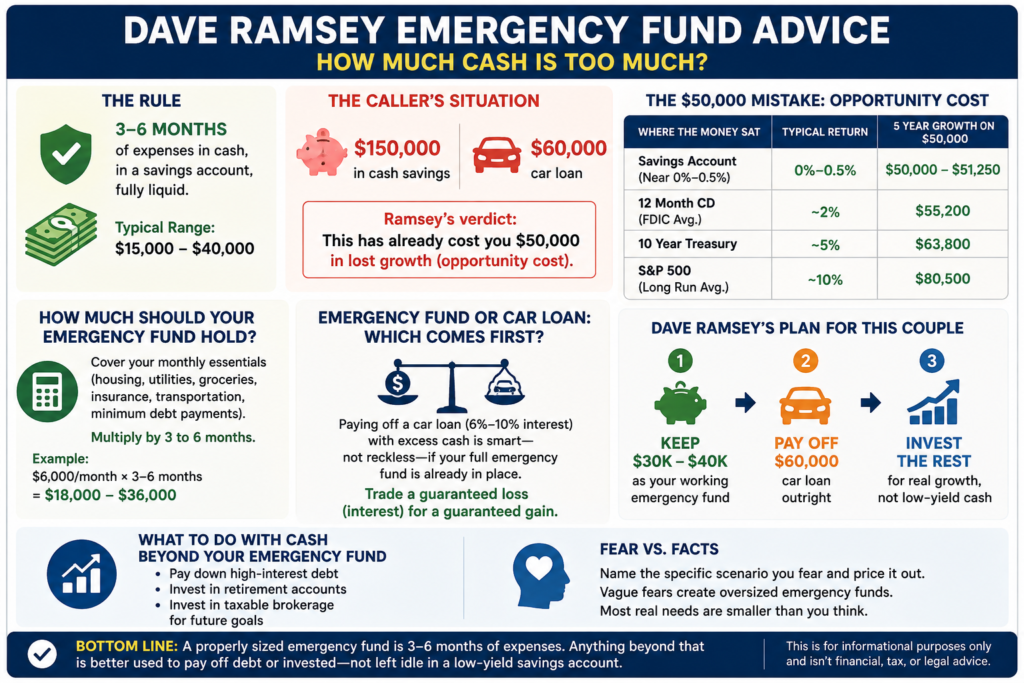
Dave Ramsey’s Emergency Fund Rule Explained
The standard Dave Ramsey emergency fund guideline is simple: three to six months of expenses in cash, sitting in a regular savings account, fully liquid and untouched. For most households, that lands somewhere between $15,000 and $40,000, depending on income and monthly bills.
The caller’s household was nowhere near that range. At $150,000 in savings, they had roughly three to four times what a typical Dave Ramsey emergency fund should hold, while simultaneously paying interest on a $60,000 car loan. That combination is what triggered the blunt response on air.
Why This Couple’s Emergency Fund Became a $50,000 Mistake
Ramsey told the caller directly that keeping such a large Dave Ramsey emergency fund style balance in cash had already cost them $50,000. That number isn’t a fee or a penalty. It’s opportunity cost, the return they gave up by not investing the excess cash over the past several years.
Here’s the simple math behind that claim.
| Where the money sat | Typical return | 5 year growth on $50,000 |
|---|---|---|
| Standard savings account | Near 0% to 0.5% | About $50,000 to $51,250 |
| 12 month CD (FDIC national average) | Near 2% | About $55,200 |
| 10 year Treasury | Near 5% | About $63,800 |
| S&P 500 (long run average) | Near 10% | About $80,500 |
That gap between doing nothing and investing is exactly what Ramsey meant by “screwing around with a stupid savings account.” A well sized Dave Ramsey emergency fund protects you. Anything held far beyond that just sits there losing ground to inflation.
How Much Should Your Emergency Fund Actually Hold
So what’s the right number? A Dave Ramsey emergency fund should cover real, predictable risk, not every fear you can imagine. Start with your monthly essentials: housing, utilities, groceries, insurance, minimum debt payments, and transportation. Multiply that by three to six months.
For a household spending $6,000 a month on essentials, that’s a $18,000 to $36,000 target. Once you hit that number, additional cash sitting idle stops being safety and starts being a drag on your net worth.
In the caller’s case, Ramsey suggested keeping $30,000 to $40,000 as their working Dave Ramsey emergency fund, using part of the remainder to pay off the $60,000 car loan outright, and investing what was left over.
Emergency Fund or Car Loan: Which Comes First
This is where the caller’s instinct was actually right, and his wife’s hesitation was the sticking point. Paying off a car loan with cash from an oversized Dave Ramsey emergency fund isn’t reckless, it’s math. A car loan carries interest, usually 6% to 10% depending on credit and terms. Cash sitting in a low yield account earns close to nothing.
Wiping out the loan with excess savings, while still keeping a full Dave Ramsey emergency fund intact for true emergencies, is one of the more straightforward wins in personal finance. You’re not gambling anything. You’re trading a guaranteed loss for a guaranteed gain.
Dave Ramsey Emergency Fund vs Paying Off a Car Loan
To be clear, the debate isn’t emergency fund versus car loan as an either or choice. It’s about right sizing the Dave Ramsey emergency fund first, then using anything above that target on debt or investing. Keep too little, and one bad month turns into a credit card balance. Keep too much, and you’re quietly losing money every year to inflation and missed returns.
The couple’s case is a useful gut check. If your savings balance is several multiples of your actual monthly expenses and you’re still carrying loan debt, the excess in your Dave Ramsey emergency fund is working against you, not for you.
What to Do With Cash Beyond Your Emergency Fund
Once your Dave Ramsey emergency fund is fully funded at the three to six month level, extra cash generally has three good homes: paying down high interest debt, investing in a retirement account, or a taxable brokerage account for goals further out.
Ramsey’s advice to the caller followed that order almost exactly. Fund the account, kill the car loan, and invest the rest instead of letting it sit.
Building an Emergency Fund When Fear Is Driving the Decision
There was a deeper layer to this call worth mentioning. The wife’s reluctance to shrink their Dave Ramsey emergency fund wasn’t really about the car loan. It traced back to past infertility struggles and old medical bills, and the fear of ever being caught without a cushion again.
Ramsey’s response to that was worth noting too. Instead of arguing with the fear, he asked her to name the specific scenario she was afraid of and price it out. Once a vague fear becomes a real number, it’s usually smaller than the emergency fund built to cover it. That’s a useful exercise for anyone whose savings target is being driven by anxiety rather than actual monthly expenses.
If you want to see exactly what your own three to six month cushion should look like based on your real expenses, you can run the numbers with our Emergency Fund Calculator before deciding what to do with anything above it.
Bottom Line
A properly sized Dave Ramsey emergency fund is three to six months of expenses, nothing more. Anything beyond that is better used paying off high interest debt or invested for real growth, not left sitting idle in a low yield savings account.
Please analyze and use calculators designed for complete information
This is for informational purposes only and isn’t financial, tax, or legal advice.

Raghu Shekar writes about personal finance, banking, Medicare, and retirement planning at SimpleUSAFinance. His goal is simple: break down the numbers people actually need — no jargon, no sales pitch — so readers can make their own decisions with confidence. When he’s not writing, he’s usually digging through the latest rate changes, tax brackets, or Medicare updates to keep the site’s calculators and guides current.