The checking vs savings question sounds basic, but most people get it wrong in one direction or the other. Either too much cash sits in checking earning nothing, or too little sits in savings, leaving no cushion when something breaks. Getting the split right is one of the simplest ways to make your money work harder without taking on any risk.
Here’s a clear way to think through checking vs savings, with real numbers so you can apply it to your own accounts today.
Checking vs Savings Basics Everyone Should Know
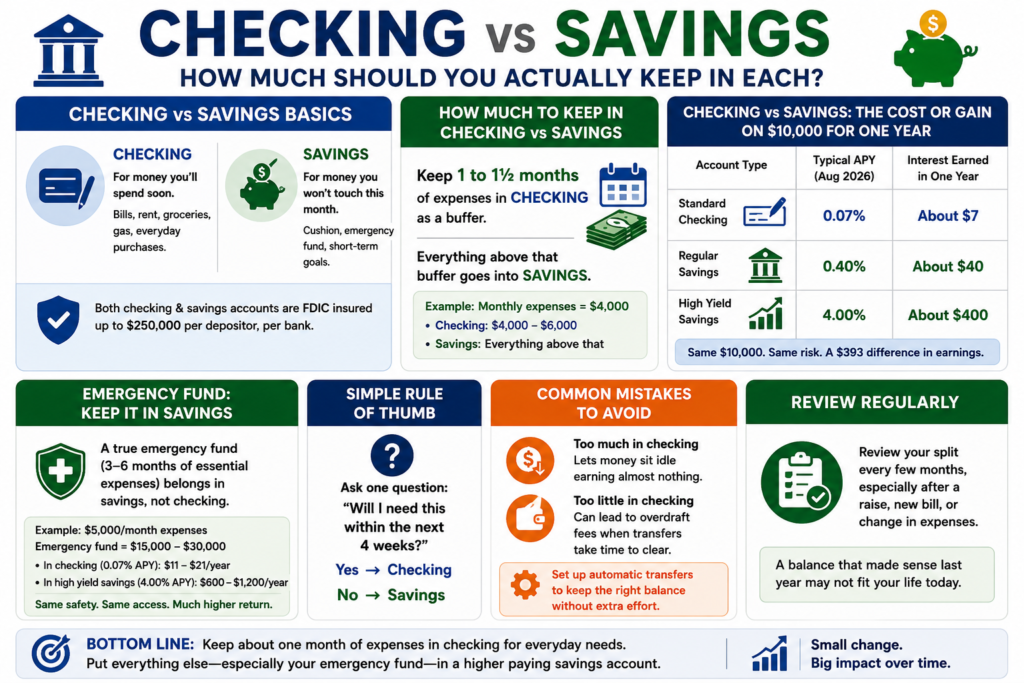
The core difference in checking vs savings comes down to purpose, not just interest rate. Checking is for money you’re about to spend, bills, rent, groceries, and everyday purchases. Savings is for money you’re not touching this month, your cushion and your near term goals.
As of August 2026, the national average interest checking account pays around 0.07% APY, according to FDIC data. Regular savings accounts average about 0.38% to 0.63% APY nationally, while high yield savings accounts at online banks pay closer to 4.00% APY. That gap is the entire reason checking vs savings matters. Money parked in the wrong account is quietly losing ground every month.
How Much to Keep in Checking vs Savings Each Month
A workable rule for checking vs savings is to keep one to one and a half months of expenses in checking, and everything else in savings. If your monthly expenses run $4,000, that means keeping roughly $4,000 to $6,000 in checking as a buffer against timing gaps between paychecks and bills.
Anything above that buffer should move to savings. Sitting on $10,000 in a checking account earning close to 0% APY, when even a basic savings account pays 0.4% and a high yield account pays 4%, is money left on the table every single month.
Checking vs Savings Example With Real Numbers
Here’s what the checking vs savings decision actually costs or earns over a year on a $10,000 balance.
| Account type | Typical APY | Interest earned in one year |
|---|---|---|
| Standard checking | 0.07% | About $7 |
| Regular savings | 0.40% | About $40 |
| High yield savings | 4.00% | About $400 |
That’s the difference between an idle checking balance and a properly placed savings balance. Same $10,000, same risk, a $393 gap in what it earns.
Savings vs Checking: Why Excess Cash Belongs in Savings
Flipping the comparison to savings vs checking makes the case even clearer. Savings accounts are FDIC insured up to $250,000 per depositor, per bank, exactly like checking accounts. You lose no safety by moving money over. You only gain a better return.
The only reason to keep money in checking beyond your monthly buffer is convenience, and convenience is expensive when the rate difference is this wide. For most households, the right checking vs savings split leaves checking lean and savings doing the heavy lifting.
Checking vs Savings for Emergency Funds
Your emergency fund is where checking vs savings decisions matter most. A true emergency fund, three to six months of essential expenses, should live in savings, not checking. It needs to be liquid, but it doesn’t need to be instantly spendable the way rent money does.
For a household with $5,000 in monthly essential expenses, that’s a $15,000 to $30,000 emergency fund. Left in checking at 0.07% APY, that balance earns roughly $11 to $21 a year. The same balance in a high yield savings account earns $600 to $1,200 a year, for the exact same level of safety and the exact same access when you actually need it.
Checking or Savings: A Simple Rule of Thumb
If you’re unsure whether a dollar belongs in checking or savings, ask one question: will I need this within the next four weeks? If yes, checking. If no, savings. That single filter resolves most checking vs savings confusion without needing a spreadsheet or a budgeting app.
Review the split every few months, especially after a raise, a new bill, or a change in your monthly expenses. A checking vs savings balance that made sense last year may not fit your current spending anymore.
Common Checking vs Savings Mistakes to Avoid
The most common checking vs savings mistake is letting checking become a savings account by default, simply because moving money feels like extra effort. Most banks let you set up automatic transfers, so the split happens without you thinking about it every month.
The second mistake is the opposite problem, keeping too little in checking and triggering overdraft fees because savings withdrawals take a day or two to clear. Both mistakes come from not treating checking vs savings as an active decision. A monthly buffer in checking, a target range in savings, and an automatic transfer between the two solves both problems at once.
If you want to see exactly how much your own buffer and emergency fund should be based on your real monthly expenses, you can run your own checking vs savings numbers with our Emergency Fund Calculator.
Bottom Line
The right checking vs savings split is about one month of expenses in checking and everything else, especially your emergency fund, in a higher paying savings account. It costs nothing to fix and it’s one of the easiest wins in personal finance.
This is for informational purposes only and isn’t financial, tax, or legal advice.

Raghu Shekar writes about personal finance, banking, Medicare, and retirement planning at SimpleUSAFinance. His goal is simple: break down the numbers people actually need — no jargon, no sales pitch — so readers can make their own decisions with confidence. When he’s not writing, he’s usually digging through the latest rate changes, tax brackets, or Medicare updates to keep the site’s calculators and guides current.