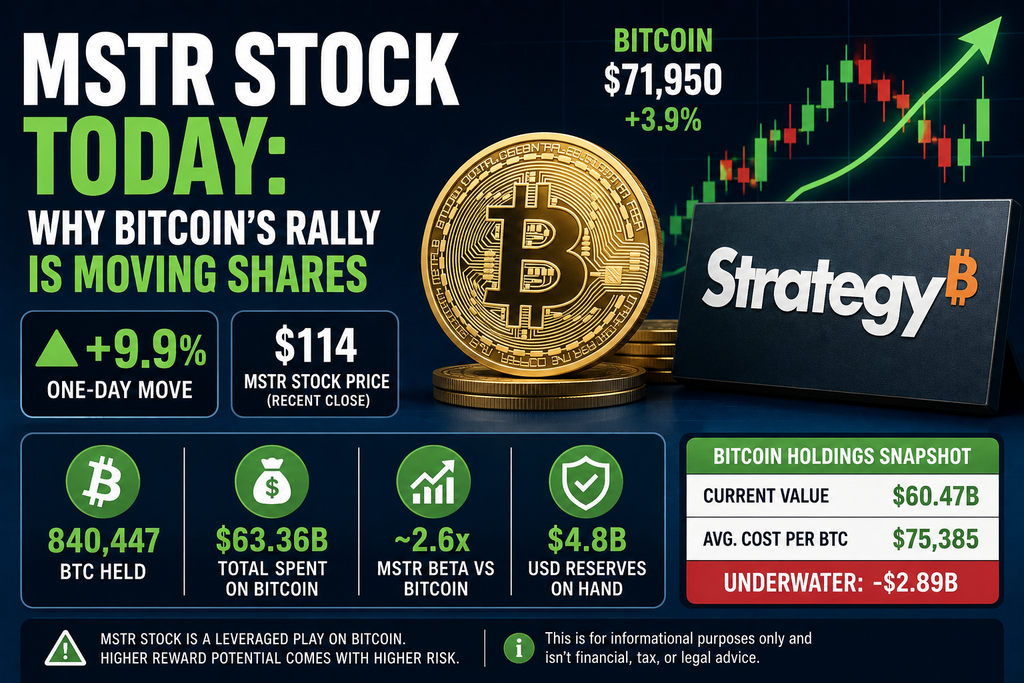
If you searched “MSTR stock” this week, you probably saw the same headline everywhere: Strategy Inc, the company still widely known as MicroStrategy, jumped hard as Bitcoin broke above $71,000. Shares rose more than 9% in a single session and added roughly $4 billion in market value before the opening bell. For anyone trying to understand MSTR stock, the short version is this: it isn’t really a software stock anymore. It moves like a leveraged bet on Bitcoin.
This guide breaks down what’s actually happening with the stock right now, in plain numbers, no jargon, so you can decide what it means for your own portfolio.
What Is Driving the MSTR Stock Rally This Week?
The MSTR stock rally traces back to Bitcoin itself. Bitcoin broke out of a six week trading range and climbed toward $72,000, triggering a wave of forced short covering across crypto markets. That short squeeze reportedly wiped out more than $3 billion in bearish bets in a single day.
Because Strategy holds a massive Bitcoin treasury, its shares reacted with amplified force. The stock closed up over 12% one day and then gained another 9 to 10% the next, pushing shares from the mid $90s into the $110s in under two weeks. That kind of two-week move is exactly why traders keep this ticker on a short leash.
How MSTR Stock Price Tracks Bitcoin’s Every Move
This is the single most important thing to understand before trading MSTR stock: it is a leveraged proxy, not a direct Bitcoin substitute. Recent data put its price sensitivity, or “beta,” at roughly 2.6 times Bitcoin’s daily move. When Bitcoin rose about 3.9% in one session, the shares rose closer to 10%.
That relationship cuts both ways. When Bitcoin drops, MSTR stock has historically fallen even harder than the coin itself. Investors who buy it for Bitcoin exposure are also buying that extra volatility, whether they want it or not. That two-way leverage is the entire personality of this name.
MSTR Stock vs Bitcoin: A Quick Numbers Snapshot
| Metric | Figure |
|---|---|
| MSTR stock price (recent close) | ~$114 |
| One-day move | +9.9% |
| Bitcoin price | ~$71,950 |
| Bitcoin one-day move | +3.9% |
| Bitcoin held by Strategy | 840,447 BTC |
| Average purchase cost per BTC | $75,385 |
| Total spent acquiring Bitcoin | $63.36 billion |
| Current value of Bitcoin holdings | $60.47 billion |
Notice that last row. Even after the rally, Strategy’s Bitcoin treasury was still worth less than what the company paid for it, a reminder that a strong week for MSTR stock doesn’t erase a rough stretch for its underlying holdings.
Why Strategy Sells MSTR Stock Instead of Bitcoin to Raise Cash
One detail matters a lot for anyone following MSTR stock closely: the company has been funding its obligations by issuing new shares instead of selling Bitcoin. In the week ending August 16, Strategy raised about $333.7 million by selling 3.46 million MSTR shares, while its Bitcoin holdings stayed exactly the same.
That cash went toward dividends on its preferred stock and toward building up USD reserves, which climbed to roughly $4.8 billion. For a business this leveraged, a bigger cash cushion is a meaningful buffer.
MSTR Stock Dilution: What Weekly Share Sales Mean for Holders
Here’s the tradeoff. Every time Strategy issues new shares to raise cash, existing shareholders get a slightly smaller slice of the company and its Bitcoin per share. The company has argued this is manageable as long as Bitcoin per fully diluted share keeps growing over time. Whether that holds up is something anyone holding MSTR stock should keep watching quarter to quarter, alongside the company’s own published Bitcoin ledger.
What Wall Street Analysts Say About MSTR Stock Price Targets
Analyst sentiment on MSTR stock remains largely positive on paper, even as targets have come down alongside Bitcoin’s swings. Several firms, including Clear Street, Benchmark, and B. Riley, trimmed their price targets this month while keeping Buy ratings in place. Reported targets have ranged widely, from roughly $125 on the low end to over $500 on the high end, with an average well above the recent trading price.
Wide target ranges like that are a signal in themselves. They tell you analysts largely agree on the direction of the stock but disagree sharply on how much Bitcoin exposure is worth paying for. That gap is worth remembering the next time a headline cites just one number.
Risks Every MSTR Stock Investor Should Weigh
Before adding MSTR stock to a portfolio, it’s worth being honest about the risk profile:
- Bitcoin risk, amplified. The shares tend to move roughly two to three times Bitcoin’s daily swing, in either direction.
- Dilution risk. Regular share issuance to fund dividends and operations can reduce the Bitcoin backing behind each share over time.
- Debt and preferred obligations. Strategy carries billions in long-term debt and pays a 12% annualized dividend on its Series A preferred stock, both of which compete with common shareholders for cash.
- Concentration risk. The core software business is a small part of the story; the vast majority of the company’s value rides on one asset, Bitcoin.
- Headline risk. Because MSTR stock moves so fast, prices quoted in any article, including this one, can be stale within hours.
None of this makes the stock a bad investment by default, but it does make it a fundamentally different kind of holding than a typical dividend or index stock.
Should You Buy MSTR Stock? Bottom Line
MSTR stock is best understood as a high-beta way to express a view on Bitcoin through a regular brokerage account, not as a steady, buy-and-hold equity. The recent rally shows how quickly gains can build when Bitcoin moves higher, and the treasury math shows just as clearly how quickly that can reverse. If you’re weighing this stock against a direct Bitcoin allocation, run your own numbers with our Investment Risk Calculator before deciding how much volatility fits your plan.
This is for informational purposes only and isn’t financial, tax, or legal advice.

Raghu Shekar writes about personal finance, banking, Medicare, and retirement planning at SimpleUSAFinance. His goal is simple: break down the numbers people actually need — no jargon, no sales pitch — so readers can make their own decisions with confidence. When he’s not writing, he’s usually digging through the latest rate changes, tax brackets, or Medicare updates to keep the site’s calculators and guides current.