For nearly two decades, the donut hole was the most dreaded phrase in Medicare Part D. It described a coverage gap where beneficiaries who spent too much on prescriptions suddenly saw their costs spike. If you’re researching Medicare drug coverage today, here’s the short version: the donut hole no longer exists. It was eliminated starting January 1, 2025, and replaced with a hard annual spending cap. This guide explains what changed and how the new system actually works in 2026.
Quick Answer: Is There Still a Donut Hole?
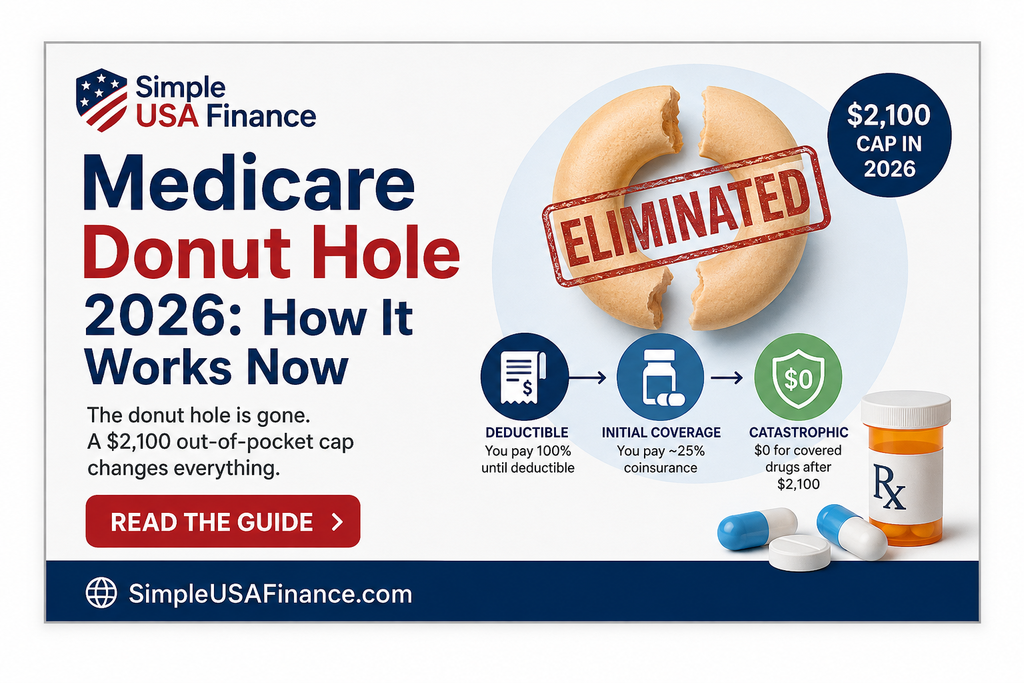
No. The Medicare Part D donut hole was fully closed by the Inflation Reduction Act (IRA). Instead of the old donut hole phase where you paid a much larger share of your drug costs, Part D now has three phases: a deductible phase, an initial coverage phase, and a catastrophic coverage phase with a $0 out-of-pocket cost once you hit the annual threshold. According to the Centers for Medicare & Medicaid Services, that threshold is $2,100 for 2026, up from $2,000 in 2025.
What the Donut Hole Used to Be
To understand why the elimination matters, it helps to know what the donut hole actually did. When Medicare Part D launched in 2006, the program had four coverage phases instead of three. After a beneficiary and their plan spent a combined amount on medications (the “initial coverage limit”), the enrollee entered the gap phase — a stretch where they temporarily paid a much larger percentage of their own drug costs, sometimes the full price, until they reached a separate catastrophic coverage threshold.
For people managing chronic conditions or taking expensive brand-name or specialty drugs, falling into this gap midway through the year could mean an unexpected jump from a modest copay to hundreds of dollars a month. The official Medicare.gov cost page confirms this structure is no longer part of Part D benefit design.
How the Donut Hole Was Phased Out
The donut hole‘s disappearance didn’t happen overnight. The Affordable Care Act began shrinking it gradually starting in 2010, requiring drug manufacturers to offer discounts on brand-name medications purchased during the gap. Over the following decade, the beneficiary’s share of costs while in that gap dropped from 100% down toward 25%. The Inflation Reduction Act of 2022 then finished the job, eliminating it entirely as of January 1, 2025, and replacing the old discount arrangement with a Manufacturer Discount Program.
The Three Part D Phases That Replaced It
Since the donut hole was removed, Part D now runs on three phases each calendar year:
- Deductible phase — You pay 100% of your drug costs, generic and brand-name, until you meet your plan’s deductible. Plans can charge up to $615 in 2026, though many charge less or nothing at all.
- Initial coverage phase — You pay coinsurance, typically 25%, on covered drugs. There’s no longer a separate gap phase after this stage; instead, spending simply continues to accumulate toward the annual cap.
- Catastrophic coverage phase — Once your out-of-pocket spending reaches $2,100 in 2026, you pay $0 for covered Part D drugs for the rest of the calendar year.
Because there’s no longer a donut hole sitting between phases two and three, beneficiaries move directly from paying coinsurance to paying nothing once they hit the cap — a much simpler and more predictable path than the old four-phase system.
Why the $2,100 Cap Matters More Than the Old System Ever Did
The annual out-of-pocket cap is the direct replacement for the donut hole, and it’s arguably more protective. Under the old system, reaching the gap didn’t mean your spending was capped — it just meant your cost-sharing percentage changed, and total spending could still climb for months. The new $2,100 threshold, confirmed by CMS’s official Part D redesign fact sheet, is a true ceiling. Once you hit it, covered drug costs stop entirely for the year, regardless of how expensive your medications are.
This cap is indexed annually based on drug cost growth, which is why it rose from $2,000 in 2025 to $2,100 in 2026. Unlike the old gap phase, which fluctuated in severity depending on the drug and the year, the cap applies uniformly across standalone Part D plans and Medicare Advantage plans with drug coverage.
What Replaced the Discount Program
When the donut hole existed, the Coverage Gap Discount Program required manufacturers to discount brand-name drugs purchased during that phase. Now that it’s gone, that program has been replaced by the Manufacturer Discount Program, which applies discounts across the initial coverage and catastrophic phases instead of a single gap period. The Kaiser Family Foundation has published detailed analysis of how these manufacturer obligations shifted once the donut hole was eliminated.
The Medicare Prescription Payment Plan
One side effect of removing the donut hole is that some beneficiaries now hit their full out-of-pocket cap earlier in the year, especially if they fill an expensive prescription in January. To smooth that out, Medicare introduced the Prescription Payment Plan (sometimes called “smoothing”), letting enrollees spread their covered drug costs into monthly installments across the year instead of paying it all at once. It’s optional, and it doesn’t reduce what you owe — it only changes the timing. Details are available directly from Medicare.gov’s payment plan overview.
Common Misconceptions
- “I still need to budget for the donut hole.” Not anymore — it was removed for all Part D plans starting in 2025, and that remains true in 2026.
- “The gap just moved to a different spending level.” No. There’s no gap phase at all now; spending flows directly from the initial coverage phase into catastrophic coverage.
- “Only standalone Part D plans lost the donut hole.” The elimination applies to Medicare Advantage plans with drug coverage too — the $2,100 cap is a federal requirement across all Part D coverage.
- “My premium counts toward the cap that replaced it.” It doesn’t. Only your deductible, copays, and coinsurance for covered drugs count toward the $2,100 threshold.
Frequently Asked Questions
When exactly did the donut hole end? It ended on December 31, 2024, with the new structure taking effect January 1, 2025.
Does the $2,100 cap replace it for good? Yes. The Inflation Reduction Act permanently restructured Part D, so a donut hole is not expected to return; the cap simply adjusts upward each year with drug cost inflation.
Will my Medicare Advantage plan bring back a coverage gap? No. Every Part D-covered plan, including Medicare Advantage plans with drug benefits, must follow the same three-phase structure with no gap phase.
The Bottom Line
The donut hole that once defined – and complicated – Medicare Part D is gone, replaced by a simpler three-phase structure and a hard annual out-of-pocket cap. For anyone on expensive medications, that change removes one of the biggest sources of financial unpredictability in Medicare drug coverage. For the most current numbers each year, check the official CMS Part D redesign resources or your plan’s Evidence of Coverage.
Please check our personalised calculators
This is for informational purposes only and isn’t financial, tax, or legal advice.

Raghu Shekar writes about personal finance, banking, Medicare, and retirement planning at SimpleUSAFinance. His goal is simple: break down the numbers people actually need — no jargon, no sales pitch — so readers can make their own decisions with confidence. When he’s not writing, he’s usually digging through the latest rate changes, tax brackets, or Medicare updates to keep the site’s calculators and guides current.