Switching banks used to mean weeks of chasing missed bills and confused merchants. Here is how to switch banks without missing a single payment or losing a direct deposit along the way. The trick is not speed, it is sequencing: you open the new account, move things over one at a time, and only close the old account once everything is confirmed on the new side.
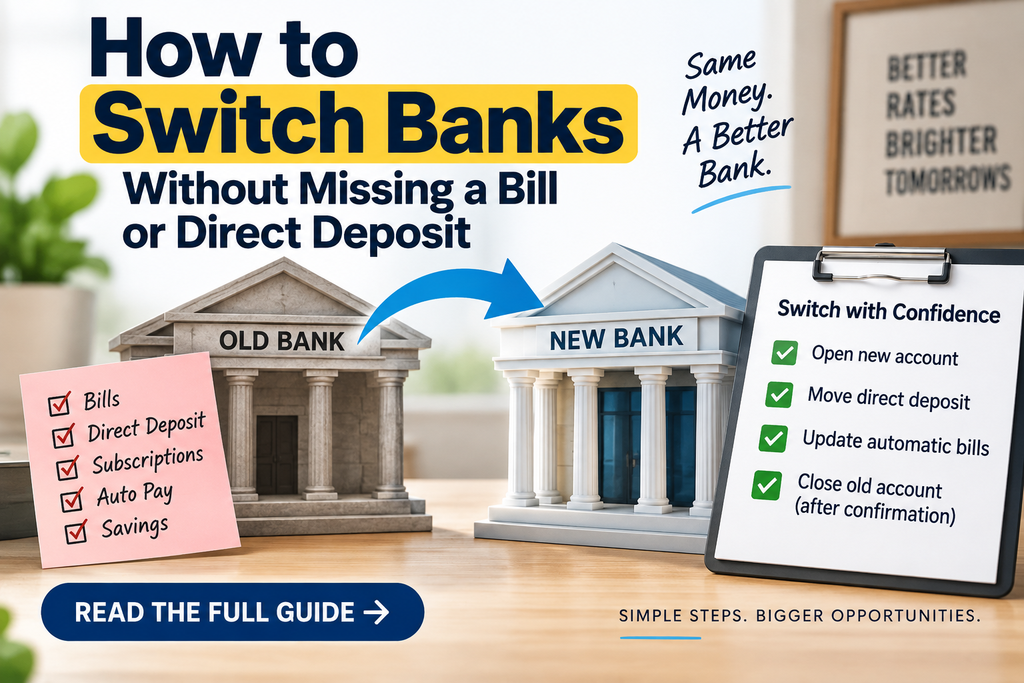
Why People Put Off Switching Banks
Most people know how to switch banks in theory, but the fear of a bounced bill or a missing paycheck keeps them stuck with an account they do not like. That fear is reasonable, and it is the main reason so many people search for how to switch banks without something falling through the cracks. A direct deposit that lands in a closed account can take days to redirect, and a missed automatic payment can trigger a late fee or even a service shutoff.
The good news is that learning how to switch banks safely just means following a short overlap period instead of a same-day cutover. Banks expect this, and none of them will penalize you for keeping two accounts open for a few weeks. Nothing about closing an old account has to be rushed, and rushing is exactly what causes the missed bills people worry about in the first place.
Step 1: Open the New Account Before You Touch the Old One
The first rule of how to switch banks is to never close the old account first. Open the new checking account, get your new account and routing numbers, and order a debit card before you do anything else.
Many online banks will approve a new account the same day and let you fund it with an initial transfer from your current bank. That transfer becomes the seed money you will use for the switch itself. This first step is where most people who search for how to switch banks make their only real decision, since everything after it is just execution.
What to Have Ready When You Apply
Before you start, gather what you need so the how to switch banks process does not stall on paperwork:
- Government-issued ID and Social Security number
- Your current bank’s account and routing numbers, for the funding transfer
- An initial deposit, even a small one, to activate the account
Step 2: Move Your Direct Deposit First
Once the new account is open, the next step in how to switch banks is redirecting your paycheck or benefits deposit. Log in to your employer’s payroll portal, or ask HR for a direct deposit change form, and enter your new account and routing numbers.
Direct deposit changes typically take one to two pay cycles to fully switch over, so do not close the old account until you see the deposit actually land in the new one. If you receive Social Security, a pension, or a benefits payment, update that separately through the paying agency’s own portal. This is the single most important part of how to switch banks correctly, since a missed paycheck causes more stress than any late bill.
Step 3: Update Your Automatic Bills
This is the step most people rush, and it is the one that causes missed payments. Anyone figuring out how to switch banks needs a full list of every automatic payment before touching the old account. Skipping this step is the single most common reason a bank switch goes wrong.
Common Bills People Forget to Move
- Streaming and subscription services
- Auto and life insurance premiums
- Mortgage or auto loan autopay
- Utility and phone bills
- Gym memberships and small recurring charges
Go through three months of old bank statements to catch anything billed quarterly. Update each one with your new account and routing numbers, and set the changeover date a few days after your first confirmed direct deposit. A checklist like this is really the whole answer to how to switch banks without a gap in coverage.
Step 4: Run a Short Overlap Period
The safest way to learn how to switch banks without a slipup is to keep both accounts open and funded for two to three full billing cycles. Leave enough of a buffer in the old account to cover any last automatic payment that has not yet moved.
During this overlap, check both accounts weekly. Confirm your direct deposit has landed in the new account at least twice, and confirm every bill you updated has actually pulled from the new account, not the old one. This weekly check is the part of how to switch banks that most guides skip, but it is what actually prevents a missed payment.
Example: Your paycheck of $2,400 is deposited on the 1st and 15th. Your rent autopay of $1,450 pulls on the 3rd, and your $85 car insurance pulls on the 20th. A safe overlap means confirming two full paycheck cycles and both of those automatic payments have successfully hit the new account before you touch the old one.
If you are also comparing where your emergency cash or short-term savings should sit while you switch, our CD Growth Calculator can show how a 0.01% APY at an old brick-and-mortar bank compares to a 4.50% APY at an online bank over just one year. Comparing rates like this is often the extra push people need to finally go through with how to switch banks instead of putting it off another year.
| Account type | Typical APY | Typical monthly fee |
|---|---|---|
| Old brick-and-mortar checking | 0.01% | $12 |
| New online checking | 0.50% | $0 |
| New online high-yield savings | 4.50% | $0 |
Step 5: Close the Old Account the Right Way
Once every bill and deposit has cleared the new account for at least one full cycle, you are ready for the last part of how to switch banks: closing the old one properly.
Call the bank directly and request a formal account closure rather than just letting the balance sit at zero. Ask for written confirmation, either by email or mail, and keep it for your records in case a forgotten charge shows up later. This single call is the final box to check on how to switch banks, and it protects you from a reopened account or a surprise dormant-account fee months down the road.
Mistakes That Undo an Otherwise Smooth Switch
A few habits turn a clean process into a messy one. Knowing how to switch banks well also means knowing what not to do along the way.
- Closing the old account before a full billing cycle has passed
- Forgetting a quarterly or annual charge, like an insurance premium or a domain renewal
- Updating your direct deposit but not double-checking the new routing number
- Assuming a paper check refund will not still be deposited into the old account by habit
Getting how to switch banks right the first time means treating this list as a final check, not an afterthought.
Anyone who has learned how to switch banks the hard way usually points to one of these four mistakes as the cause, which is exactly why the order of steps above matters more than speed when you switch banks.
Bottom Line
Learning how to switch banks is really about patience, not paperwork. Move the direct deposit first, update every bill, run a short overlap, and only then close the old account. Follow that order and how to switch banks stops being something to dread.
This is for informational purposes only and isn’t financial, tax, or legal advice.

Raghu Shekar writes about personal finance, banking, Medicare, and retirement planning at SimpleUSAFinance. His goal is simple: break down the numbers people actually need — no jargon, no sales pitch — so readers can make their own decisions with confidence. When he’s not writing, he’s usually digging through the latest rate changes, tax brackets, or Medicare updates to keep the site’s calculators and guides current.