Most people save into one account and call it done, but a sinking fund vs emergency fund comparison shows why that single account usually fails you twice. A sinking fund vs emergency fund are not competing strategies, they are two different tools built for two different kinds of expenses, and mixing them up is one of the most common budgeting mistakes out there. This guide breaks down what each one does, how much to put in each, and why relying on only one leaves a gap in your budget.
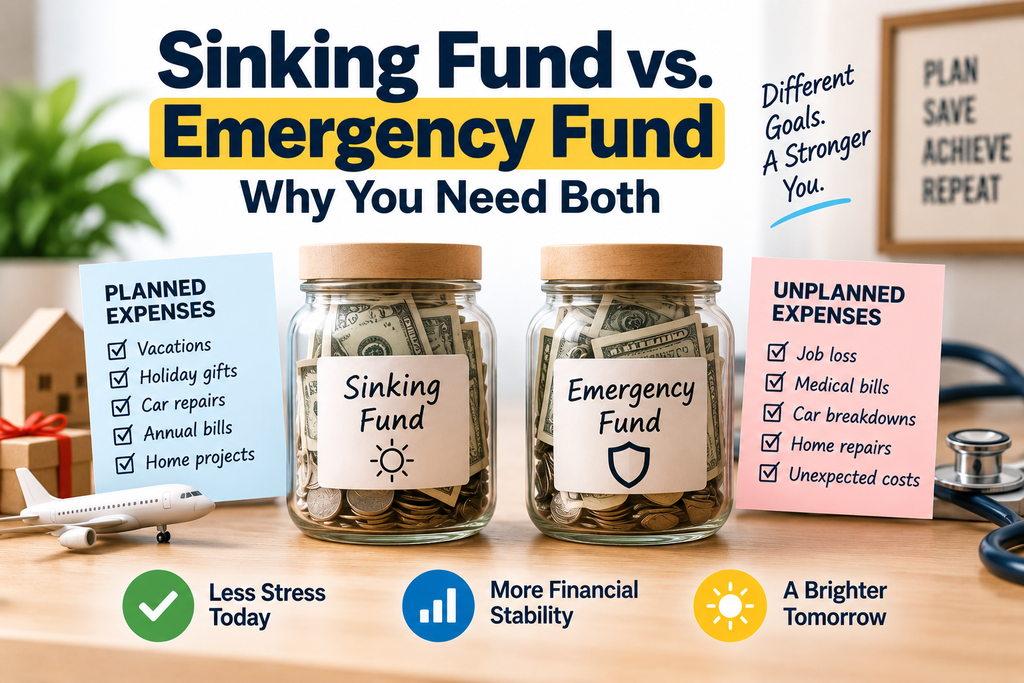
What a Sinking Fund Actually Does
The sinking fund vs emergency fund distinction sounds academic until you actually need one and only have the other.
A sinking fund is money you set aside for a planned, known expense with a rough timeline attached. Think holiday gifts, car registration, an annual insurance premium, or a vacation you already know is happening in eight months. Understanding this half of the sinking fund vs emergency fund pair is usually the easier part, since the goal itself is concrete.
The sinking fund vs emergency fund distinction starts here: a sinking fund has a defined purpose and a defined amount. You know roughly what the expense will cost and roughly when it is due, so you can divide the total by the number of months you have and save that exact amount each pay period.
What an Emergency Fund Actually Does
An emergency fund covers the expenses you cannot predict. A job loss, an unexpected medical bill, a sudden car repair, or a broken appliance all fall into this category. There is no fixed amount and no fixed date, only the certainty that something unplanned will eventually happen.
Most financial guidance points to 3 to 6 months of essential expenses as a starting target for an emergency fund. That is a much larger number than most sinking fund goals, and it is meant to sit untouched until a genuine emergency hits. The CFPB‘s Start Small, Save Up initiative is a good starting point if you are building this half of the sinking fund vs emergency fund pair from zero.
The Core Difference in One Line
If you know what it is and roughly when you will need it, use a sinking fund. If you have no idea what it will be or when, that is what the emergency fund is for. Keeping that test in mind resolves most sinking fund vs emergency fund confusion before it starts.
Why You Actually Need Both
Skipping either half of the sinking fund vs emergency fund pair creates a predictable problem. Without sinking funds, every predictable annual expense feels like a surprise, and people often raid their emergency fund to cover things like property taxes or holiday spending that were never actually emergencies.
Without an emergency fund, a genuine crisis, like a layoff or a major medical bill, forces you to either go into debt or drain the sinking funds you built for planned goals, undoing months of progress on things you were actually looking forward to. This is the failure mode that shows up most often when someone has never thought through the sinking fund vs emergency fund split at all.
Example: Sarah budgets $2,400 a year in predictable but irregular costs: $600 for holiday gifts, $800 for a car insurance premium paid twice yearly, $500 for an annual subscription and gym renewal, and $500 for a small vacation. Spread across 12 months, her sinking funds need $200 a month. Separately, her monthly essential expenses total $3,200, so her emergency fund target of 4 months’ worth is $12,800, built up over time in a completely separate account.
| Fund type | Purpose | Typical target | Timeline |
|---|---|---|---|
| Sinking fund | Known, planned expense | Cost of the specific goal | Weeks to 12 months |
| Emergency fund | Unknown, unplanned expense | 3 to 6 months of expenses | Ongoing, no end date |
The FDIC’s Money Smart program covers this same sinking fund vs emergency fund split in more depth if you want a structured, no-cost course to work through with a partner or family member.
How to Set Up Both Without Overcomplicating Your Budget
Start the emergency fund first if you have neither, since it protects you from debt in a real crisis. A sinking fund vs emergency fund priority order usually favors building at least one month of expenses in the emergency fund before splitting savings toward sinking fund goals. That order matters more than most people assume, since a half-funded sinking fund is an inconvenience, but a half-funded emergency fund during a real crisis is a debt trap.
Once that base is in place, open a second account, or use sub-accounts if your bank offers them, and label each sinking fund by its purpose: gifts, car, vacation, home repairs. Automate a transfer for each one right after payday so the money moves before you have a chance to spend it.
If you are unsure how large your emergency fund should be based on your actual monthly expenses, our Emergency Fund Calculator can walk through the math using your specific budget rather than a generic rule of thumb, which makes the sinking fund vs emergency fund split concrete instead of theoretical.
Common Situations Where the Split Actually Matters
A few real-life scenarios make the sinking fund vs emergency fund distinction click faster than any definition. If your car needs new tires next spring and you already know it, that is a sinking fund. If your car breaks down on the highway next week, that is an emergency fund.
The same logic applies to medical costs. A planned surgery with a known co-pay you can schedule savings around belongs in a sinking fund. An unexpected ER visit belongs squarely in the emergency fund, since there was no way to plan around the timing or the amount.
Holiday spending is one of the clearest examples of a sinking fund vs emergency fund mix-up in practice. Families who treat December gift spending as an emergency every single year are really describing a sinking fund problem, since the expense happens on the same schedule every year and is entirely predictable. Getting the sinking fund vs emergency fund label right on a recurring expense like this one usually saves an entire category of year-end financial stress.
Mistakes People Make Mixing the Two
The most common mistake in the sinking fund vs emergency fund conversation is treating them as the same pool of money. Combining them makes it too easy to justify pulling emergency cash for a planned purchase, which then leaves nothing when a real emergency shows up.
Another mistake is starving the emergency fund to overfund sinking funds for fun goals like vacations. A sinking fund vs emergency fund balance should always favor the emergency fund reaching at least a partial cushion before nonessential sinking fund goals get extra contributions.
Keeping the accounts physically separate, even if that just means separate savings sub-accounts at the same bank, makes the sinking fund vs emergency fund line much easier to respect when a tempting purchase comes up. Labeling each account clearly reinforces the sinking fund vs emergency fund boundary every time you log in to check a balance.
Bottom Line
A sinking fund vs emergency fund is really a question of planned versus unplanned, not one being better than the other. Understanding a sinking fund vs emergency fund this way, as two tools for two different jobs, is what actually protects your budget. Build both, keep them separate, and you stop treating predictable bills like emergencies and emergencies like an excuse to skip your goals.
This is for informational purposes only and isn’t financial, tax, or legal advice.

Raghu Shekar writes about personal finance, banking, Medicare, and retirement planning at SimpleUSAFinance. His goal is simple: break down the numbers people actually need — no jargon, no sales pitch — so readers can make their own decisions with confidence. When he’s not writing, he’s usually digging through the latest rate changes, tax brackets, or Medicare updates to keep the site’s calculators and guides current.