The moment you go from a paycheck to a 1099, 1099 vs W-2 taxes stop working the same way, and the difference is bigger than most people expect. This article breaks down exactly what changes: who pays what share of payroll tax, what you can deduct, what a real dollar example looks like using 2026 numbers, and how to plan for the cash-flow side most first-year freelancers miss. By the end, you’ll know why the same income can produce a very different tax bill depending on which form you get.
The Core Difference Between 1099 vs W-2 Taxes
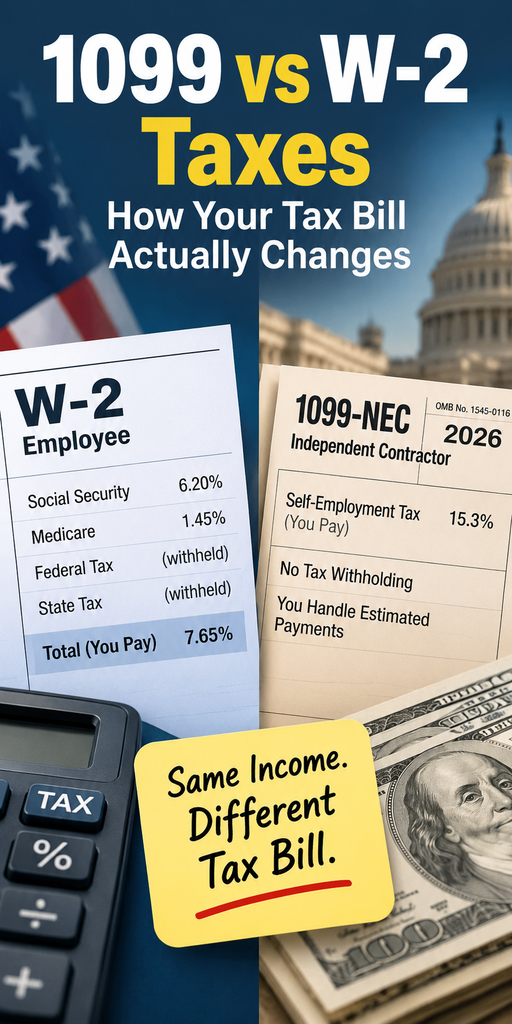
On a W-2, your employer withholds income tax and splits Social Security and Medicare taxes with you 50/50. That combined payroll tax, known as FICA, totals 7.65% from your paycheck and another 7.65% your employer pays on your behalf.
On a 1099, there’s no employer to split anything with. This is the single biggest driver of the gap in 1099 vs W-2 taxes, and it catches many new freelancers off guard on their first tax bill.
Self-Employment Tax: The Part W-2 Employees Never See
As a 1099 worker, you owe self-employment tax, which is 15.3% of your net earnings, applied to 92.35% of that amount. It breaks into two pieces: 12.4% for Social Security, capped at the 2026 wage base of $184,500, and 2.9% for Medicare, which has no cap at all.
This is the core mechanical difference in 1099 vs W-2 taxes. A W-2 employee pays 7.65% total in payroll tax; a 1099 worker effectively pays both halves, or 15.3%, before income tax even enters the picture.
A Side-by-Side Example on $80,000 in Net Income
Here’s how 1099 vs W-2 taxes play out on the same $80,000:
| Item | W-2 Employee | 1099 Contractor |
|---|---|---|
| Payroll/self-employment tax rate | 7.65% (employer pays other 7.65%) | 15.3% |
| Tax owed on payroll side | $6,120 | $11,304 (on 92.35% of $80,000) |
| Who pays the “employer half” | Employer | You |
The 1099 contractor pays roughly $5,000 more in payroll-type tax on the same income, before factoring in any deductions.
The Same Example, After Common Deductions
That $5,000 gap looks smaller once realistic 1099 deductions are applied. Say the same $80,000 contractor has $8,000 in legitimate business expenses (home office, software, mileage) plus the above-the-line deduction for half their self-employment tax:
| Adjustment | Effect |
|---|---|
| Business expense deductions ($8,000) | Reduces taxable net earnings |
| Deduct half of self-employment tax ($5,652) | Reduces adjusted gross income |
| Net effect vs. the unadjusted example above | Closes roughly $2,000–$3,000 of the payroll tax gap |
This is why comparing 1099 vs W-2 taxes purely on the 15.3% headline rate overstates the real-world gap for most contractors who track their expenses carefully.
Deductions That Only Apply on the 1099 Side
The gap in 1099 vs W-2 taxes isn’t entirely one-directional. A 1099 worker can deduct half of their self-employment tax above the line, along with business expenses like a home office, mileage, equipment, and software, none of which a W-2 employee can claim against wage income.
These deductions don’t erase the extra self-employment tax, but they meaningfully soften it. A freelancer with real business expenses often nets out closer to a W-2 employee’s effective rate than the headline 15.3% suggests.
What Doesn’t Change Between 1099 and W-2
Regular federal income tax brackets apply the same way regardless of which form you receive. For 2026, the standard deduction is $16,100 for single filers and $32,200 for married couples filing jointly, and that applies whether your income shows up on a W-2 or a Schedule C.
So while 1099 vs W-2 taxes diverge sharply on the payroll tax side, your income tax bracket and standard deduction eligibility stay consistent. The difference is layered on top of, not instead of, ordinary income tax.
Estimated Payments: A Practical Difference in 1099 vs W-2 Taxes
A W-2 employee has taxes withheld automatically from each paycheck. A 1099 worker generally needs to make quarterly estimated tax payments using Form 1040-ES, covering both income tax and self-employment tax.
Missing these payments can trigger an underpayment penalty, which is a real, practical consequence of 1099 vs W-2 taxes that catches first-year freelancers by surprise. Setting aside 25 to 30% of each payment for taxes is a common starting rule of thumb until you calculate your actual rate. The 2026 quarterly due dates generally fall in mid-April, mid-June, mid-September, and mid-January of the following year.
Does an LLC or S-Corp Change 1099 vs W-2 Taxes?
Some freelancers form an S-corp specifically to reduce the self-employment tax side of 1099 vs W-2 taxes. Under that structure, you pay yourself a “reasonable salary” subject to payroll tax, and take remaining profit as a distribution that avoids self-employment tax entirely. This can produce real savings for higher earners, but it adds payroll administration, separate tax filings, and state-level fees that can offset the benefit for smaller incomes — generally this only starts to pay off once net self-employment income clears roughly $50,000–$60,000 a year, though the exact break-even depends on your state and bookkeeping costs.
Which Side Comes Out Ahead?
Neither side of 1099 vs W-2 taxes is automatically better; it depends on your deductions, your income level, and whether you value the stability of withholding over the flexibility of self-employment. High earners with substantial business write-offs sometimes come out close to even, while those with few deductions feel the self-employment tax gap the most.
If you’re deciding whether to structure your work as a business entity to manage this gap, our free Capital Gains Calculator can help you model related investment income scenarios alongside your Schedule C planning.
Frequently Asked Questions
Can I switch from 1099 to W-2 with the same company? Yes, and it’s common when a company decides to formally hire a long-term contractor. When this happens, only income earned after the switch date is reported on the W-2; income earned before stays on the 1099 for that tax year.
Do I still owe self-employment tax if I have a full-time W-2 job and a side 1099 gig? Yes, self-employment tax applies to your net 1099 earnings regardless of other W-2 income, though the Social Security portion stops once your combined wages and net self-employment earnings hit the annual wage base.
What happens if I underpay my estimated taxes as a 1099 worker? The IRS can charge an underpayment penalty calculated on the shortfall for each quarter, even if you pay the full amount owed by the April filing deadline. Paying close to your actual quarterly liability, rather than a rough guess, avoids this.
Bottom Line
1099 vs W-2 taxes differ mainly because of who pays the employer share of payroll tax, not because of a different income tax system. Understanding the 15.3% self-employment tax, the deductions that offset it, and the quarterly payment requirement is the key to estimating your real tax bill accurately.
This is for informational purposes only and isn’t financial, tax, or legal advice.

Raghu Shekar writes about personal finance, banking, Medicare, and retirement planning at SimpleUSAFinance. His goal is simple: break down the numbers people actually need — no jargon, no sales pitch — so readers can make their own decisions with confidence. When he’s not writing, he’s usually digging through the latest rate changes, tax brackets, or Medicare updates to keep the site’s calculators and guides current.