Minimum credit card payments look small and manageable on your statement, but the real cost hides in how long they stretch out your debt. This article walks through exactly how minimum credit card payments are calculated, what they actually cost you in interest using 2026 rates, how that cost changes across different balance sizes, and why the gap between the minimum and a real payoff plan is bigger than most people expect.
How Minimum Credit Card Payments Are Calculated
Minimum credit card payments are usually set as whichever is larger: a flat dollar amount, typically $20 to $35, or a percentage of your balance, typically 1% to 3%. Most issuers use around 2% of the balance plus that month’s interest charge as their formula.
There are actually two common formulas issuers rely on:
- Percentage of balance method. A flat 1%–3% of your statement balance, with a dollar floor (often $25–$35) so the payment never drops below a set minimum on small balances.
- Interest-plus-principal method. The full interest charge for the month, plus a small percentage (often just 1%) of the principal. This version can look almost identical to the percentage method on paper, but it front-loads even more of your payment toward interest.
That means minimum credit card payments shrink every month as your balance goes down, which sounds helpful but actually extends your payoff timeline even further. A shrinking payment on a slowly shrinking balance is a slow trap, not a fast one. This is also why two people with the same starting balance and rate can end up with noticeably different minimum payments — the underlying formula matters as much as the balance itself.
The Real Cost of Minimum Credit Card Payments in 2026 Rates
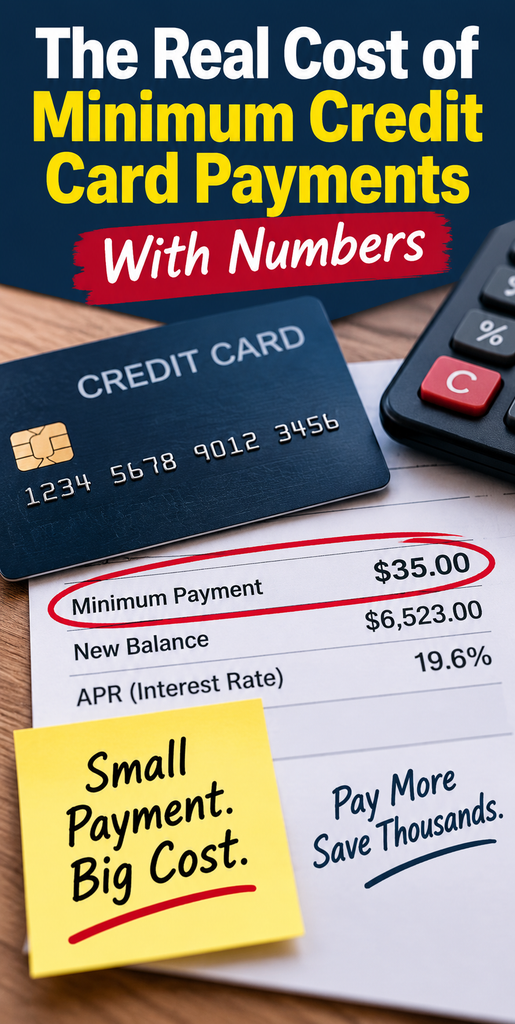
As of mid-2026, the average credit card interest rate sits around 19.6% APR. TransUnion data puts the average U.S. credit card balance at roughly $6,523. Put those two numbers together with minimum credit card payments, and the results are stark.
Bankrate analyst Ted Rossman calculated that a $6,523 balance at a 20% rate, paid only at the minimum, takes about 219 months, over 18 years, to pay off, and costs roughly $9,448 in interest alone. That’s more in interest than the original balance itself.
A Side-by-Side Payoff Example
Here’s how minimum credit card payments compare to a fixed higher payment on a $5,000 balance at 20% APR:
| Payment Strategy | Time to Pay Off | Total Interest Paid |
|---|---|---|
| Minimum payment only (~2% of balance) | Around 17 years | Roughly $7,000+ |
| Fixed $150/month | About 4 years | Roughly $2,100 |
| Fixed $250/month | About 2 years | Roughly $1,150 |
The minimum payment path costs three to six times more in interest than a modest fixed payment, on the exact same balance.
How the Math Changes at Other Balance Levels
The pattern holds whether your balance is small or large — only the dollar amounts shift:
| Starting Balance | Minimum-Only Payoff Time | Total Interest at Minimum |
|---|---|---|
| $2,500 | Roughly 12–13 years | Around $3,100 |
| $6,523 (average) | About 18 years | Roughly $9,448 |
| $10,000 | Over 20 years | Roughly $15,500 |
Notice that interest cost doesn’t scale in a simple straight line with balance — larger balances at the minimum spend even more time trapped in the high-interest, low-principal-reduction phase, which is why the payoff time keeps stretching rather than staying proportional.
Why Minimum Credit Card Payments Barely Touch the Principal
In the early years of paying minimum credit card payments, most of each payment goes toward interest, not principal. On a high-rate card, it’s common for 60% or more of an early minimum payment to be pure interest. On a $6,523 balance at 19.6% APR, a roughly $163 minimum payment might include around $100 in interest alone in the first month, leaving only about $63 actually reducing the balance.
This is why balances paid at the minimum seem to barely move for months at a time. Minimum credit card payments are structured to keep the account current, not to meaningfully reduce what you owe.
When Paying Only the Minimum Actually Makes Sense
Minimum credit card payments aren’t always a mistake. There are a few situations where paying only the minimum, temporarily, is a reasonable choice rather than a trap:
- During a genuine cash-flow gap, such as a job loss or medical event, when keeping the account current and avoiding a missed-payment mark on your credit report matters more than short-term interest cost.
- If you’re using a 0% introductory APR promotional period and plan to pay off the balance before it expires — in that case the minimum simply satisfies the issuer while interest isn’t accruing.
- If you’re deliberately prioritizing a higher-rate debt elsewhere (like a payday loan or another card) and making minimums on the lower-rate card while attacking the highest-rate one first.
Outside of these specific cases, sticking to minimum credit card payments as a default strategy is almost always the most expensive path available.
The Federally Required Warning You’re Already Seeing
Since the CARD Act took effect, every credit card statement must include a minimum payment warning box showing how long it will take to pay off your balance at the minimum, versus paying it off in three years, along with the total dollar cost of each path. If you’ve never read that box, it’s worth checking on your next statement.
The Consumer Financial Protection Bureau publishes simple examples showing that paying even modestly more than minimum credit card payments can cut both your payoff time and total interest dramatically.
How to Get Off the Minimum Credit Card Payments Track
A few practical moves make the biggest difference when you’re ready to stop relying on minimum credit card payments:
- Pick a fixed dollar amount above the minimum and pay that same number every month, regardless of how the minimum shifts.
- Target your highest-APR card first if you carry more than one balance (the “avalanche” method), or your smallest balance first if you need quick psychological wins (the “snowball” method).
- Avoid new charges on the card you’re paying down, since new spending resets your progress.
- Consider a 0% balance transfer card if your credit qualifies, which can pause interest accrual entirely for 12–21 months while you pay down principal.
- Run your real numbers through our free Debt Payoff Calculator to see your actual payoff date and total interest based on your balance and rate.
Frequently Asked Questions
Does paying only the minimum hurt my credit score? Not directly — making the minimum payment on time keeps your account in good standing. However, carrying a high balance relative to your credit limit (high utilization) can lower your score, and minimum payments keep utilization high for far longer than a faster payoff would.
Will my minimum payment ever reach $0? No. Once your balance drops to a very low amount, most issuers switch to requiring your full remaining balance rather than a percentage, so the account fully resolves rather than lingering indefinitely.
Is it better to pay the minimum on time or pay extra but occasionally late? Always pay at least the minimum on time. A missed or late payment triggers fees and can also raise your APR through a penalty rate, which makes minimum credit card payments even less effective going forward.
Bottom Line
Minimum credit card payments are designed to keep your account in good standing, not to get you out of debt efficiently. Even a modest increase above the minimum can cut years off your payoff timeline and save thousands in interest.
How Minimum Credit Card Payments Are Calculated
Minimum credit card payments are usually set as whichever is larger: a flat dollar amount, typically $20 to $35, or a percentage of your balance, typically 1% to 3%. Most issuers use around 2% of the balance plus that month’s interest charge as their formula.
There are actually two common formulas issuers rely on:
- Percentage of balance method. A flat 1%–3% of your statement balance, with a dollar floor (often $25–$35) so the payment never drops below a set minimum on small balances.
- Interest-plus-principal method. The full interest charge for the month, plus a small percentage (often just 1%) of the principal. This version can look almost identical to the percentage method on paper, but it front-loads even more of your payment toward interest.
That means minimum credit card payments shrink every month as your balance goes down, which sounds helpful but actually extends your payoff timeline even further. A shrinking payment on a slowly shrinking balance is a slow trap, not a fast one. This is also why two people with the same starting balance and rate can end up with noticeably different minimum payments — the underlying formula matters as much as the balance itself.
The Real Cost of Minimum Credit Card Payments in 2026 Rates
As of mid-2026, the average credit card interest rate sits around 19.6% APR. TransUnion data puts the average U.S. credit card balance at roughly $6,523. Put those two numbers together with minimum credit card payments, and the results are stark.
Bankrate analyst Ted Rossman calculated that a $6,523 balance at a 20% rate, paid only at the minimum, takes about 219 months, over 18 years, to pay off, and costs roughly $9,448 in interest alone. That’s more in interest than the original balance itself.
A Side-by-Side Payoff Example
Here’s how minimum credit card payments compare to a fixed higher payment on a $5,000 balance at 20% APR:
| Payment Strategy | Time to Pay Off | Total Interest Paid |
|---|---|---|
| Minimum payment only (~2% of balance) | Around 17 years | Roughly $7,000+ |
| Fixed $150/month | About 4 years | Roughly $2,100 |
| Fixed $250/month | About 2 years | Roughly $1,150 |
The minimum payment path costs three to six times more in interest than a modest fixed payment, on the exact same balance.
How the Math Changes at Other Balance Levels
The pattern holds whether your balance is small or large — only the dollar amounts shift:
| Starting Balance | Minimum-Only Payoff Time | Total Interest at Minimum |
|---|---|---|
| $2,500 | Roughly 12–13 years | Around $3,100 |
| $6,523 (average) | About 18 years | Roughly $9,448 |
| $10,000 | Over 20 years | Roughly $15,500 |
Notice that interest cost doesn’t scale in a simple straight line with balance — larger balances at the minimum spend even more time trapped in the high-interest, low-principal-reduction phase, which is why the payoff time keeps stretching rather than staying proportional.
Why Minimum Credit Card Payments Barely Touch the Principal
In the early years of paying minimum credit card payments, most of each payment goes toward interest, not principal. On a high-rate card, it’s common for 60% or more of an early minimum payment to be pure interest. On a $6,523 balance at 19.6% APR, a roughly $163 minimum payment might include around $100 in interest alone in the first month, leaving only about $63 actually reducing the balance.
This is why balances paid at the minimum seem to barely move for months at a time. Minimum credit card payments are structured to keep the account current, not to meaningfully reduce what you owe.
When Paying Only the Minimum Actually Makes Sense
Minimum credit card payments aren’t always a mistake. There are a few situations where paying only the minimum, temporarily, is a reasonable choice rather than a trap:
- During a genuine cash-flow gap, such as a job loss or medical event, when keeping the account current and avoiding a missed-payment mark on your credit report matters more than short-term interest cost.
- If you’re using a 0% introductory APR promotional period and plan to pay off the balance before it expires — in that case the minimum simply satisfies the issuer while interest isn’t accruing.
- If you’re deliberately prioritizing a higher-rate debt elsewhere (like a payday loan or another card) and making minimums on the lower-rate card while attacking the highest-rate one first.
Outside of these specific cases, sticking to minimum credit card payments as a default strategy is almost always the most expensive path available.
The Federally Required Warning You’re Already Seeing
Since the CARD Act took effect, every credit card statement must include a minimum payment warning box showing how long it will take to pay off your balance at the minimum, versus paying it off in three years, along with the total dollar cost of each path. If you’ve never read that box, it’s worth checking on your next statement.
The Consumer Financial Protection Bureau publishes simple examples showing that paying even modestly more than minimum credit card payments can cut both your payoff time and total interest dramatically.
How to Get Off the Minimum Credit Card Payments Track
A few practical moves make the biggest difference when you’re ready to stop relying on minimum credit card payments:
- Pick a fixed dollar amount above the minimum and pay that same number every month, regardless of how the minimum shifts.
- Target your highest-APR card first if you carry more than one balance (the “avalanche” method), or your smallest balance first if you need quick psychological wins (the “snowball” method).
- Avoid new charges on the card you’re paying down, since new spending resets your progress.
- Consider a 0% balance transfer card if your credit qualifies, which can pause interest accrual entirely for 12–21 months while you pay down principal.
- Run your real numbers through our free Debt Payoff Calculator to see your actual payoff date and total interest based on your balance and rate.
Frequently Asked Questions
Does paying only the minimum hurt my credit score? Not directly — making the minimum payment on time keeps your account in good standing. However, carrying a high balance relative to your credit limit (high utilization) can lower your score, and minimum payments keep utilization high for far longer than a faster payoff would.
Will my minimum payment ever reach $0? No. Once your balance drops to a very low amount, most issuers switch to requiring your full remaining balance rather than a percentage, so the account fully resolves rather than lingering indefinitely.
Is it better to pay the minimum on time or pay extra but occasionally late? Always pay at least the minimum on time. A missed or late payment triggers fees and can also raise your APR through a penalty rate, which makes minimum credit card payments even less effective going forward.
Bottom Line
Minimum credit card payments are designed to keep your account in good standing, not to get you out of debt efficiently. Even a modest increase above the minimum can cut years off your payoff timeline and save thousands in interest.
This is for informational purposes only and isn’t financial, tax, or legal advice.

Raghu Shekar writes about personal finance, banking, Medicare, and retirement planning at SimpleUSAFinance. His goal is simple: break down the numbers people actually need — no jargon, no sales pitch — so readers can make their own decisions with confidence. When he’s not writing, he’s usually digging through the latest rate changes, tax brackets, or Medicare updates to keep the site’s calculators and guides current.