An automatic savings plan moves money into savings before you ever see it, which is exactly why it works better than willpower alone. Most people who say they cannot save are not bad with money, they simply never removed the decision from their own hands. This guide shows you how to set up an automatic savings plan that runs quietly in the background, plus real numbers on what small, regular transfers actually add up to over time.
What an Automatic Savings Plan Actually Does
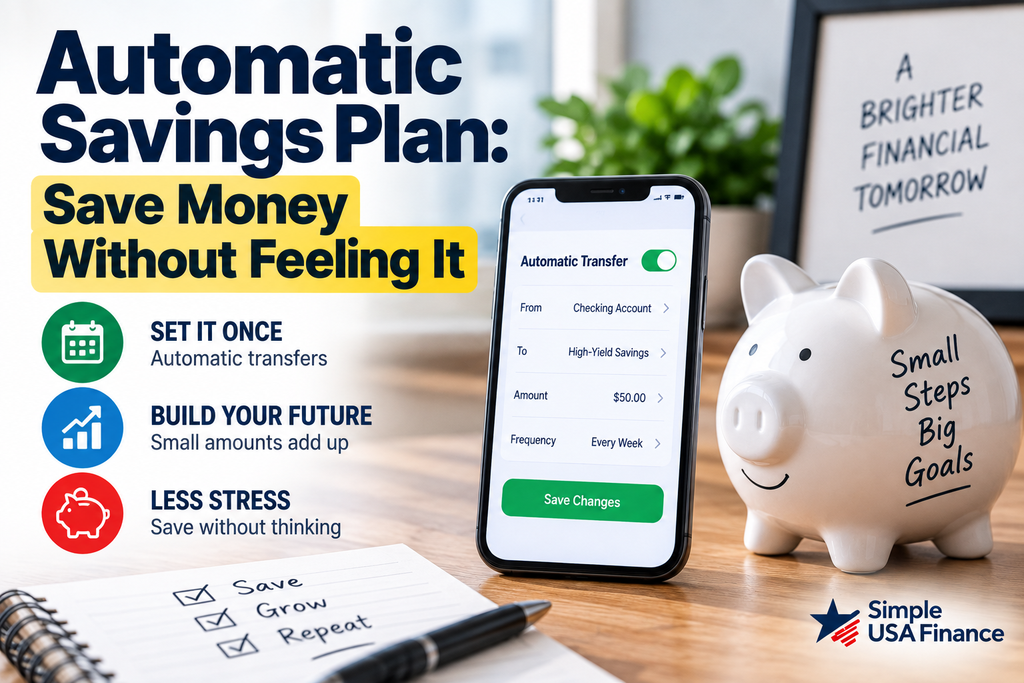
An automatic savings plan is a standing instruction that moves a set amount of money out of your checking account and into savings on a schedule you choose, without you having to remember or decide each time. Because the transfer happens automatically, the money is gone from your spending balance before you can talk yourself out of saving it.
Most banks let you set up an automatic savings plan directly through their app or website in a few minutes, choosing the amount, the frequency, and the destination account. Once it is running, this kind of setup requires almost no ongoing attention beyond an occasional check to make sure the numbers still make sense.
Some banks also let you schedule more than one transfer, so you could send a smaller amount every payday and a larger one whenever a bonus or tax refund lands. Splitting transfers this way keeps the core habit steady while still letting occasional windfalls boost your progress.
Pay Yourself First: The Core Idea Behind Every Automatic Savings Plan
The pay yourself first principle is the foundation of any automatic savings plan. Instead of saving whatever is left over at the end of the month, which is often nothing, you move money to savings first and build your spending around what remains.
This works because it flips the usual order of operations. A typical setup schedules the transfer for the same day your paycheck lands, so the money moves before bills, groceries, or anything else has a chance to claim it.
Where the Money Should Land
An automatic savings plan only works if the destination account is genuinely separate from the one you spend from every day. Moving money into a savings account at a different bank than your checking account adds a small amount of friction, which is often enough to stop impulsive transfers back.
This separation matters more than the amount you save at first. Someone moving $15 a week into a truly separate account will often end up with more saved after a year than someone moving $50 a week into an account they can see and touch every time they check their balance.
Round Up Savings vs Fixed Transfers
A round up savings feature is one of the gentlest ways to run an automatic savings plan, since it rounds each debit card purchase up to the nearest dollar and moves the difference into savings. If your coffee costs $4.45, a round up savings feature would send an extra $0.55 into your account without you noticing.
Fixed transfer versions of an automatic savings plan move a set dollar amount on a set schedule instead, regardless of how much you spent that day. Research on savings apps has found that fixed, guaranteed transfers tend to produce meaningfully larger year end savings totals than round up savings alone, since the amount does not shrink just because you spent less.
The Real Numbers: What Small Transfers Add Up To
Here is what a simple automatic savings plan produces over one year at a few common transfer amounts, assuming a weekly transfer into a savings account.
| Weekly Transfer | Total After 1 Year | After 5 Years (No Interest) |
|---|---|---|
| $10 | $520 | $2,600 |
| $25 | $1,300 | $6,500 |
| $50 | $2,600 | $13,000 |
| $100 | $5,200 | $26,000 |
Placing that same automatic savings plan into a high yield savings account paying around 4 percent interest, instead of a standard account paying closer to 0.4 percent, adds meaningful growth on top of these totals over several years, simply because the account is doing part of the work for you.
Choosing the Right Account for Your Automatic Savings Plan
Not every savings account is a good home for an automatic savings plan. A high yield savings account, usually offered by an online bank, pays several times the national average rate and keeps your money liquid in case you need it.
Online banks can usually afford these higher rates because they skip the cost of physical branches, and they pass part of that savings on to depositors. The tradeoff is that you manage the account entirely through an app or website, which is rarely a problem once the transfers are already running on their own.
Before you set up an automatic savings plan, confirm the account has no minimum balance fee, no cap on the number of transfers, and no penalty for withdrawing early. It should feel effortless, not like something you have to manage around a bank’s fine print.
If you are building toward a specific dollar target, such as three to six months of expenses, SimpleUSAFinance’s Emergency Fund Calculator can help you size your automatic savings plan to hit that goal on a realistic timeline.
Why Some Automatic Savings Plans Fail
The most common reason an automatic savings plan falls apart is an overdraft caused by transferring more than the checking account can spare. Start smaller than feels meaningful, since a $10 weekly automatic savings plan that actually runs for a year beats a $100 plan that gets turned off after two months.
The second common failure is treating the savings account like a backup checking account and transferring money back out whenever cash feels tight. Keeping the savings account at a different bank, without a linked debit card, makes that kind of casual withdrawal slightly harder and much less tempting.
Bottom Line
An automatic savings plan works because it removes the daily decision to save, replacing it with a single choice you make once. Start with an amount you will not miss, put it in a high yield account, and let the automatic savings plan run untouched for a full year before you judge the results.
For official tips on setting up automatic transfers the right way, see the Consumer Financial Protection Bureau’s guidance on ConsumerFinance.gov. The CFPB’s research on which automated savings rules actually work best is also available on ConsumerFinance.gov.
This is for informational purposes only and isn’t financial, tax, or legal advice.

Raghu Shekar writes about personal finance, banking, Medicare, and retirement planning at SimpleUSAFinance. His goal is simple: break down the numbers people actually need — no jargon, no sales pitch — so readers can make their own decisions with confidence. When he’s not writing, he’s usually digging through the latest rate changes, tax brackets, or Medicare updates to keep the site’s calculators and guides current.