If you’re comparing a CD vs high-yield savings account for money you’ll need in about a year, a wedding, a down payment, a tax bill, the honest answer depends less on which account “wins” and more on one question: can you leave the money untouched for the full term? That single question drives almost every CD vs high-yield savings decision, so it’s worth answering honestly before you look at a single rate.
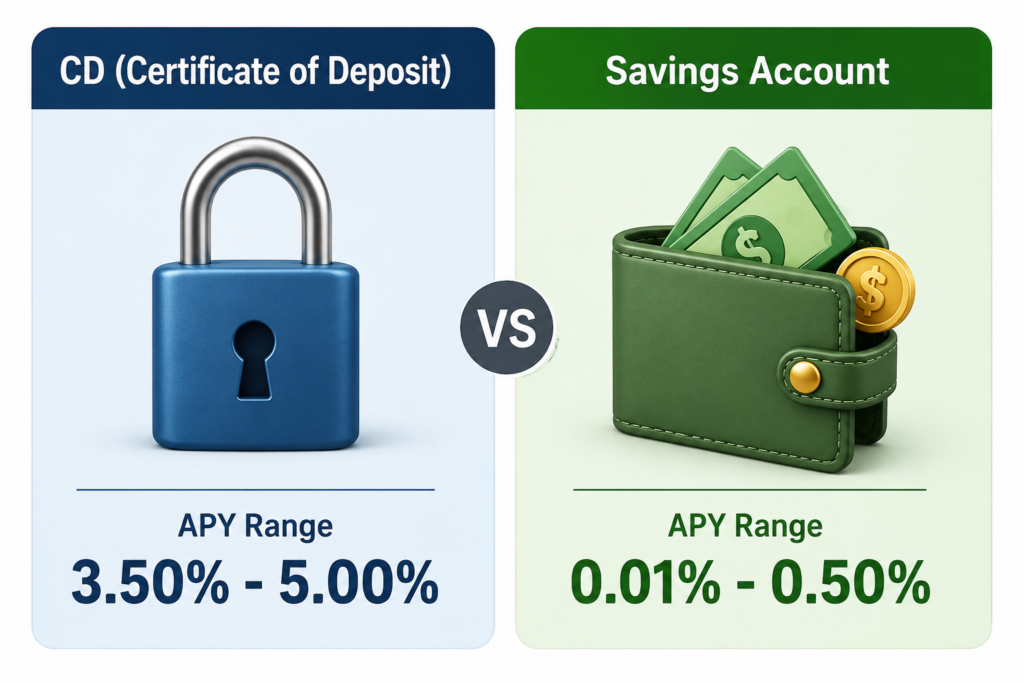
CD vs High-Yield Savings: What a CD Actually Locks In
A certificate of deposit (CD) trades flexibility for certainty, which is the core trade off in any CD vs high-yield savings comparison. You agree to leave your money in for a set term, 12 months in this case, and the bank guarantees your rate for that entire period, even if rates drop elsewhere. Pull the money out early, and you’ll usually pay a penalty worth a few months of interest, which can eat into or even wipe out what you earned. That penalty is one of the biggest practical differences in the CD vs high-yield savings decision, since a HYSA has no equivalent cost for withdrawing.
As of August 2026, the strongest 12-month CD rates are landing in the 4.15% to 4.50% APY range at online banks and credit unions, well above the national average of well under 2%, which includes a lot of banks still offering next to nothing on standard savings products. On rate alone, the CD vs high-yield savings gap at the top of the market is small, it’s the guarantee, not the number, that sets a CD apart.
Early Withdrawal Penalties in Practice
Most 12-month CDs charge an early withdrawal penalty equal to somewhere between 90 and 180 days of interest, depending on the bank. On a $10,000 CD earning 4.40% APY, a 180-day penalty works out to roughly $217, meaning if you pulled the money out after just two or three months, you could end up with less than you deposited. This is the sharpest edge in the CD vs high-yield savings comparison: a HYSA simply has no equivalent downside for early access.
CD vs High-Yield Savings: What a High-Yield Savings Account Offers
A high-yield savings account (HYSA) skips the lock-in entirely, and that flexibility is the main reason people lean this way in the CD vs high-yield savings debate. Your money stays accessible, and top online accounts are currently paying in a similar 4.00% to 5.00% APY range. The trade-off: that rate isn’t guaranteed to stay put. Banks can lower it any time, and if the Federal Reserve cuts rates again, your HYSA yield will likely follow it down, while a CD you locked in today wouldn’t. This variability is the crux of the CD vs high-yield savings math over any longer stretch.
CD vs High-Yield Savings: Real Numbers on $10,000 Over 12 Months
Here’s what the CD vs high-yield savings difference looks like in dollars, assuming rates hold steady for the year:
| Account Type | APY | Value After 12 Months |
|---|---|---|
| 12-Month CD | 4.40% | $10,440 |
| High-Yield Savings | 4.40% | $10,440 (if rate holds) |
| High-Yield Savings | drops to 3.50% mid-year | ~$10,395 |
At today’s rates, a CD and a HYSA can earn almost identically, the real difference in a CD vs high-yield savings comparison only shows up if savings rates fall during your 12 months, in which case the CD comes out ahead simply because it can’t be cut. The gap grows with a bigger balance: on $50,000, that same mid-year rate drop is the difference between roughly $52,200 and $51,975, real money, even if the percentage gap looks small. Run your own numbers through this lens, since the CD vs high-yield savings outcome shifts with both your balance and your time horizon.
You can plug in your own deposit amount, rate, and term with our CD Growth Calculator to see your exact numbers.
CD vs High-Yield Savings: Which Way Are Rates Likely to Head?
Nobody can predict the Fed with certainty, but it’s worth knowing the backdrop before you settle the CD vs high-yield savings question for yourself. Rate cuts through late 2025 pushed both CD and savings yields down from their peak, and the Fed has since paused, largely due to inflation pressure. That pause is exactly the environment where a CD’s locked-in rate becomes more valuable in the CD vs high-yield savings equation, you’re protected if rates fall again, and you lose very little if they don’t.
CD vs High-Yield Savings and Your Tax Bill
Interest from both sides of the CD vs high-yield savings comparison is taxed as ordinary income in the year you earn it, even if it’s a CD and you don’t touch the money until maturity. Your bank will send a 1099-INT if you earn $10 or more in interest, and you’ll owe tax on that amount at your regular federal income tax rate. It’s easy to forget this step, especially with a CD, since the cash isn’t sitting in your checking account reminding you it’s taxable.
CD vs High-Yield Savings: Which One Fits Your Goal?
- Choose a CD if you know the exact date you’ll need the money, you’re confident you won’t touch it early, and you want to lock in today’s rate in case it falls.
- Choose high-yield savings if there’s any chance your timeline could shift, or the money is also doubling as part of your emergency fund, accessibility matters more than a fraction of a percent.
- Split the difference by keeping part of the money in a CD and part in savings, so you’re not choosing all or nothing in the CD vs high-yield savings decision.
Either way, confirm the account is FDIC-insured (or NCUA-insured at a credit union) up to $250,000 per depositor, per institution, both CDs and HYSAs at legitimate banks carry this protection, so safety isn’t the deciding factor in a CD vs high-yield savings choice.
Bottom Line
At today’s rates, a CD and a high-yield savings account will likely earn you close to the same amount over 12 months, the real decision in the CD vs high-yield savings question is about access, not yield. If you might need the cash early, savings wins by default. If the date is locked in and you’re worried rates could drop, a CD protects what you’d earn. However you land on the CD vs high-yield savings choice, matching the account to your actual timeline matters more than chasing an extra tenth of a percent.
This is for informational purposes only and isn’t financial, tax, or legal advice.

Raghu Shekar writes about personal finance, banking, Medicare, and retirement planning at SimpleUSAFinance. His goal is simple: break down the numbers people actually need — no jargon, no sales pitch — so readers can make their own decisions with confidence. When he’s not writing, he’s usually digging through the latest rate changes, tax brackets, or Medicare updates to keep the site’s calculators and guides current.