Most people guess their 2026 tax bracket by looking at their total income and matching it to a rate. That guess is almost always wrong, and it usually makes taxes feel scarier than they are. Your 2026 tax bracket only applies to the slice of income sitting inside that bracket, not your whole paycheck.
Here’s how the seven 2026 tax brackets actually work, the real IRS numbers for single and joint filers, two worked examples at different income levels, and how this year’s thresholds compare to 2025.
How the 2026 Tax Brackets Actually Work
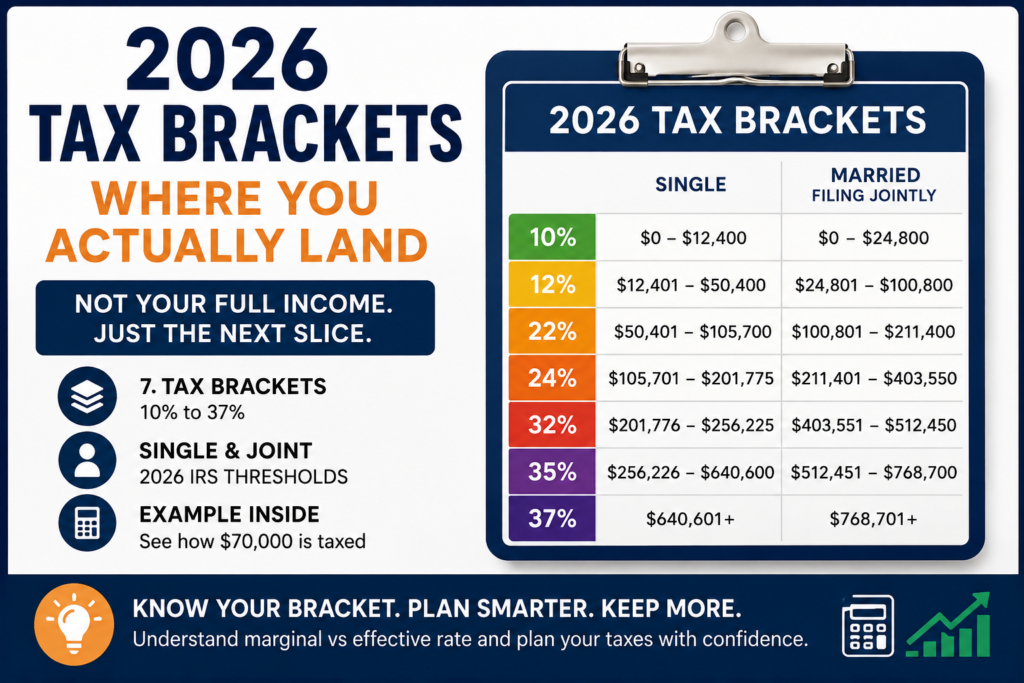
The federal system taxes income in layers. Your first dollars are taxed at the lowest rate, and only the dollars above each threshold move into the next 2026 tax bracket. Nobody pays one flat rate on their entire income.
This is why two people with different total incomes can have very different tax bills, even if they’re technically in the same bracket. What matters is how much of your income sits above each threshold, not just which bracket you touch at the top.
The 2026 Tax Bracket Thresholds for Single Filers
These are the confirmed IRS figures for tax year 2026, from Revenue Procedure 2025-32, covering income you earn this year and file on your 2027 return.
| Rate | Taxable Income (Single) |
|---|---|
| 10% | $0 – $12,400 |
| 12% | $12,401 – $50,400 |
| 22% | $50,401 – $105,700 |
| 24% | $105,701 – $201,775 |
| 32% | $201,776 – $256,225 |
| 35% | $256,226 – $640,600 |
| 37% | $640,601 and up |
If you’re a single filer, this table is your 2026 tax bracket map. The standard deduction for single filers rises to $16,100 for 2026, which comes off your income before any of these brackets apply.
2026 Tax Brackets for Married Filing Jointly
Married couples filing jointly get roughly double the single thresholds at every level:
| Rate | Taxable Income (Married Filing Jointly) |
|---|---|
| 10% | $0 – $24,800 |
| 12% | $24,801 – $100,800 |
| 22% | $100,801 – $211,400 |
| 24% | $211,401 – $403,550 |
| 32% | $403,551 – $512,450 |
| 35% | $512,451 – $768,700 |
| 37% | $768,701 and up |
The standard deduction for joint filers is $32,200 for 2026. Head of household filers get their own table, with a $24,150 standard deduction and thresholds that fall between single and joint; check the IRS Revenue Procedure 2025-32 tables directly if that’s your filing status, since the exact income cutoffs differ from both of the tables above.
How 2026 Thresholds Compare to 2025
Every bracket threshold moved up for inflation this year. For a single filer, the top of the 12% bracket rose from $49,150 in 2025 to $50,401 in 2026, and the standard deduction climbed from $15,750 to $16,100 — so a taxpayer whose income grew only modestly can see their 2026 tax bracket situation improve slightly, simply because more income now fits inside the lower brackets.
A Worked Example: Where a $70,000 Single Filer’s 2026 Tax Bracket Actually Lands
Say a single filer has $70,000 in taxable income for 2026, after subtracting the standard deduction. Here’s how the math breaks down layer by layer:
- The first $12,400 is taxed at 10%: $1,240
- The next $38,000 (from $12,400 to $50,400) is taxed at 12%: $4,560
- The remaining $19,600 (from $50,400 to $70,000) is taxed at 22%: $4,312
Total federal tax: $10,112. That filer’s marginal 2026 tax bracket is 22%, since that’s the rate on their last dollar earned. But their effective rate, the tax bill divided by total income, is about 14.4%. That gap between marginal and effective is the single most misunderstood part of how tax brackets work.
A Second Example: A Married Couple at a Higher Income
Now take a married couple filing jointly with $220,000 in taxable income after their standard deduction, landing them inside the 24% bracket. The layered math looks like this:
- The first $24,800 is taxed at 10%: $2,480
- The next $76,000 (to $100,800) is taxed at 12%: $9,120
- The next $110,600 (to $211,400) is taxed at 22%: $24,332
- The remaining $8,600 (to $220,000) is taxed at 24%: $2,064
Total federal tax: roughly $37,996. Their marginal 2026 tax bracket is 24%, but their effective rate comes out to about 17.3% — again, well below the marginal number most people assume applies to their whole income.
Marginal Rate vs Effective Rate in Your 2026 Tax Bracket
Your marginal rate is the label people usually mean when they say “I’m in the 24% bracket.” It only describes your last dollar of income, not your whole return.
Your effective rate is what you actually paid, as a share of your total income. Because the lower brackets tax your first dollars at 10% and 12%, your effective rate will always sit below your marginal 2026 tax bracket rate. Confusing the two is why so many people overestimate what a raise or bonus will cost them.
Why Your 2026 Tax Bracket Might Differ From Last Year’s
Even if your income doesn’t change, your 2026 tax bracket can shift because the IRS adjusts every threshold for inflation each year. The One Big Beautiful Bill also made the current seven rates permanent, so the 10% through 37% structure isn’t going anywhere for 2026.
That means a raise that pushed you close to a bracket edge in 2025 might land you more comfortably inside the lower bracket for 2026, simply because the thresholds moved up. It’s worth rechecking your bracket instead of assuming last year’s number still applies.
How Capital Gains Fit Into the Picture
Long-term capital gains and qualified dividends don’t use the ordinary 2026 tax bracket table above — they run on their own separate rate schedule of 0%, 15%, or 20%, based on your total taxable income. This means a retiree in the 12% ordinary income bracket may pay a 0% rate on qualified long-term gains, while someone in a top ordinary bracket pays 20% on theirs, regardless of the ordinary rate they’d otherwise face on wages.
Planning Around Your 2026 Tax Bracket
A few moves are worth considering once you know your 2026 tax bracket, especially near a threshold:
- Increasing pre-tax 401(k) or traditional IRA contributions to lower your taxable income
- Timing a Roth conversion for a year when your bracket is lower than usual
- Bunching charitable donations into one year if you’re close to itemizing
- Reviewing capital gains timing, since long-term gains have their own separate rate schedule
None of these change your bracket after the fact, so the earlier in the year you plan around your 2026 tax bracket, the more room you have to act. If you want to see how shifting income between years affects your own numbers, run your 2026 tax bracket scenario through our Retirement Corpus Calculator before making a Roth conversion or contribution decision.
Frequently Asked Questions
Does a bonus get taxed at a higher flat rate than my regular paycheck? Employers often withhold bonuses at a flat 22% federal rate, but that’s not your actual tax rate — your bonus is combined with your other income and taxed at your normal marginal 2026 tax bracket rates when you file.
Do state income taxes use the same brackets as federal? No. States set their own brackets entirely separate from the federal 2026 tax bracket system, and some states have no income tax at all.
Bottom Line
Your 2026 tax bracket is a layered system, not a single rate slapped on your whole paycheck, and the confirmed IRS thresholds above are the ones to use for anything you earn this year. Knowing the difference between your marginal and effective rate is the fastest way to stop overestimating what a raise, bonus, or side income will actually cost you.
For more financial information, please check our articles.
This is for informational purposes only and isn’t financial, tax, or legal advice.

Raghu Shekar writes about personal finance, banking, Medicare, and retirement planning at SimpleUSAFinance. His goal is simple: break down the numbers people actually need — no jargon, no sales pitch — so readers can make their own decisions with confidence. When he’s not writing, he’s usually digging through the latest rate changes, tax brackets, or Medicare updates to keep the site’s calculators and guides current.