Your 401(k) when you change jobs doesn’t disappear, but it also doesn’t just take care of itself. What happens to your 401(k) when you change jobs depends on the choice you make in the weeks after you leave, and getting it wrong can cost you thousands in taxes and penalties. Here’s exactly what your options are.
Your 401(k) Doesn’t Vanish When You Leave a Job
The money in your 401(k) when you change jobs is yours, assuming it’s vested, and it stays invested exactly where it is until you take action. There’s no deadline forcing you to move it the day you leave, except in one specific case covered below. The real risk isn’t losing the account; it’s forgetting about it entirely.
The Four Things That Can Happen to a 401(k) When You Change Jobs
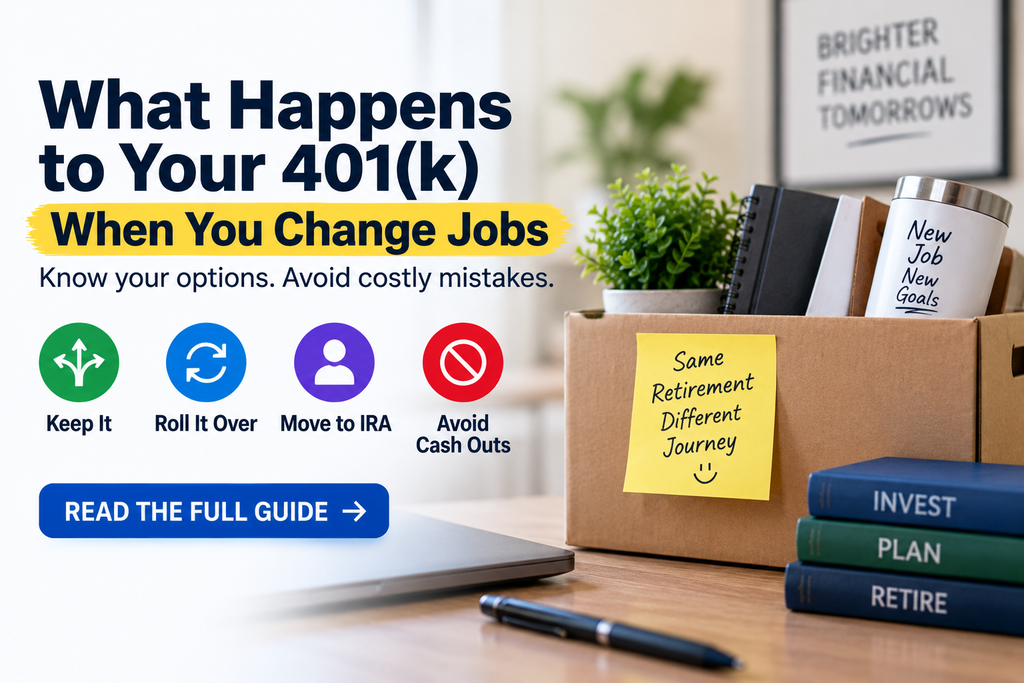
There are four paths for a 401(k) when you change jobs, and each has different tax consequences:
- Leave it with your old employer — allowed if your vested balance is above the 2026 auto-rollover threshold of $7,000.
- Roll it into your new employer’s 401(k) — if the new plan accepts incoming rollovers.
- Roll it into an IRA — usually the most flexible option, with lower fees and more investment choices.
- Cash it out — almost always the wrong move; the amount is taxed as ordinary income plus a 10% penalty if you’re under 59½.
Why Small Balances Get Treated Differently for a 401(k) When You Change Jobs
If your 401(k) balance is under $7,000 when you change jobs, your old employer can force the money out of the plan without your consent under SECURE 2.0’s updated 2026 rules. Balances under $1,000 can be cashed out directly; anything between $1,000 and $7,000 typically gets auto-rolled into a default IRA, often one with higher fees and a low-yield money market fund. Acting before that happens gives you control over where a 401(k) when you change jobs actually lands, instead of your old employer choosing for you.
Direct Rollover vs. Indirect Rollover: The 60-Day Trap
When you move a 401(k) after changing jobs, how you move it matters as much as where. A direct rollover sends the money straight from the old plan to the new one, with no taxes withheld. An indirect rollover sends a check to you first, and the plan is required to withhold 20% for taxes.
Here’s the trap: you have 60 days to deposit the full original balance into a new account, including the 20% that was withheld, or the missing portion counts as a taxable distribution plus a possible 10% penalty.
| Scenario | Amount Rolled Over | Tax Result |
|---|---|---|
| $50,000 direct rollover | $50,000 | No tax, no penalty |
| $50,000 indirect, all $50,000 redeposited within 60 days | $50,000 (you cover the 20% withheld from other funds) | No tax, no penalty |
| $50,000 indirect, only $40,000 redeposited | $10,000 | Treated as a distribution: taxed plus 10% penalty if under 59½ |
That $10,000 gap in the last row is exactly the kind of mistake a 401(k) when you change jobs can trigger if you don’t know the withholding rule ahead of time.
What About a Roth 401(k) When You Change Jobs?
If part or all of your balance is in a Roth 401(k), the rollover math for a 401(k) when you change jobs changes slightly. A Roth 401(k) when you change jobs should generally roll into a Roth IRA to preserve its tax-free status; rolling Roth dollars into a traditional IRA can create a taxable event on the growth. If your old plan holds both Roth and traditional contributions, most providers let you split the rollover into a Roth IRA and a traditional IRA in the same transaction, so the tax treatment for each portion stays intact.
What If You’re 55 or Older When You Change Jobs?
There’s one age-based exception worth knowing. If you separate from an employer during or after the calendar year you turn 55, the Rule of 55 lets you withdraw from that specific employer’s 401(k) when you change jobs penalty-free, even before age 59½. This only applies to the plan at the job you just left, not to IRAs or other old 401(k)s, so it’s a reason some people leave a 401(k) when they change jobs in place rather than rolling it over right away.
Fees You Might Be Missing on an Old 401(k) When You Change Jobs
An old 401(k) when you change jobs doesn’t stop charging fees just because you’re no longer contributing. Some employer plans quietly shift former employees to a different, higher fee schedule, or the underlying funds carry expense ratios well above a low-cost IRA. Reviewing your old plan’s fee disclosure at least once a year, even if you leave the money there, can catch this before it eats into your returns.
Deciding What to Do With Your 401(k) After Changing Jobs
There’s no single right answer for every 401(k) when you change jobs, but a few things narrow it down fast. If your new employer’s plan has good, low-fee investment options, rolling in keeps things simple. If you want more control over your investments, an IRA usually wins. Either way, it helps to see the long-term impact before deciding: plug your numbers into our Retirement Corpus Calculator to compare how each option affects your balance by retirement age.
It’s also worth checking whether your new job’s contribution limits or match make sense before you decide to stop contributing to the old plan altogether. Our 401(k) Contribution Calculator can show you how much to set aside in the new plan to stay on track after the change.
Frequently Asked Questions
How long do I have to decide what to do with a 401(k) when you change jobs? There’s no strict deadline unless your balance is small enough to trigger a forced distribution or auto-rollover. Still, deciding within the first few months keeps you from forgetting about the account entirely.
Can I roll a 401(k) into a new employer’s plan before I officially start? No. Most new plans require you to be an active employee, and many also require a waiting period, before they’ll accept an incoming rollover from an old 401(k) when you change jobs.
Does leaving a 401(k) with an old employer cost me anything? Not directly, but you lose the ability to make new contributions to that account, and you’ll need to separately track and manage that 401(k) alongside any new retirement accounts.
What happens to unvested employer contributions when I leave? Unvested employer matching or profit-sharing contributions are typically forfeited back to the plan when a 401(k) when you change jobs situation comes up. Only your own contributions and any vested employer contributions are guaranteed to be yours to move.
Bottom Line
What happens to your 401(k) when you change jobs comes down to four choices, and the one you should almost never pick is cashing out. Act within the first few months, before an auto-rollover or a forgotten account makes the decision for you.
This is for informational purposes only and isn’t financial, tax, or legal advice.

Raghu Shekar writes about personal finance, banking, Medicare, and retirement planning at SimpleUSAFinance. His goal is simple: break down the numbers people actually need — no jargon, no sales pitch — so readers can make their own decisions with confidence. When he’s not writing, he’s usually digging through the latest rate changes, tax brackets, or Medicare updates to keep the site’s calculators and guides current.