A Roth conversion moves money from a traditional IRA into a Roth IRA, and you pay income tax on the amount converted the year you do it. The real question behind Roth conversion now vs later isn’t whether you’ll pay tax; it’s which year hands you the smaller bill. This guide walks through the tax brackets, a real example, and the two hidden costs that often decide the answer.
Roth Conversion Now vs Later: The Basic Tradeoff
The core tradeoff in Roth conversion now vs later comes down to your tax rate today versus your tax rate whenever you’d otherwise be forced to withdraw that money. Convert now and you pay tax at today’s rate, on your terms and timeline.
Wait, and required minimum distributions eventually force the withdrawal anyway, at whatever rate applies then, often stacked on top of Social Security and other income you don’t control.
How Tax Brackets Decide Roth Conversion Now vs Later
Tax brackets are the entire mechanism behind Roth conversion now vs later. For 2026, single filers pay 22% on taxable income from $50,400 to $105,700, and 24% from $105,700 to $201,775, per IRS Revenue Procedure 2025-32.
If converting now keeps you inside a lower bracket than the one your future RMDs will push you into, converting now wins. If your income is temporarily low, between retiring and starting Social Security, for example, that gap year is often the cheapest conversion window you’ll ever get.
Roth Conversion Now vs Later: A Real Example
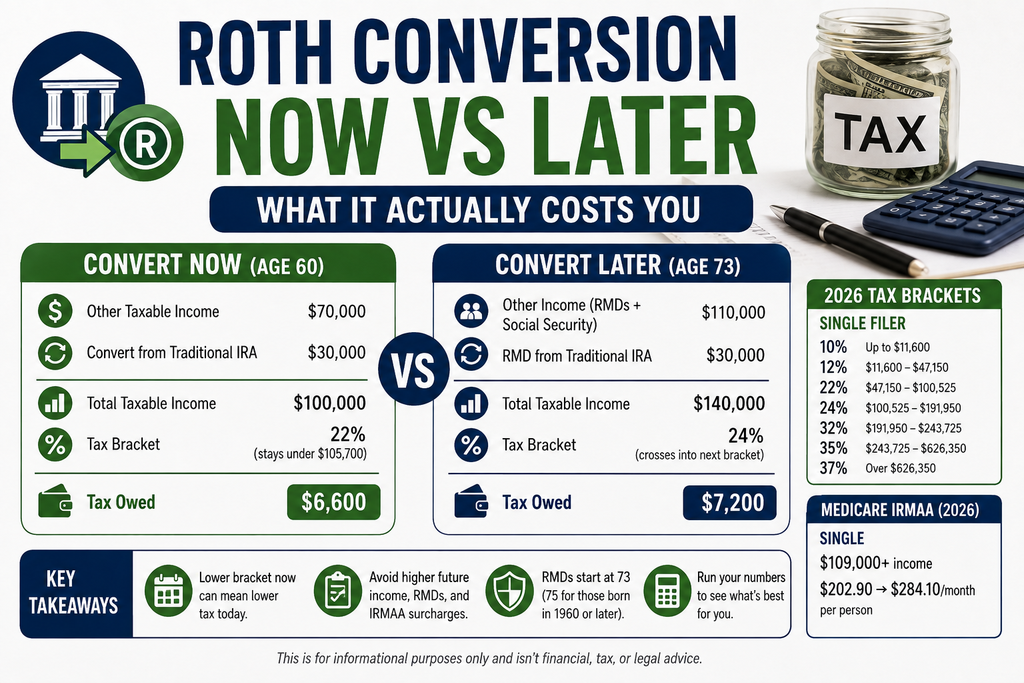
Numbers make Roth conversion now vs later concrete instead of theoretical. Say you’re a single filer, age 60, with $70,000 in other taxable income this year and a $30,000 slice of your traditional IRA you’re deciding whether to convert now.
How the Numbers Compare for Roth Conversion Now vs Later
| Scenario | Taxable Income Before Conversion | Rate Applied to the $30,000 | Tax Owed |
|---|---|---|---|
| Convert now, at 60 | $70,000 | 22% (stays under $105,700) | $6,600 |
| Convert later, at 73, via forced RMDs | $110,000 (RMDs plus Social Security) | 24% (crosses into next bracket) | $7,200 |
Converting now saves $600 in federal tax on this slice alone, just from staying in the lower bracket, before counting anything else.
RMDs and Roth Conversion Now vs Later
Required minimum distributions are the deadline that forces the later side of Roth conversion now vs later. The IRS requires withdrawals from traditional IRAs starting at age 73 for anyone born between 1951 and 1959, rising to age 75 for anyone born in 1960 or later, under the SECURE 2.0 Act.
Roth IRAs have no RMDs during the original owner’s lifetime, so converting before that deadline hits removes that slice of money from forced withdrawals entirely, on top of whatever bracket savings you get.
IRMAA and Roth Conversion Now vs Later
This is the cost most people miss in Roth conversion now vs later: Medicare’s income surcharge. For 2026, Medicare’s IRMAA surcharge kicks in once your income tops $109,000 (single) or $218,000 (married filing jointly), based on your tax return from two years earlier.
Cross that threshold and your Part B premium jumps from the standard $202.90 a month to $284.10, an extra $974 a year, per person, and it’s a cliff, not a gradual increase. Large RMDs late in retirement are a common way people accidentally trip this wire.
When Waiting Costs More: Roth Conversion Later vs Now
Looking at Roth conversion later vs now from the other direction makes the risk clearer. Waiting means the size of your eventual RMD, and your tax rate on it, are both largely out of your hands by the time they arrive.
A market runup between now and age 73 could make your account balance, and therefore your RMD, considerably larger than the $30,000 slice in this example, pushing even more income into a higher bracket and closer to the IRMAA cliff.
Deciding Between Roth Conversion Now and Later
There’s no single right answer to Roth conversion now vs later, it depends on your current bracket, your expected future income, and how close you already sit to an IRMAA threshold. A financial or tax professional can model your specific numbers before you convert anything.
You can run your own Roth conversion now vs later math against your actual IRA balance and income with our Roth Conversion Calculator, which shows the tax owed at today’s bracket compared with your projected bracket at RMD age.
For many people approaching retirement, converting modest amounts each year in the gap between stopping work and starting RMDs captures most of the benefit without triggering IRMAA or a higher bracket.
Bottom Line
Roth conversion now vs later comes down to comparing your tax bracket today against your likely bracket once RMDs and Social Security stack up and factoring in whether either scenario pushes you into an IRMAA surcharge.
This is for informational purposes only and isn’t financial, tax, or legal advice.

Raghu Shekar writes about personal finance, banking, Medicare, and retirement planning at SimpleUSAFinance. His goal is simple: break down the numbers people actually need — no jargon, no sales pitch — so readers can make their own decisions with confidence. When he’s not writing, he’s usually digging through the latest rate changes, tax brackets, or Medicare updates to keep the site’s calculators and guides current.