If your income dropped after retirement, divorce, or the loss of a spouse, you do not have to keep paying a Medicare surcharge based on old numbers. You can appeal an IRMAA determination using Form SSA-44, and Social Security can recalculate your premium using more recent income instead of the tax return it normally relies on. This guide walks through when you qualify, what to file, and how long the process takes.
What Does It Mean to Appeal an IRMAA Determination?
Medicare sets your Income-Related Monthly Adjustment Amount, or IRMAA, using your tax return from two years earlier. For 2026 premiums, that means your 2024 return. If your income has since fallen because of a specific life event, you can appeal an IRMAA determination and ask Social Security to use a more current year instead.
This is not a general hardship request. Social Security only agrees to appeal an IRMAA determination when the drop in income is tied to one of eight recognized events, not simply because your investments lost value or your income varies year to year.
Who Can Appeal an IRMAA Determination
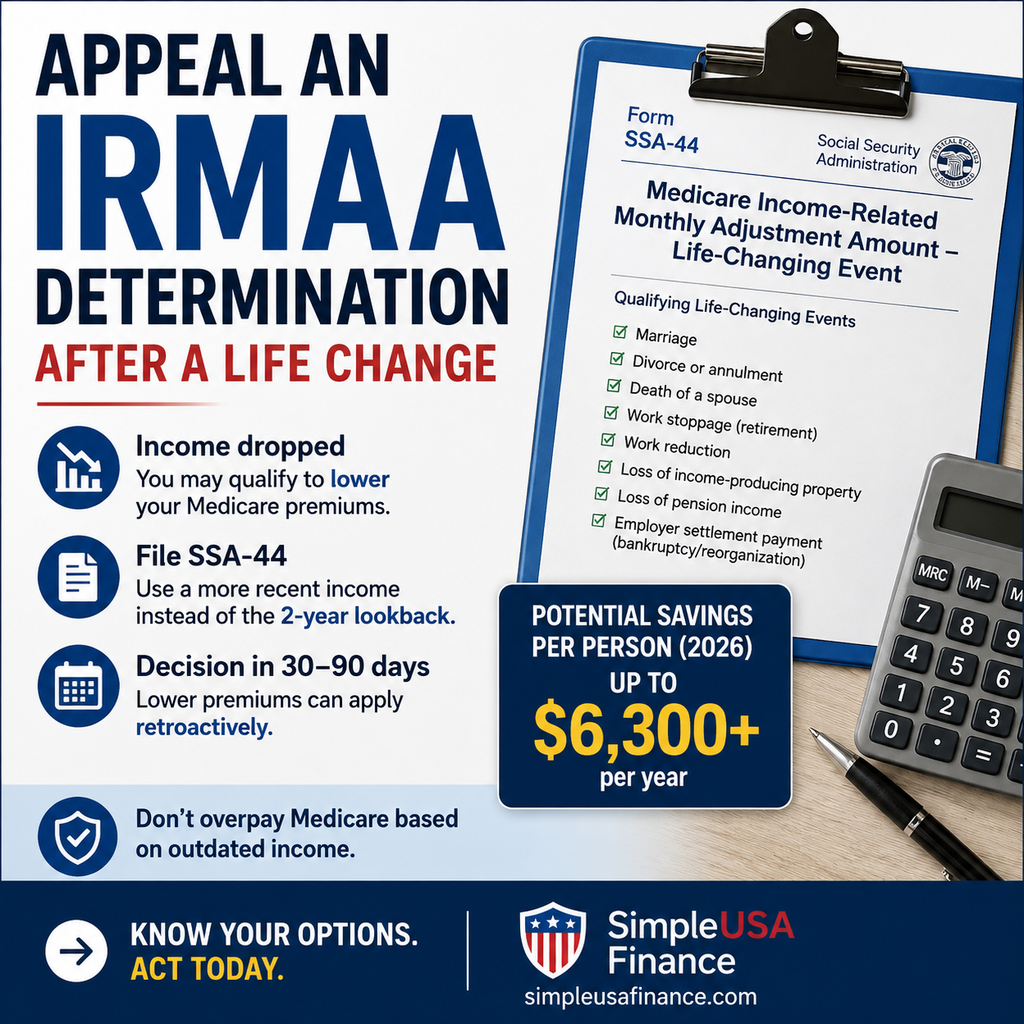
You can appeal an IRMAA determination if you or your spouse experienced one of these eight qualifying life changing events:
- Marriage
- Divorce or annulment
- Death of a spouse
- Work stoppage, such as retirement
- Work reduction
- Loss of income producing property, if the loss was involuntary
- Loss of pension income
- Employer settlement payment tied to a bankruptcy or reorganization
A Roth conversion, a large capital gain, or a one-time IRA withdrawal will not qualify you to appeal an IRMAA determination, even if it feels like a one-time event. Those situations correct themselves on their own once the higher-income year ages out of the two-year lookback.
Appealing an IRMAA Determination vs Waiting for the Lookback to Catch Up
If your income dropped for a reason that is not on the list above, you generally cannot use this option right away. Instead, your premium will adjust automatically once Social Security processes the tax return that reflects the lower income, which is usually two years later. Filing Form SSA-44 only makes sense when your situation matches one of the eight qualifying events.
How to Appeal an IRMAA Determination Step by Step
The process to appeal an IRMAA determination is more straightforward than most people expect.
- Download Form SSA-44 from the Social Security Administration’s website.
- Select the qualifying event that applies to you and enter the date it occurred.
- Provide either your estimated income for the current year or a copy of a more recent tax return, along with tax exempt interest income.
- Attach supporting documentation for the event itself, such as a retirement letter, divorce decree, or death certificate.
- Submit the form and documents to your local Social Security office by mail, fax, or in person.
Because these numbers need to be accurate, not optimistic guesses, base your income estimate on your actual pension, Social Security, and investment income going forward rather than a best case scenario.
What Happens After You Appeal an IRMAA Determination
Once you appeal an IRMAA determination, Social Security typically takes 30 to 90 days to issue a decision. If your appeal is approved, the new, lower premium can apply retroactively to the month the life changing event occurred, which often means a refund for any months you overpaid.
If your request is denied and you still believe the decision is wrong, your denial letter will explain how to request a formal hearing before an Administrative Law Judge, followed by further review through the Medicare Appeals Council and, if needed, federal court.
What an Approved IRMAA Determination Appeal Can Be Worth
The dollar impact of a successful appeal depends on how many IRMAA tiers you drop. For 2026, moving from the lowest surcharge tier back to the standard premium can save roughly $1,150 per person per year on Part B and Part D combined. Moving down from one of the higher tiers can save several thousand dollars per person annually.
| Situation | Approximate Annual Savings Per Person |
|---|---|
| Drop from Tier 1 to standard premium | ~$1,150 |
| Drop from a middle tier to standard | ~$3,000 to $4,500 |
| Drop from the top tier to standard | ~$6,300 |
These figures move each year as CMS updates the brackets, so treat them as a general sense of scale rather than an exact promise. If you want to see how a lower income tier could affect your own Medicare costs before you file, you can run your own numbers with our free Retirement Corpus Calculator to plan around the new premium.
Common Mistakes That Delay an IRMAA Determination Appeal
A few avoidable errors slow down or sink an appeal:
- Submitting an income estimate without documentation of the qualifying event itself.
- Assuming a home sale, stock sale, or Roth conversion qualifies, when it does not.
- Waiting months after the life changing event before filing, which only extends the time you spend overpaying.
- Sending the form to the wrong office instead of your local Social Security office.
Filing promptly matters. There is no requirement to wait for your annual Medicare notice before you appeal an IRMAA determination, and the sooner you file, the sooner any overpayment stops.
Bottom Line
If retirement, divorce, or the death of a spouse lowered your income, you have a real path to appeal an IRMAA determination and bring your Medicare premium back in line with your current finances. Gather your documentation, file Form SSA-44 promptly, and watch for a decision within 90 days.
This is for informational purposes only and isn’t financial, tax, or legal advice.

Raghu Shekar writes about personal finance, banking, Medicare, and retirement planning at SimpleUSAFinance. His goal is simple: break down the numbers people actually need — no jargon, no sales pitch — so readers can make their own decisions with confidence. When he’s not writing, he’s usually digging through the latest rate changes, tax brackets, or Medicare updates to keep the site’s calculators and guides current.