CD laddering sounds complicated until you see the actual math. Instead of locking your entire savings into one certificate of deposit, this strategy splits your money across several CDs with different maturity dates. Below, we walk through CD laddering step by step using a real $10,000 example and current 2026 rates, so you can see exactly what you would earn.
What Is CD Laddering?
CD laddering is a savings strategy where you divide one lump sum into several certificates of deposit that mature at different times instead of all at once. Rather than choosing between a short CD you can access soon and a long CD with a better rate, this approach lets you capture both benefits at once.
Each time one rung of the ladder matures, you either spend that cash or roll it into a new long term CD. This keeps part of your money earning the higher rates that longer CDs typically offer, while still giving you regular access to cash as each certificate comes due.
How CD Laddering Works With Real Numbers
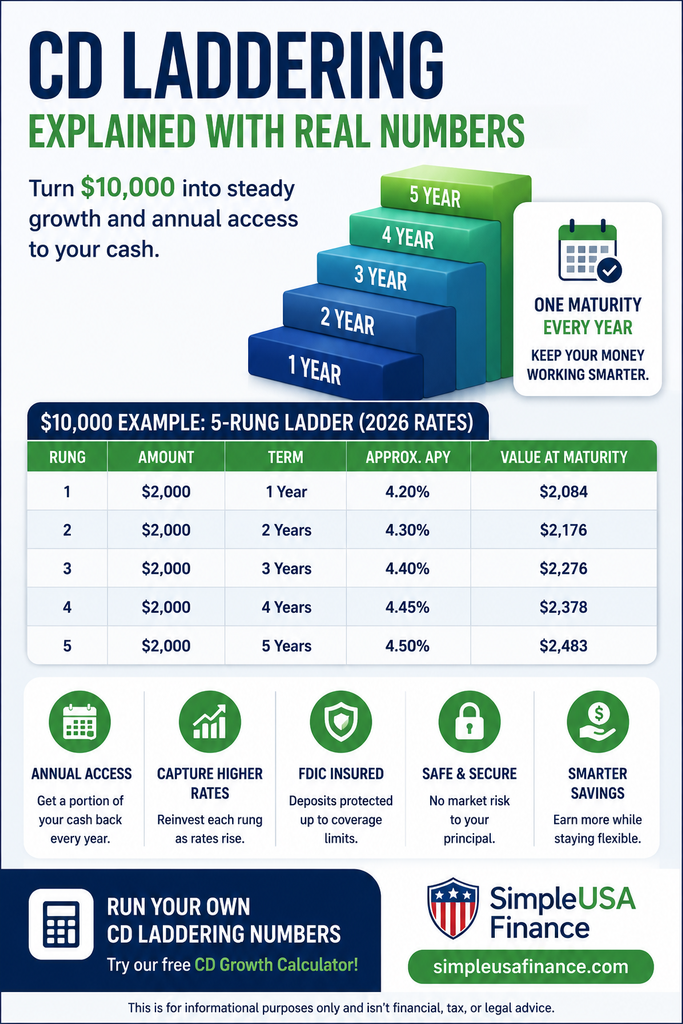
The clearest way to understand this strategy is with an actual dollar example rather than a general description. Say you have $10,000 you want to keep safe while still earning a solid return.
Using representative rates available from online banks in August 2026, a five rung ladder might look like this:
| Rung | Amount | Term | Approximate APY | Value at Maturity |
|---|---|---|---|---|
| 1 | $2,000 | 1 year | 4.20% | $2,084 |
| 2 | $2,000 | 2 years | 4.30% | $2,176 |
| 3 | $2,000 | 3 years | 4.40% | $2,276 |
| 4 | $2,000 | 4 years | 4.45% | $2,378 |
| 5 | $2,000 | 5 years | 4.50% | $2,483 |
These rates are illustrative examples based on published national CD rate ranges rather than a specific bank offer, and actual rates change often, so always confirm current numbers before opening an account.
A $10,000 CD Laddering Example, Step by Step
Here is how this example plays out over five years:
- You open all five CDs on the same day, spreading $10,000 across 1, 2, 3, 4, and 5 year terms.
- In year one, the shortest CD matures. You can spend that money or reinvest it into a new 5 year CD.
- In year two, the second CD matures, and you repeat the same choice.
- By year five, every original CD has matured at least once, and you have a system where one rung comes due every single year.
- From that point forward, you always have access to cash within 12 months, without ever holding your entire balance in a single short term, lower rate account.
CD Laddering vs a Single CD
Comparing this strategy against putting the full $10,000 into one 5 year CD shows the tradeoff clearly. The single CD earns a slightly higher rate on the full balance, but locks up every dollar for five years. CD laddering earns close to that same average return while giving you a maturity date every year instead of every five years.
If interest rates rise after you open your CDs, this approach also lets you reinvest each maturing rung at the new, higher rate instead of waiting years for a single certificate to come due.
CD Laddering Rates in 2026
As of August 2026, top nationally available CD rates generally range from about 4.0% to 4.5% APY depending on the term, while the national average sits well below that, often under 2.5%. Building this strategy around the top available rates rather than your local bank’s standard rate makes a meaningful difference over several years.
Before committing funds to a ladder, compare current rates using a resource like Bankrate’s CD rate tables to confirm you are getting a competitive APY at each term rather than accepting whatever your primary bank happens to offer.
Pros and Cons of CD Laddering
CD laddering is not the right fit for every saver, so weigh both sides before you start.
Advantages of CD laddering:
- Regular access to a portion of your cash every year
- Ability to capture rising rates as each rung matures
- FDIC or NCUA insurance on deposits within coverage limits
- No stock market risk to your principal
Drawbacks of CD laddering:
- Lower potential return than staying fully invested in the market long term
- Early withdrawal penalties if you need a rung’s cash before maturity
- More paperwork and tracking than a single account
- Returns can lag inflation in some years
How to Start CD Laddering
Getting a ladder running takes just a few steps.
- Decide on your total amount and how many rungs you want, commonly three to five.
- Divide the total evenly, or weight it toward longer terms if you can go without that cash sooner.
- Shop multiple banks and credit unions for the best APY at each term length.
- Open each CD on the same day so your maturity dates stay evenly spaced going forward.
- Set a calendar reminder for each maturity date so you decide in advance whether to reinvest or withdraw.
If you want to see how your own numbers would grow, you can run your own CD laddering numbers with our free CD Growth Calculator before opening any accounts.
Bottom Line
CD laddering lets you earn competitive rates on a portion of your savings every year while keeping the rest working toward higher long term yields. Run the real numbers for your own amount and current rates before choosing your rungs.
This is for informational purposes only and isn’t financial, tax, or legal advice.
Note: the CD Growth Calculator is listed in your build plan as still marked “Coming Soon” — swap in whichever calculator is actually live if that hasn’t shipped yet.

Raghu Shekar writes about personal finance, banking, Medicare, and retirement planning at SimpleUSAFinance. His goal is simple: break down the numbers people actually need — no jargon, no sales pitch — so readers can make their own decisions with confidence. When he’s not writing, he’s usually digging through the latest rate changes, tax brackets, or Medicare updates to keep the site’s calculators and guides current.