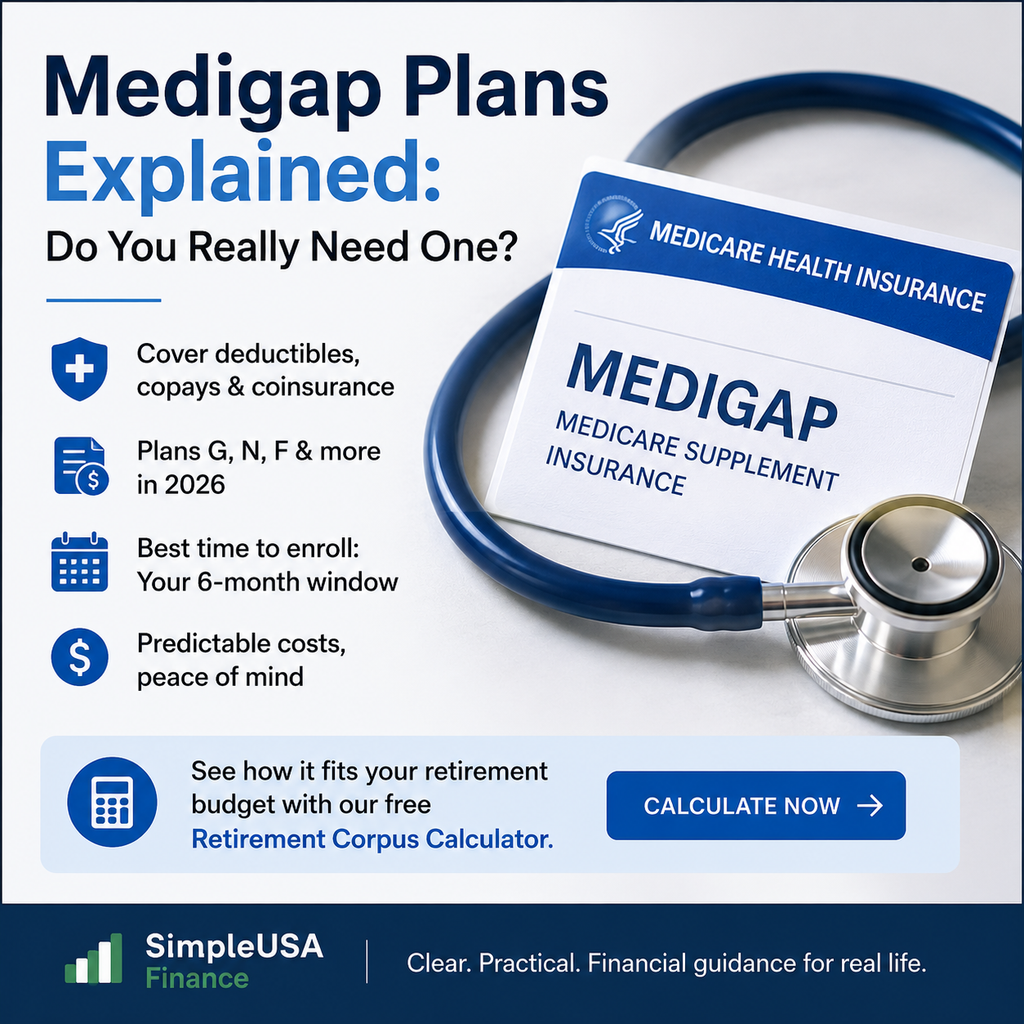
If you are turning 65 or already enrolled in Original Medicare, you have probably heard people mention Medigap and wondered if you actually need a plan. These policies are designed to fill the gaps that Original Medicare leaves behind, such as deductibles, copays, and coinsurance. This guide walks through what Medigap plans cover in 2026, what they cost, and how to decide whether one belongs in your monthly budget.
What Are Medigap Plans and How Do They Work?
Medigap plans, also known as Medicare Supplement Insurance, are sold by private insurers but standardized and regulated at the federal level. Every plan with the same letter, such as Plan G or Plan N, must offer the exact same core benefits no matter which company sells it. That means shopping around really comes down to price, customer service, and how an insurer handles claims, not the coverage itself.
Original Medicare pays roughly 80% of most covered costs, leaving you responsible for the rest. A supplement policy steps in to cover some or all of that remaining 20%, along with the Part A and Part B deductibles depending on which letter you choose.
Types of Medigap Plans Available in 2026
Not everyone can buy every type of coverage on this list. Plan F, once one of the most popular choices, is now limited to people who became eligible for Medicare before January 1, 2020. For everyone newer to the program, Plan G has become the most common Medigap plan on the market today.
Here is a quick look at the most widely sold options in 2026:
| Plan | What It’s Known For | Typical Monthly Range |
|---|---|---|
| Plan G | Most complete coverage for new enrollees | $120 to $290 |
| High Deductible Plan G | Lowest premium, higher risk | $30 to $75 |
| Plan N | Lower premium, small copays | $95 to $220 |
| Plan F (legacy only) | Full coverage, pre 2020 eligibility only | $165 to $345 |
Plan G vs Plan N: Which Medigap Plan Fits Best?
Choosing between these two popular Medigap plans usually comes down to how much monthly premium you want to pay versus how much you are willing to pay out of pocket per visit. Plan G covers nearly everything except the annual Part B deductible, which sits at $283 in 2026. Plan N carries a lower premium but adds small copays, often up to $20 for a doctor visit and up to $50 for an ER visit that does not lead to admission.
How Much Do Medigap Plans Cost in 2026?
The average monthly cost across all Medigap plans is about $149.50 in 2026, though your actual price depends heavily on your age, state, and the insurer you choose. Some states use community rating, which means every enrollee pays the same amount for a given plan regardless of age. Other states allow attained age pricing, so your premium climbs a little each year you get older.
For example, a Plan G policy in Texas might run $120 to $170 a month, while the same coverage in New York, a community rated state, can average closer to $354 a month. That is a real difference worth checking before you assume any Medigap plan is a fixed, predictable cost nationwide.
Do You Actually Need a Medigap Plan?
Whether you need a Medigap plan comes down to how much financial risk you are comfortable carrying. Original Medicare alone has no annual out of pocket maximum, which means a serious illness or hospital stay could leave you with thousands of dollars in bills. This coverage caps that exposure in exchange for a predictable monthly premium.
If you are generally healthy and rarely visit the doctor, a lower premium option like Plan N or a high deductible Plan G might make sense. If you would rather never see a surprise medical bill, a standard Plan G remains the most comprehensive Medigap plan available to new enrollees.
Medigap Plans vs Medicare Advantage
People often confuse Medigap plans with Medicare Advantage, but they work very differently. Medigap pairs with Original Medicare and lets you see any provider who accepts Medicare nationwide. Medicare Advantage plans replace Original Medicare with a private network plan that often has lower premiums but a limited provider list and yearly out of pocket maximum.
If nationwide provider access matters most to you, Medigap plans are usually the stronger fit. If a lower monthly cost matters more and you are comfortable with a network, Medicare Advantage may be worth comparing separately.
When to Enroll in a Medigap Plan
The best time to buy any of the Medigap plans on this list is during your six month Medigap Open Enrollment Period, which starts the month you turn 65 and are enrolled in Part B. During this window, insurers must sell you a policy at the best available rate without medical underwriting. Missing this window can mean higher costs or even denial of coverage later, so timing your purchase matters as much as picking the right letter.
You can run your own numbers on how this monthly premium fits into your broader retirement budget with our Retirement Corpus Calculator, which helps you see the long term impact of a recurring monthly cost.
Bottom Line
Medigap plans exist to make your healthcare costs predictable by covering the gaps Original Medicare leaves behind. Whether you need one depends on your health, your budget, and how much financial risk you are willing to carry into retirement, but for many people a Medigap plan is worth the monthly premium for the peace of mind it buys.
This is for informational purposes only and isn’t financial, tax, or legal advice.

Raghu Shekar writes about personal finance, banking, Medicare, and retirement planning at SimpleUSAFinance. His goal is simple: break down the numbers people actually need — no jargon, no sales pitch — so readers can make their own decisions with confidence. When he’s not writing, he’s usually digging through the latest rate changes, tax brackets, or Medicare updates to keep the site’s calculators and guides current.