If you have ever watched news about a bank collapse and felt your stomach drop, you are not alone. What happens to your money if a bank fails depends almost entirely on one thing: whether your bank is FDIC-insured and whether your balance is under the coverage limit. For most everyday savers, the answer to what happens to your money if a bank fails is simple: insured money is safe. Here is exactly how it works, step by step.
What Happens to Your Money If a Bank Fails, in Plain English
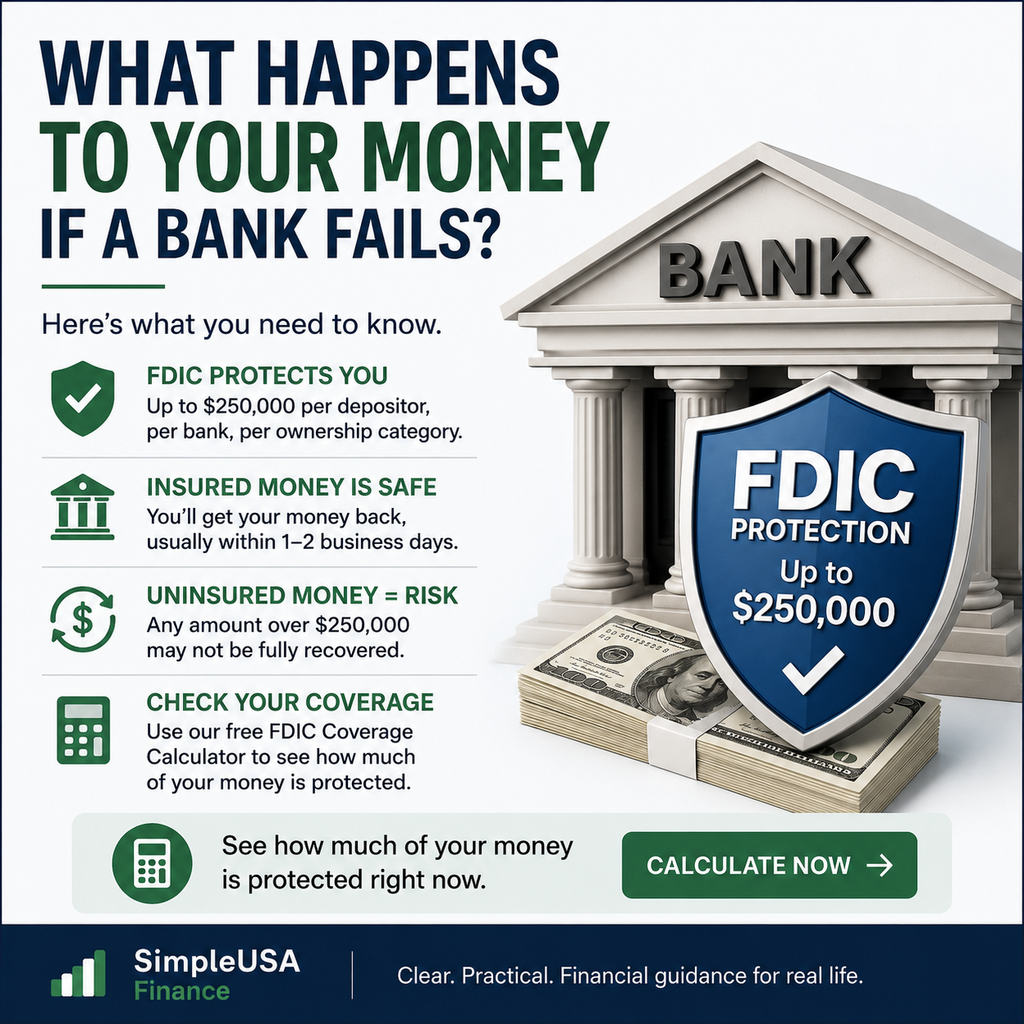
When a bank closes its doors for good, the Federal Deposit Insurance Corporation, or FDIC, steps in immediately. This is the short version of what happens to your money if a bank fails: if your deposit is insured, you get your money, usually within one to two business days. You do not have to file a claim, call a hotline, or prove anything happened. The FDIC already knows your balance from the bank’s own records.
Most of the time, another bank buys the failed one. Your account, debit card, and online banking simply move to the new bank as if nothing happened. If no buyer is found, the FDIC mails you a check for your insured amount instead.
How the FDIC Protects Your Money If a Bank Fails
The core rule behind what happens to your money if a bank fails is the $250,000 coverage limit. The FDIC insures deposits up to $250,000 per depositor, per bank, per ownership category. That limit has not changed since 2008, but it stacks in useful ways.
A single person can often be covered well beyond $250,000 at one bank by spreading funds across ownership categories, for example:
| Account Type | Coverage |
|---|---|
| Individual checking | $250,000 |
| Joint savings (with spouse) | $500,000 |
| IRA | $250,000 |
| Total at one bank | $1,000,000 |
Credit union members get a similar answer to what happens to your money if a bank fails, except the NCUA, not the FDIC, insures those accounts, also up to $250,000 per person per credit union.
Trust accounts work a little differently. As of a 2024 rule change, a trust owner naming five or more beneficiaries can be covered up to $1,250,000 per owner across all trust deposits at the same bank. That is a meaningful jump from the standard limit, and it changes what happens to your money if a bank fails for families with larger balances, since it lets them protect a bigger nest egg without opening accounts at multiple institutions.
It also helps to remember what the FDIC does not cover. Stocks, bonds, mutual funds, annuities, and the contents of a safe deposit box are not deposits, so they fall outside FDIC protection entirely, even if you bought them through a bank teller. Treasury bills and notes are not FDIC-insured either, though they carry their own backing from the federal government.
What Happens to Your Money If a Bank Fails and You’re Uninsured
This is the part people worry about, and rightly so. If your balance is above $250,000 in a single ownership category at one bank, what happens to your money if a bank fails changes. The FDIC-insured portion is paid out right away. The uninsured portion becomes a claim against the failed bank’s remaining assets, and you may eventually recover some, all, or none of it, over months or years, depending on what the bank had left.
In practice, regulators have occasionally protected uninsured depositors in full during high-profile failures, but that has been a discretionary decision made case by case, not a guarantee. When you are estimating what happens to your money if a bank fails, you should never assume that kind of exception will happen for you.
Timeline: What Happens to Your Money If a Bank Fails
Here is a realistic timeline for what happens to your money if a bank fails:
- Friday afternoon: Regulators typically close troubled banks at the end of the business week.
- Monday morning: The bank reopens, often under a new name or new owner, with your insured funds fully accessible.
- Weeks later: If a buyer was not found, the FDIC finishes mailing checks to insured depositors.
- Months to years later: Uninsured claims, if any, are settled as the bank’s remaining assets are sold off.
Notice how short the disruption is for insured depositors. That is the entire point of deposit insurance.
What Happens to Your Money If a Bank Fails: Common Myths
A lot of confusion swirls around what happens to your money if a bank fails, so let’s clear up three myths:
- Your money does not disappear. Insured deposits are backed by the full faith and credit of the U.S. government.
- You do not need to rush to the branch the moment you hear rumors. Panicked withdrawals do not speed up FDIC protection.
- Your credit score is not affected by a bank failure. This is about deposits, not debt.
Understanding what happens to your money if a bank fails ahead of time removes most of the fear from the situation.
How to Prepare for What Happens to Your Money If a Bank Fails
You can control most of what happens to your money if a bank fails before anything ever happens. Confirm your bank is FDIC-insured, know which ownership categories your accounts fall under, and keep balances at any single bank under $250,000 per category. If you are unsure how your accounts add up, see exactly what happens to your money if a bank fails with our free FDIC Coverage Calculator, which shows how much of your balance is protected right now.
For business accounts, the same principle applies, but the categories work a little differently, so it is worth double-checking with your bank directly or on the FDIC’s official BankFind tool to confirm your institution’s insured status.
A quick three-item checklist covers what happens to your money if a bank fails for most households:
- Look for the FDIC or NCUA sign at your branch, or search your bank’s name on BankFind.
- Add up every account you hold at that one bank, by ownership category, not just by account name.
- If any single category is close to or over $250,000, either open an account at a second insured bank or ask about a trust or retirement designation that raises your coverage.
None of this takes more than a few minutes, and it is far easier to do on a calm afternoon than during a week when a bank is making headlines.
Bottom Line
So, what happens to your money if a bank fails? If your deposit is FDIC-insured and under $250,000 per category, you get it back quickly, usually within a business day or two, with little to no disruption. The real risk sits with uninsured balances, so spreading large sums across account types or banks is the simplest way to stay fully protected.
This is for informational purposes only and isn’t financial, tax, or legal advice.

Raghu Shekar writes about personal finance, banking, Medicare, and retirement planning at SimpleUSAFinance. His goal is simple: break down the numbers people actually need — no jargon, no sales pitch — so readers can make their own decisions with confidence. When he’s not writing, he’s usually digging through the latest rate changes, tax brackets, or Medicare updates to keep the site’s calculators and guides current.