Roth vs traditional IRA is one of the most common retirement questions people search, and for good reason. The two accounts hold the same investments, but they tax your money at completely different points in time.
This guide breaks down the Roth vs traditional IRA trade-off in plain numbers, walks through a real example, and gives you a simple way to decide which one fits your situation for 2026.
The Core Roth vs Traditional IRA Trade-Off
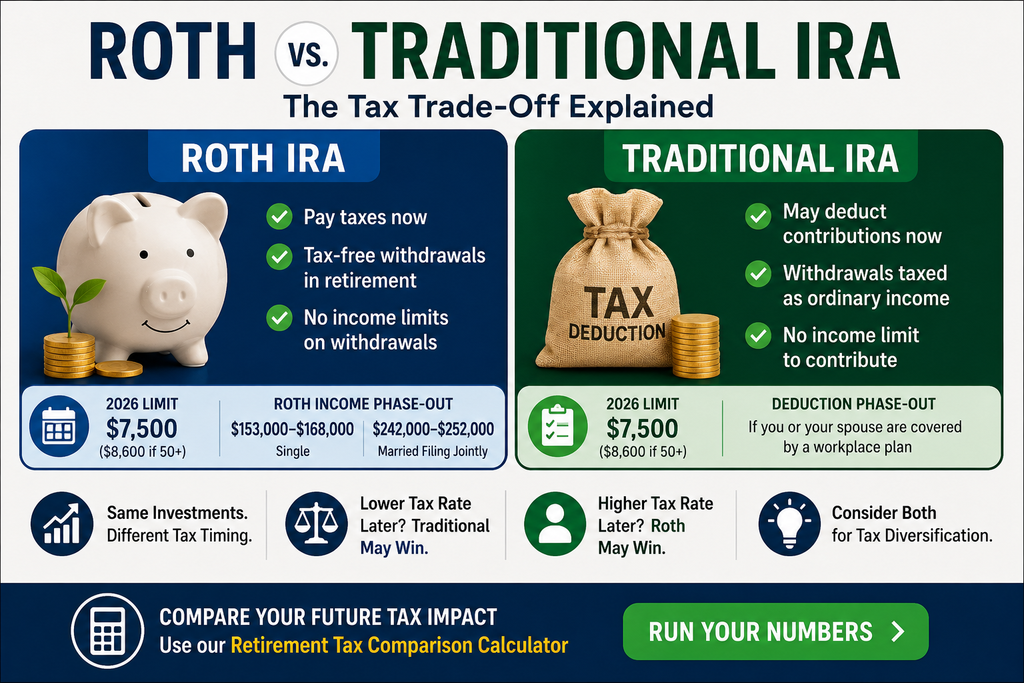
The entire Roth vs traditional IRA decision comes down to one question: do you want your tax break now, or later? A traditional IRA can lower your taxable income the year you contribute, while a Roth IRA gives you tax-free withdrawals decades from now.
With a traditional IRA, your contribution may be deductible, and the money grows tax-deferred until you withdraw it in retirement, at which point it is taxed as ordinary income. With a Roth IRA, you contribute money you have already paid tax on, and qualified withdrawals in retirement are completely tax free.
Neither side of the Roth vs traditional IRA trade-off is universally better. The right answer depends on your income today, your expected income in retirement, and how many years your money has left to grow before you need it.
2026 Contribution Limits for Roth vs Traditional IRA
For 2026, the IRS set the combined annual contribution limit for traditional and Roth IRAs at $7,500, with an additional $1,100 catch-up contribution allowed once you turn 50, for a total of $8,600.
That limit applies across both account types together, not separately. Understanding Roth vs traditional IRA limits matters here because you cannot contribute $7,500 to each; the total across both accounts cannot exceed $7,500 for most savers under 50.
A Simple Roth vs Traditional IRA Numbers Example
Say you contribute $7,500 and are in the 22 percent federal tax bracket. A traditional IRA contribution could reduce your taxable income by $7,500 this year, saving roughly $1,650 in taxes today. A Roth contribution offers no deduction now, but that same $7,500 grows and comes out completely tax free in retirement.
| Factor | Traditional IRA | Roth IRA |
|---|---|---|
| Tax treatment of contribution | May be deductible now | No deduction |
| Tax treatment of withdrawals | Taxed as ordinary income | Tax free if qualified |
| 2026 contribution limit | $7,500 ($8,600 if 50+) | $7,500 ($8,600 if 50+) |
| Income limits to contribute | None | Phases out above $153,000 single, $242,000 married |
Why Income Limits Change the Roth vs Traditional IRA Decision
Roth vs traditional IRA is not always a free choice. For 2026, Roth IRA eligibility phases out for single filers between $153,000 and $168,000 of modified adjusted gross income, and for married couples filing jointly between $242,000 and $252,000.
Traditional IRAs have no income limit on contributions, but the tax deduction can be reduced or eliminated if you or your spouse are covered by a workplace retirement plan and your income is above certain thresholds. This is where Roth vs traditional IRA planning gets more complicated for higher earners, since the deduction, not the contribution itself, is what phases out.
Roth vs Traditional IRA and Your Future Tax Bracket
The real Roth vs traditional IRA question is a bet on your future tax rate. If you expect to be in a lower tax bracket in retirement than you are today, the upfront deduction from a traditional IRA is usually worth more. If you expect a similar or higher tax bracket later, paying tax now through a Roth often comes out ahead.
Younger workers early in their careers frequently lean Roth, since their current tax rate tends to be lower than what they might pay decades later. Workers closer to peak earning years often lean traditional, since the immediate deduction is worth more against a higher current tax bracket.
Common Mistakes in the Roth vs Traditional IRA Comparison
A frequent mistake is assuming Roth vs traditional IRA is a once and done decision. In reality, many people contribute to both types over their career, or convert traditional balances to Roth in lower income years through a Roth conversion.
Another mistake is ignoring the 6 percent excise tax that applies to excess contributions in either account type. If you contribute more than the annual limit across your combined Roth vs traditional IRA accounts, the excess amount is taxed 6 percent for every year it remains uncorrected, unless withdrawn by the tax filing deadline.
A less obvious mistake is treating the Roth vs traditional IRA choice as separate from your broader retirement accounts. If you already have a workplace 401(k), the tax diversification a Roth IRA provides can matter more than squeezing out one more deduction through a traditional account.
A few practical steps to apply this to your own plan:
- Estimate whether your current tax bracket is likely lower or higher than your expected retirement bracket
- Check your modified adjusted gross income against the 2026 Roth phase-out ranges before assuming you are eligible
- Confirm whether a workplace plan limits your traditional IRA deduction this year
- Consider splitting contributions between both account types if you are uncertain which side of the trade wins
If you want to see how the Roth vs traditional IRA choice plays out over decades of growth, run your own numbers with our Retirement Tax Comparison Calculator, which models both scenarios side by side using your actual contribution amount and expected tax rates.
Roth vs Traditional IRA: Where to Confirm the Rules
For the official numbers behind everything in this guide, the IRS retirement topics page on IRA contribution limits lists the current annual limits and how they apply across traditional and Roth accounts. The IRS page on IRA deduction limits covers exactly how workplace coverage affects your traditional IRA deduction.
Checking these sources directly is worth doing before you finalize a Roth vs traditional IRA decision, since income thresholds and limits are adjusted for inflation most years.
Bottom Line
Roth vs traditional IRA is really a choice about when you want to pay tax on your retirement savings, not whether you pay it at all. Match the account to your expected future tax bracket, watch the 2026 contribution and income limits, and revisit the decision as your income changes.
This is for informational purposes only and isn’t financial, tax, or legal advice.

Raghu Shekar writes about personal finance, banking, Medicare, and retirement planning at SimpleUSAFinance. His goal is simple: break down the numbers people actually need — no jargon, no sales pitch — so readers can make their own decisions with confidence. When he’s not writing, he’s usually digging through the latest rate changes, tax brackets, or Medicare updates to keep the site’s calculators and guides current.