Most people know credit score factors exist, but few know which ones actually matter. That gap leads to a lot of wasted effort, like closing old cards or obsessively checking a score that barely moved.
This guide breaks down the real credit score factors used by the FICO Score, the model most lenders rely on, ranks them by weight, and shows you which moves actually change your number.
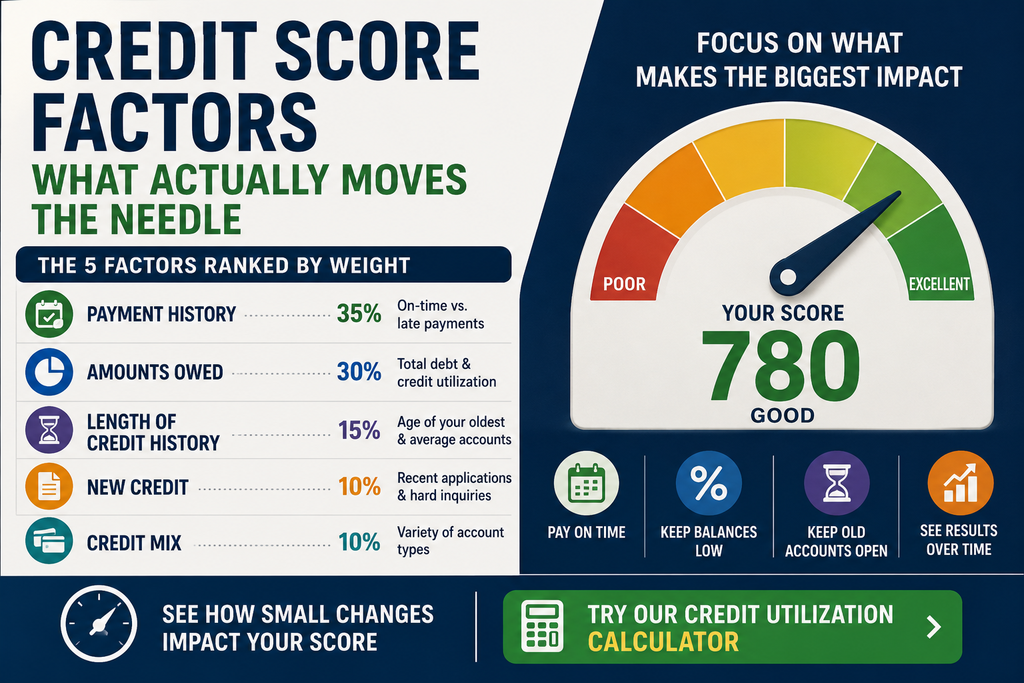
The Five Credit Score Factors and Their Weights
There are five credit score factors in the standard FICO model, and they are not weighted equally. Payment history carries about 35 percent, amounts owed about 30 percent, length of credit history about 15 percent, new credit about 10 percent, and credit mix about 10 percent.
Together, the first two credit score factors make up 65 percent of your score. That single fact explains why so much credit advice focuses on paying on time and keeping balances low, since those two categories dwarf everything else combined.
A Simple Breakdown of Credit Score Factors by Weight
| Credit Score Factor | Approximate Weight | What It Measures |
|---|---|---|
| Payment history | 35% | On time versus late or missed payments |
| Amounts owed | 30% | Total debt and credit utilization ratio |
| Length of credit history | 15% | Age of your oldest and average accounts |
| New credit | 10% | Recent applications and hard inquiries |
| Credit mix | 10% | Variety of account types you manage |
Why Payment History Dominates Credit Score Factors
Of all the credit score factors, payment history has the single biggest impact, and for good reason. Lenders care most about whether you have actually paid back money you borrowed, and a track record of on-time payments is the strongest predictor of future repayment.
A single late payment will not destroy your score if the rest of your history is clean, but the damage scales with severity. A 30-day late payment hurts less than a 60-day late, which hurts less than a collection, charge-off, or bankruptcy. Among all credit score factors, this one rewards consistency more than any quick fix.
Amounts Owed and Credit Score Factors You Can Control Fastest
Amounts owed is the second heaviest of the credit score factors, and it is also the fastest one to change. Your credit utilization ratio, the percentage of available revolving credit you are using, resets every time your statement balance is reported.
Keeping utilization below 30 percent avoids a meaningful hit, but the people with the highest scores typically stay under 10 percent. Because this factor updates monthly, it is often the quickest lever among all credit score factors when you need to move your number before an application.
The Slower Credit Score Factors: History, New Credit, and Mix
The remaining credit score factors move much more slowly. Length of credit history rewards patience, since it looks at how long your accounts have existed and how recently you have used them. There is no shortcut here beyond keeping old accounts open.
New credit and credit mix round out the smaller credit score factors. Each hard inquiry from a new application typically costs a few points and fades within months, while credit mix rewards having a healthy variety of account types, like a mix of credit cards and installment loans, without pushing you to open accounts you do not need.
Soft inquiries, like checking your own score through a bank app or a free monitoring service, never count against you. Only hard inquiries tied to an actual application for credit show up as a factor here, and even those tend to matter far less than people assume once a few months pass.
Common Mistakes People Make With Credit Score Factors
A common mistake is spreading effort evenly across all five factors instead of prioritizing. Since payment history and amounts owed control 65 percent of your score, focusing there first produces far more movement than optimizing credit mix or avoiding every hard inquiry.
Another mistake is closing old, unused credit cards to simplify your finances. That single move can shorten your average account age and reduce your available credit, working against two of these factors at once instead of just tidying up your wallet.
A related trap is applying for several new cards or loans right before a big purchase, like a car or a home. Each application can trigger a hard inquiry, and stacking several in a short window signals higher risk to lenders at exactly the moment you most need a strong score.
A few practical steps based on how these credit score factors actually work:
- Automate at least the minimum payment on every account so payment history stays clean
- Check your credit utilization ratio before a big application and pay down balances if it is above 30 percent
- Keep your oldest accounts open even if you rarely use them
- Space out new credit applications instead of applying for several accounts in a short window
If you want to see how paying down a balance shifts your overall picture, run your own credit score factors scenario with our Credit Utilisation Calculator, which shows how a specific payment changes your utilization ratio.
Where the Official Credit Score Factors Data Comes From
For the source behind the FICO weighting used throughout this guide, myFICO’s official credit score education resources break down each of the five categories in detail. The Consumer Financial Protection Bureau also publishes plain-English guidance on credit reports and how the underlying data behind these credit score factors gets collected.
It is worth noting that newer scoring models, including updated FICO and VantageScore versions, are being phased into mortgage underwriting in 2026 and weigh trended payment data slightly differently, so always confirm which score version a specific lender is using.
Bottom Line
Credit score factors are not a mystery, but they are not equal either. Payment history and amounts owed drive most of your score, so put your effort there first, and treat length of credit history, new credit, and credit mix as slower background factors rather than quick fixes.
This is for informational purposes only and isn’t financial, tax, or legal advice.

Raghu Shekar writes about personal finance, banking, Medicare, and retirement planning at SimpleUSAFinance. His goal is simple: break down the numbers people actually need — no jargon, no sales pitch — so readers can make their own decisions with confidence. When he’s not writing, he’s usually digging through the latest rate changes, tax brackets, or Medicare updates to keep the site’s calculators and guides current.