An underfunded pension sounds alarming, but most people have no idea whether their own plan qualifies as one. The good news is that checking is simpler than it sounds, and the law already requires your plan to tell you.
This guide walks through exactly where to find your plan’s funded percentage, what counts as an underfunded pension in practice, and what protections exist if your plan really is underfunded.
What Actually Makes a Pension Underfunded
A pension is underfunded when the plan’s assets are worth less than what it owes current and future retirees. That gap is measured as a funded percentage, calculated by dividing plan assets by plan liabilities.
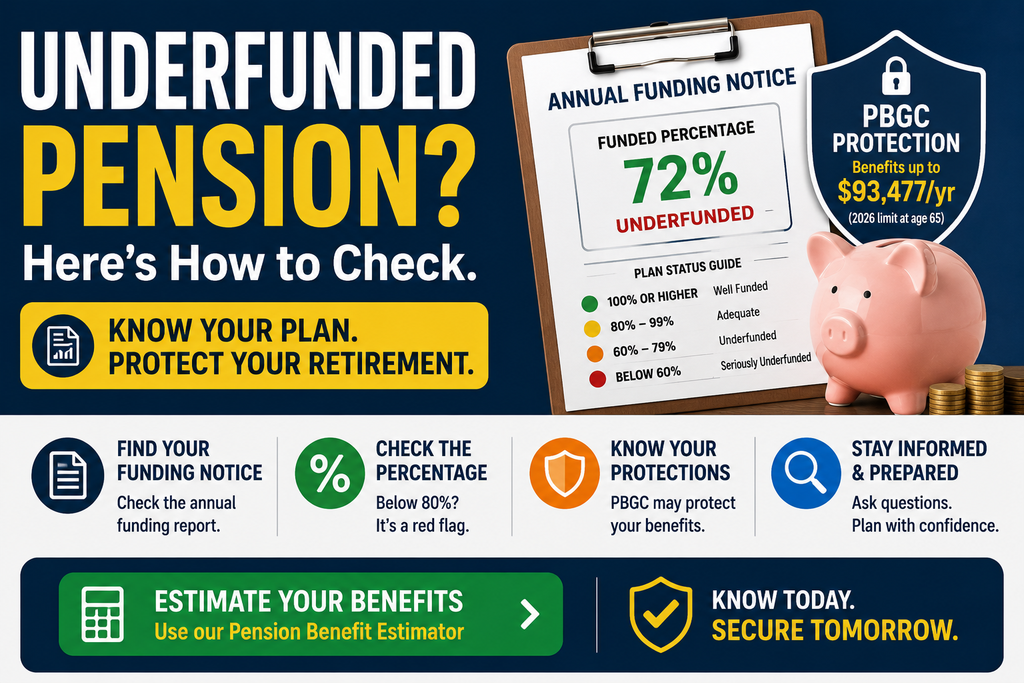
A funded percentage of 100 percent or higher means the plan can cover everything it owes. Anything meaningfully below that, and especially below 80 percent, is generally treated as an underfunded pension under federal pension law, since that threshold triggers specific restrictions on the plan.
This applies mainly to defined-benefit pensions, the traditional kind that promises a fixed monthly payment in retirement. A 401(k) or other defined-contribution account cannot become an underfunded pension in this sense, since there is no separate promised benefit for the balance to fall short of.
The Document That Tells You If You Have an Underfunded Pension
Every defined-benefit plan sponsor is legally required to send participants an Annual Funding Notice. This single document is the fastest way to check for an underfunded pension without guessing or calling anyone.
The notice discloses your plan’s funded percentage for the current and two prior years, the value of plan assets and liabilities, and a summary of how the plan invests its money. If you have not seen this notice recently, request it directly from your plan administrator or human resources department.
Multiemployer plans, the kind covering workers across several employers in the same union or industry, use a similar disclosure system but sort plans into color-coded zones, green, yellow, orange, or red, based on funded status. A plan in the red zone is treated as a critically underfunded pension and typically must adopt a formal rehabilitation plan.
A Simple Example of Reading an Underfunded Pension Notice
Say your funding notice shows plan assets of $80 million and liabilities of $100 million. Dividing 80 by 100 gives a funded percentage of 80 percent, which sits right at the line most experts use to flag an underfunded pension.
| Funded Percentage | What It Generally Means |
|---|---|
| 100% or higher | Plan can cover its obligations |
| 80% to 99% | Adequately funded but watched closely |
| 60% to 79% | Underfunded pension, benefit restrictions may apply |
| Below 60% | Seriously underfunded, at higher risk of distress |
Why an Underfunded Pension Does Not Always Mean Lost Benefits
Finding out you have an underfunded pension is not the same as losing your retirement income. Most private defined-benefit plans are insured by the Pension Benefit Guaranty Corporation, a federal agency created specifically to protect participants when a plan cannot pay full benefits.
For plans terminating in 2026, the PBGC’s maximum guarantee is $93,477 a year, or $7,789.77 a month, for a participant retiring at exactly age 65. That amount is lower if you start benefits earlier or choose survivor coverage, and higher if you delay past 65, so an underfunded pension does not automatically mean a full loss of income.
It is worth noting that PBGC insurance covers pension benefits specifically, not every type of retirement promise. Health benefits, life insurance, severance pay, and cost-of-living adjustments are generally not covered, even if your plan otherwise qualifies for PBGC protection. Multiemployer plans also fall under a separate, financially distinct guarantee program from single-employer plans, with its own funding and payout rules.
If you want to see how a lower funded percentage could affect your expected monthly benefit under PBGC limits, run your own underfunded pension scenario with our Pension Benefit Estimator, which compares your stated benefit against current guarantee limits.
What Happens If Your Underfunded Pension Gets Worse
If a plan’s funded percentage falls into certain bands, federal law restricts what the plan can pay out. Under IRS rules, plans with a funding ratio between 60 and 80 percent face limits on lump-sum payments and other accelerated distributions, which is one practical sign your underfunded pension has crossed into a more serious category.
If an underfunded pension becomes insolvent and the sponsor cannot make it whole, the PBGC can step in as trustee, take over the plan’s assets, and pay benefits up to the guaranteed maximum. This process protects participants from losing everything, even though the guaranteed amount may be less than what the original plan promised.
Steps to Check Your Own Underfunded Pension Risk
A few concrete steps to check where your plan actually stands:
- Locate your most recent Annual Funding Notice and check the funded percentage listed for the current year
- Compare that percentage against the 80 percent and 60 percent thresholds described above
- Ask your plan administrator directly if you cannot find or do not recall receiving a notice
- Check whether your plan is covered by the PBGC, since not all pension arrangements qualify for that insurance
If you want to see how a lower funded percentage could affect your expected monthly benefit under PBGC limits, run your own underfunded pension scenario with our Pension Benefit Estimator, which compares your stated benefit against current guarantee limits.
Where to Verify Underfunded Pension Rules Directly
For authoritative detail beyond this guide, the PBGC’s guaranteed benefits page for single-employer plans explains exactly how the guarantee works and what it does not cover. The PBGC’s current maximum guarantee table lists the exact 2026 dollar limits by age and payment form.
Reading your Annual Funding Notice alongside these two sources gives you a complete picture of whether your underfunded pension situation puts your retirement income at real risk or simply calls for a closer watch.
Bottom Line
An underfunded pension is measured by a simple ratio, assets divided by liabilities, and your plan is required to disclose that number to you every year. Check your Annual Funding Notice first, compare it against the 80 and 60 percent thresholds, and remember that PBGC insurance exists specifically to limit the damage if your plan cannot pay in full.
This is for informational purposes only and isn’t financial, tax, or legal advice.

Raghu Shekar writes about personal finance, banking, Medicare, and retirement planning at SimpleUSAFinance. His goal is simple: break down the numbers people actually need — no jargon, no sales pitch — so readers can make their own decisions with confidence. When he’s not writing, he’s usually digging through the latest rate changes, tax brackets, or Medicare updates to keep the site’s calculators and guides current.