If you are comparing money market accounts vs. savings accounts, the short version is this. Both are safe places to park cash, both are federally insured, and both usually beat what a checking account pays. The real difference comes down to rate, access, and minimum balance. Here is how they actually compare in September 2026, using current national numbers.
Money Market Accounts vs. Savings Accounts: The Short Answer
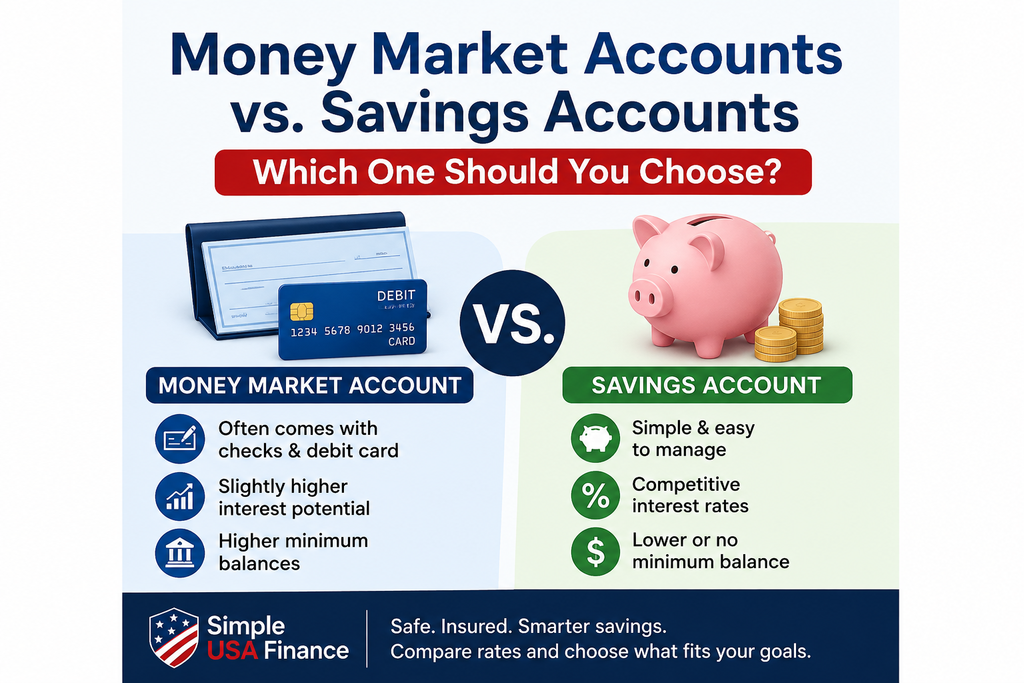
A savings account is the simplest deposit account a bank offers. You put money in, it earns interest, and you can withdraw it when needed. A money market account is also a deposit account, but it often adds check writing and a debit card while paying a slightly different rate. That single feature gap is most of what separates money market accounts vs. savings accounts on paper.
Neither account locks up your money the way a CD does. Both are meant for cash you may need soon, not long term investing. Framed side by side, money market accounts vs. savings accounts mostly comes down to how you plan to use the money.
Money Market Accounts vs. Savings Accounts: How They Compare
A savings account is built for simplicity. You open it online or in a branch, deposit money, and watch interest add up over time. Most savings accounts do not come with checks or a debit card, and some banks limit you to a handful of withdrawals per month.
A money market account works the same way at its core. It is still a deposit account, still FDIC insured, and still meant for savings you want to keep liquid. The difference is in the extras. Many money market accounts include check writing privileges and a linked debit card, which makes the money easier to reach without a transfer.
At their core, money market accounts vs. savings accounts solve the same problem. They both give you a safe, interest paying place to hold cash you are not ready to spend.
Money Market Accounts vs. Savings Accounts: Where the Rates Differ Right Now
Rates are where people notice the real gap. According to Bankrate’s national survey, the national average money market account rate sits at about 0.45% APY as of August 2026, while the national average savings account rate is close to 0.41% APY. That is the core rate story behind money market accounts vs. savings accounts today.
Those averages include big banks that pay almost nothing. Online banks tell a different story. Competitive online money market accounts currently pay up to 4.00% APY, and top high-yield savings accounts pay in a similar 4.10% to 4.75% APY range, based on current listings from Bankrate.
Money Market Accounts vs. Savings Accounts: Rate Comparison Table
| Account Type | National Average APY | Top Online Rate |
|---|---|---|
| Savings account | 0.41% | 4.10% to 4.75% |
| Money market account | 0.45% | Up to 4.00% |
The Federal Reserve held its benchmark rate at 3.50% to 3.75% at its July 2026 meeting, and deposit rates at both account types tend to move with that benchmark over time. That rate link is exactly why the gap in money market accounts vs. savings accounts tends to narrow or widen as the Fed adjusts policy.
Money Market Accounts vs. Savings Accounts: Fees, Minimums, and Access
Money market accounts typically ask for a higher minimum balance than savings accounts, sometimes $1,000 or more, to avoid a monthly fee. Fall below that line and the bank may charge you $10 to $15 a month, which can erase a rate advantage fast. This is one of the clearest practical differences in money market accounts vs. savings accounts.
Savings accounts, especially the online high-yield kind, often have no minimum balance and no monthly fee at all. That makes a savings account the simpler pick if you are just starting to build an emergency fund and do not want to think about balance rules.
Access is another point of separation. A money market account’s checks and debit card give you a way to spend directly from savings, while a standard savings account usually requires a transfer to your checking account first. On the fee and access front, money market accounts vs. savings accounts usually comes down to whichever account matches how often you need to touch the money.
Money Market Accounts vs. Savings Accounts: Which Is Safer?
Both account types carry the same federal protection. The FDIC insures deposits at member banks up to $250,000 per depositor, per bank, per ownership category, and that limit applies equally to both account types. If your bank is a credit union instead, the NCUA provides the same $250,000 protection on deposit accounts.
Neither product exposes your principal to market risk the way a stock or bond fund does. The only real risk with either account is inflation slowly outpacing your rate, which is why shopping for the higher yield matters regardless of which product you pick. On safety alone, money market accounts vs. savings accounts is close to a tie, since both rely on the same federal backstop.
Money Market Accounts vs. Savings Accounts: When to Choose One
A money market account tends to make more sense if you want checkwriting access to a larger cash cushion, such as a house down payment fund or a business reserve, and you can comfortably meet the minimum balance. It also suits people who like having one account that blends savings features with limited spending access.
A savings account is usually the better fit for a starter emergency fund, a sinking fund for a specific goal, or any cash you want to grow without worrying about balance minimums or fees. When you frame the choice as money market accounts vs. savings accounts, your goal and your comfort with minimum balances should drive the answer more than the rate alone.
Money Market Accounts vs. Savings Accounts: A Real Numbers Example
Say you have $10,000 to deposit today. At a 4.00% APY money market account, that balance earns roughly $400 in the first year, assuming the rate holds and interest compounds monthly. At a 4.50% APY high-yield savings account, the same $10,000 earns closer to $460 over the same period.
Move that same $10,000 into an account paying the national average of 0.41% to 0.45% APY, and you would earn somewhere between $41 and $45 for the entire year. The gap between a top online rate and a big bank average is the real lesson in money market accounts vs. savings accounts, not the small difference between the two product types themselves.
You can run your own money market accounts vs. savings accounts numbers with our Savings Growth Calculator to see what your specific balance and rate would earn over one, three, or five years.
Bottom Line
When you weigh money market accounts vs. savings accounts, the account type matters far less than the actual rate and fee structure you are offered. Compare current APYs, check the minimum balance, and confirm FDIC or NCUA coverage before you decide, since either account can be the right home for your cash depending on those details.
This is for informational purposes only and isn’t financial, tax, or legal advice.

Raghu Shekar writes about personal finance, banking, Medicare, and retirement planning at SimpleUSAFinance. His goal is simple: break down the numbers people actually need — no jargon, no sales pitch — so readers can make their own decisions with confidence. When he’s not writing, he’s usually digging through the latest rate changes, tax brackets, or Medicare updates to keep the site’s calculators and guides current.