If you’ve ever left a job early and wondered whether you’d keep the employer contributions to your retirement account, the answer usually comes down to your pension vesting schedule. A pension vesting schedule determines how much of your employer’s contribution you’re legally entitled to keep, based on how long you’ve worked there. This guide explains exactly how a pension vesting schedule works, the common types, and what happens if you leave before you’re fully vested.
What “Vesting” Actually Means
Vesting is the process of earning full ownership of employer-contributed retirement funds over time. Your own contributions are always 100% yours immediately; a pension vesting schedule only applies to money your employer put in on your behalf. Until you’re fully vested, leaving your job early means forfeiting some or all of that employer-contributed portion.
Why Employers Use Vesting Schedules
- Encourages employee retention over several years.
- Reduces employer cost from short-tenure departures.
- Standard practice across most pension and 401(k) matching plans.
The Two Common Types of Vesting Schedules
Most employers structure their pension vesting schedule using one of two models, and knowing which one applies to you changes how much risk you’re carrying if you’re considering a job change.
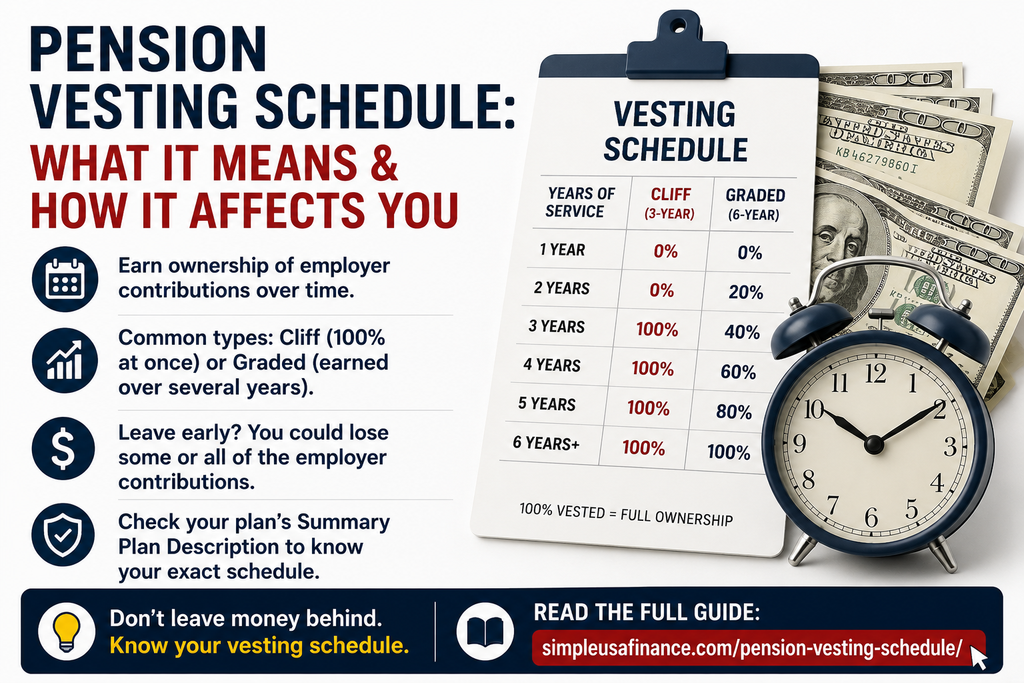
Cliff vesting: you own 0% of employer contributions until a specific date, then jump to 100% all at once, often after 3 years.
Graded vesting: you gain ownership gradually, often 20% per year starting in year 2, reaching 100% by year 6.
| Vesting Type | Year 1 | Year 3 | Year 5 | Year 6 |
|---|---|---|---|---|
| Cliff (3-year) | 0% | 100% | 100% | 100% |
| Graded (6-year) | 0% | 40% | 80% | 100% |
How a Vesting Schedule Affects Leaving a Job Early
This is where a pension vesting schedule actually costs people real money. If you’re on a 3-year cliff schedule and leave at year 2 years and 11 months, you forfeit 100% of the employer contributions, even though you were one month away from full ownership. Under a graded pension vesting schedule, you’d at least keep whatever percentage you’d already earned by that point.
Checking Your Own Vesting Schedule
Your plan’s Summary Plan Description (SPD) document will spell out your exact pension vesting schedule, including the vesting type, the timeline, and how partial years of service are counted. If you don’t have this document, your HR or benefits department is required to provide it on request.
Common Mistakes People Make
A common mistake is assuming all retirement contributions vest the same way; your own contributions are always fully yours, so people sometimes overestimate what they’d lose by confusing the two. Another mistake is timing a resignation without checking the pension vesting schedule first, walking away from tens of thousands of dollars over a matter of weeks. People also assume vesting schedules are identical across employers, when in reality the timeline, type, and even how partial years count can vary significantly plan to plan.
What Happens to Forfeited Funds
Money forfeited due to an incomplete pension vesting schedule doesn’t disappear, it typically goes back into the employer’s plan and may be used to offset future employer contributions or administrative costs, depending on plan rules. It is not returned to the departing employee under any circumstance once forfeited.
Planning Around Your Vesting Timeline
If you know you’re approaching a vesting milestone under your pension vesting schedule, it’s often worth staying those extra weeks or months if a job change isn’t urgent, since the dollar value of unvested employer contributions can be significant relative to a short delay in starting a new role. If you’re weighing whether staying makes financial sense, run your own numbers with our Pension: Lump-Sum vs Annuity Calculator to see how vested employer contributions could affect your long-term retirement numbers.
According to the Department of Labor’s guidance on retirement plan vesting, employers offering a pension vesting schedule must follow minimum vesting standards set under federal law, meaning your specific schedule can’t be worse than the legal floor even if it varies from employer to employer.
Frequently Asked Questions
Is my own contribution to a 401(k) subject to a pension vesting schedule?
No, only employer contributions are subject to vesting, your own contributions are always 100% yours from day one.
How do I find out my exact vesting schedule?
Check your plan’s Summary Plan Description, or ask your HR or benefits department directly for your specific pension vesting schedule.
Can an employer change my pension vesting schedule after I’m hired?
Generally not retroactively for service already completed, though plans can be amended for future service under certain legal limits.
Bottom Line
A pension vesting schedule decides how much of your employer’s retirement contribution you actually get to keep if you leave your job, and the difference between forfeiting everything and keeping it all can come down to a matter of weeks. Always check your Summary Plan Description before making a job change decision near a vesting milestone.
This is for informational purposes only and isn’t financial, tax, or legal advice.

Raghu Shekar writes about personal finance, banking, Medicare, and retirement planning at SimpleUSAFinance. His goal is simple: break down the numbers people actually need — no jargon, no sales pitch — so readers can make their own decisions with confidence. When he’s not writing, he’s usually digging through the latest rate changes, tax brackets, or Medicare updates to keep the site’s calculators and guides current.