If you freelance, work commission-based sales, or pick up seasonal shifts, you already know that trying to budget when your income isn’t steady breaks most standard budgeting advice. Most budgeting tools assume a fixed monthly paycheck, which simply doesn’t match how irregular income actually works. This guide walks through a practical system to budget when your income isn’t steady, without pretending your income will behave like a 9-to-5 salary.
Why Traditional Budgeting Fails With Irregular Income
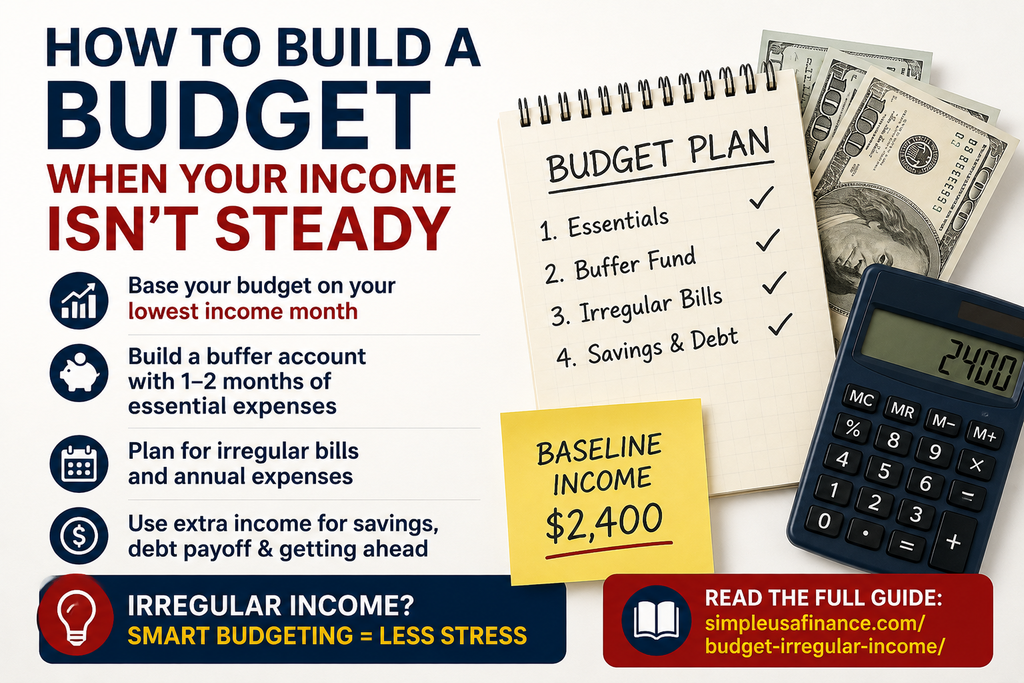
Standard budgeting methods assign a fixed dollar amount to each spending category every month. That works fine with a steady paycheck, but if you’re trying to budget when your income isn’t steady, a fixed category amount can leave you short in a slow month and sitting on unused cash in a good one. The fix isn’t a different app, it’s a different starting point: base your budget on your lowest realistic income month, not your average.
Finding Your Baseline Income
- Pull your last 6-12 months of income.
- Identify your lowest single month.
- Use that number, not your average, as your baseline for fixed expenses.
Building the Budget Around Your Baseline
Once you know how to budget when your income isn’t steady using a baseline month, the structure becomes simpler. Cover only true essentials (rent, utilities, groceries, minimum debt payments) with that baseline figure. Everything else, savings, discretionary spending, extra debt payoff, gets funded only in months where income exceeds the baseline.
Example: Say your last 12 months of income ranged from $2,400 to $5,100. Your baseline budget covers $2,400 worth of essentials every month, guaranteed. In a $4,800 month, the extra $2,400 goes toward savings, irregular bills, or getting ahead on debt.
| Month Type | Income | Baseline Covered | Extra Allocated |
|---|---|---|---|
| Low month | $2,400 | $2,400 (100%) | $0 |
| Average month | $3,600 | $2,400 | $1,200 to savings/debt |
| High month | $5,100 | $2,400 | $2,700 to savings/debt |
The Buffer Account: Your Most Important Tool
The single most useful tool to budget when your income isn’t steady is a buffer account, a separate account holding one to two months of your baseline expenses. In a slow month, you pull from the buffer instead of scrambling or relying on credit. In a strong month, you top the buffer back up before allocating anything else.
Handling Irregular Bills and Annual Expenses
Irregular income earners often forget to plan for irregular expenses too, car registration, annual subscriptions, insurance premiums, quarterly tax payments if self-employed. Divide each irregular expense by 12 and set that amount aside monthly in a separate sinking fund, so these bills stop feeling like surprises on top of an already unpredictable income.
Common Mistakes People Make
A common mistake when trying to budget when your income isn’t steady is using your average income as the baseline instead of your lowest month, which sets up a budget that fails the moment a slow month arrives. Another mistake is treating every high-income month as spending money rather than funneling the surplus into the buffer account first. People also frequently skip setting aside money for quarterly taxes if self-employed, which turns a manageable tax bill into a painful one, and can even lead to the situation where you can’t pay your tax bill in full by the deadline.
Adjusting the System Over Time
As you build a track record, revisit your baseline every 6 months. If your lowest month has genuinely trended upward, it’s reasonable to raise your baseline slightly, but always err conservatively rather than assuming your best months are now the norm.
Frequently Asked Questions
How do you budget when your income isn’t steady and you have debt?
Cover minimum payments within your baseline budget, and direct any income above baseline toward extra debt payoff before discretionary spending.
What’s the fastest way to start if I’ve never tracked irregular income before?
Pull whatever bank statements or invoices you have for the last 3-6 months minimum, identify the lowest month, and start your baseline there even if the data set is imperfect.
Do I need a different budgeting app to budget when my income isn’t steady?
No, most budgeting apps can work with this system since the core change is which number you assign as your monthly baseline, not the tool itself.
Bottom Line
Learning to budget when your income isn’t steady comes down to one shift: build your essential spending around your lowest realistic month, not your average, and let a buffer account absorb the gap in between. Once that foundation is in place, irregular income becomes far less stressful to manage month to month.
Run your own numbers with our Emergency Fund Calculator to figure out exactly how big your buffer account should be based on your own baseline and expenses.
This is for informational purposes only and isn’t financial, tax, or legal advice.

Raghu Shekar writes about personal finance, banking, Medicare, and retirement planning at SimpleUSAFinance. His goal is simple: break down the numbers people actually need — no jargon, no sales pitch — so readers can make their own decisions with confidence. When he’s not writing, he’s usually digging through the latest rate changes, tax brackets, or Medicare updates to keep the site’s calculators and guides current.