Social Security taxation catches a lot of retirees off guard, since many assume a benefit they paid into for decades arrives completely tax free. It does not always work that way. Whether Social Security taxation applies to you, and how much of your benefit ends up taxable, depends on a specific income formula rather than your benefit amount alone. Here is exactly how Social Security taxation works, the thresholds that trigger it, and a new deduction that can reduce or erase it for many retirees.
What Triggers Social Security Taxation
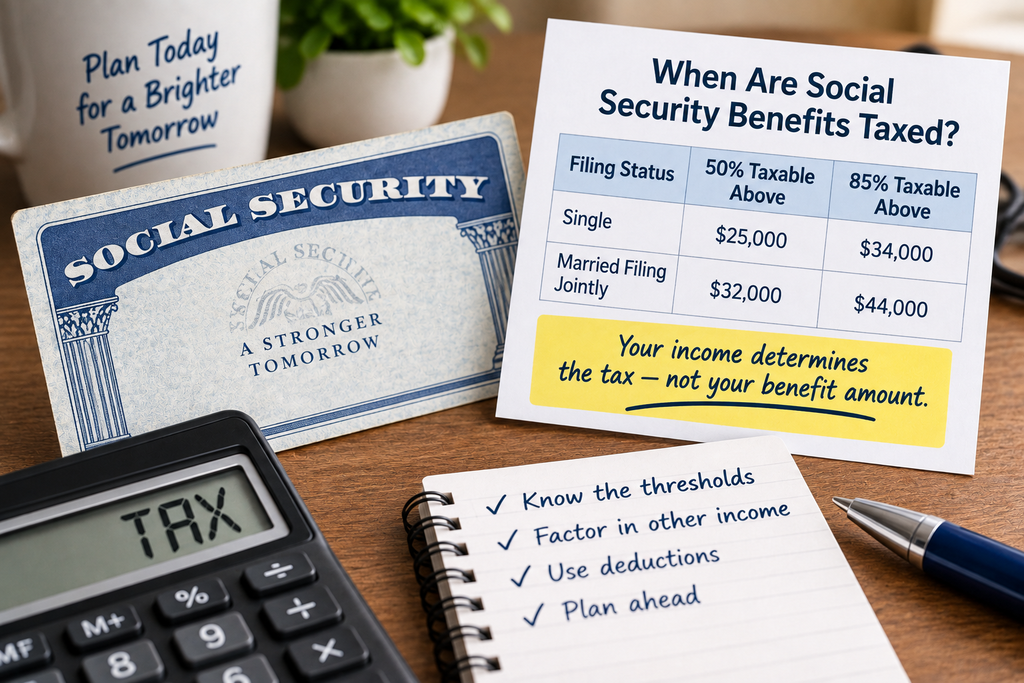
Social Security taxation is not based on how much you receive in benefits. It is based on a separate number called provisional income, sometimes called combined income, calculated as one half of your Social Security benefits plus all your other taxable income plus any tax exempt interest.
If that total stays below a base amount for your filing status, Social Security taxation does not apply at all and none of your benefit is taxed. Cross that base amount and a portion of your benefit becomes taxable, first at up to 50 percent, then at up to 85 percent once you cross a second, higher threshold.
The Exact Thresholds for 2026
For single filers, Social Security taxation begins once provisional income passes 25,000 dollars, with up to 50 percent of benefits taxable between 25,000 and 34,000 dollars, and up to 85 percent taxable above 34,000 dollars. For married couples filing jointly, those same thresholds sit at 32,000 dollars and 44,000 dollars. These numbers have not moved since the 1980s and 1990s, so more retirees run into Social Security taxation every year simply because benefits rise with cost of living adjustments while the thresholds stay frozen.
A Worked Numeric Example
Here is how Social Security taxation plays out for a single retiree with 20,000 dollars in annual Social Security benefits and 20,000 dollars in other income from a pension or retirement account withdrawal.
| Item | Amount |
|---|---|
| Half of Social Security benefits | 10,000 dollars |
| Other taxable income | 20,000 dollars |
| Provisional income | 30,000 dollars |
| Base threshold for Social Security taxation | 25,000 dollars |
| Amount over the threshold | 5,000 dollars |
| Taxable portion at 50 percent | 2,500 dollars becomes taxable |
In this example, Social Security taxation applies to 2,500 dollars of the benefit, not the full 20,000 dollars, since provisional income only cleared the first threshold rather than the second one at 34,000 dollars.
The New Senior Deduction Changes the Math
A new provision from the One Big Beautiful Bill Act, in effect for 2025 through 2028, adds a 6,000 dollar deduction for taxpayers age 65 and older, or 12,000 dollars for a married couple where both spouses are 65 or older. This deduction lowers your adjusted gross income, which in turn lowers your provisional income, which can push some retirees back under the Social Security taxation thresholds entirely.
The deduction starts phasing out above 75,000 dollars of income for single filers and 150,000 dollars for married couples, and it disappears completely at higher income levels. It does not eliminate Social Security taxation as a rule, and the underlying thresholds have not changed, but for retirees with modest other income it can meaningfully reduce or remove the taxable portion of their benefit.
This Deduction Is Not Permanent
Since the new senior deduction expires after 2028 under current law, retirees who benefit from it now should not assume the same relief from Social Security taxation will still be available a few years from now. Planning around a temporary provision works fine for this year’s return, but a long term retirement income plan should not lean on it staying in place.
State Level Rules Add Another Layer
Federal Social Security taxation is only part of the picture. A handful of states also tax Social Security benefits at the state level, though most of those states offer income based exemptions that shield many retirees from any additional bill. The rest of the states, the majority, do not tax Social Security benefits at all, so where you retire can matter almost as much as your income when it comes to your total tax exposure.
Before assuming your state follows the federal approach, check your specific state’s current rules, since a handful of states have phased out their own Social Security tax in recent years and the list of states that still apply it keeps shrinking.
Common Mistakes That Trigger a Surprise Bill
A few habits push retirees over the Social Security taxation thresholds without them realizing it until tax time. Taking a large one time withdrawal from a traditional retirement account in the same year you start benefits can spike provisional income well past the second threshold, even if your income looks modest every other year. Municipal bond interest feels tax free, but it still counts toward provisional income and can quietly trigger Social Security taxation even though the interest itself is exempt from regular income tax.
Failing to request voluntary withholding is another common trap. Social Security does not automatically withhold federal tax from your benefit unless you ask, using Form W4V, so retirees who owe tax but never elected withholding can face an unexpected balance due, or an underpayment penalty, when they file.
Ways to Reduce What Gets Taxed
A few planning moves can lower your provisional income and reduce Social Security taxation before you file. Converting traditional retirement account balances to a Roth account before claiming benefits removes future withdrawals from the provisional income calculation entirely, since Roth withdrawals do not count. Spreading taxable withdrawals across multiple years instead of taking one large distribution keeps your provisional income lower in any single year. Using health savings account funds for qualified medical expenses covers costs without adding to taxable income at all.
If you are still deciding when to claim, running the numbers through the Social Security Calculator on SimpleUSAFinance can show how different claiming ages and other income levels affect your provisional income and your exposure to Social Security taxation.
For the official worksheet and full rules, the IRS page on Social Security benefits walks through how the taxable portion is calculated on your return.
Bottom Line
Social Security taxation depends on your provisional income, not your benefit amount, and the thresholds that trigger it have stayed the same for decades even as benefits have grown. Know your number, watch the new senior deduction while it lasts, and plan withdrawals with those thresholds in mind.
This is for informational purposes only and isn’t financial, tax, or legal advice.

Raghu Shekar writes about personal finance, banking, Medicare, and retirement planning at SimpleUSAFinance. His goal is simple: break down the numbers people actually need — no jargon, no sales pitch — so readers can make their own decisions with confidence. When he’s not writing, he’s usually digging through the latest rate changes, tax brackets, or Medicare updates to keep the site’s calculators and guides current.