If you’re on Medicare, 2027 Medicare enrollment is the one window each fall where you can change your coverage without a special circumstance. It runs October 15 through December 7, 2026, and anything you pick during 2027 Medicare enrollment takes effect January 1, 2027. Some of next year’s numbers are already locked in. Others won’t be official until CMS makes its fall announcement.
Here’s what’s confirmed, what’s still a projection, and how to use this Medicare enrollment window well.
When Does 2027 Medicare Enrollment Start?
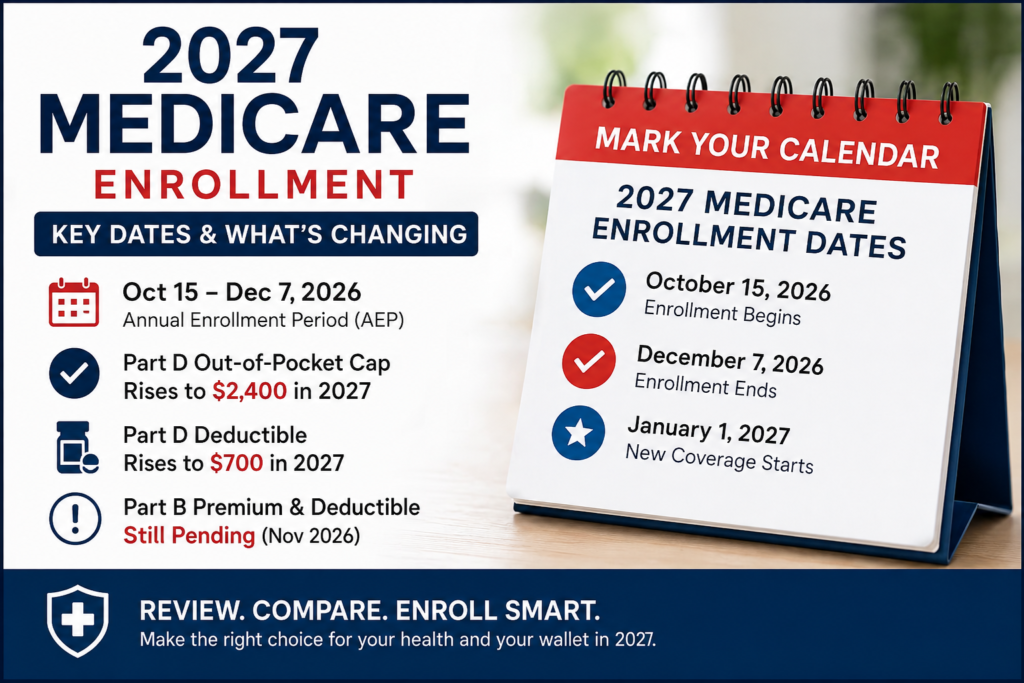
2027 Medicare enrollment opens October 15, 2026, and closes December 7, 2026. This seven-week stretch is officially called the Annual Enrollment Period, or AEP. It’s separate from the ACA Marketplace window, which runs November 1 through December 15, 2026, so don’t confuse the two if you’re also shopping ACA plans for a spouse or family member.
Mark your calendar for these three dates:
| Date | What Happens |
|---|---|
| October 15, 2026 | 2027 Medicare enrollment begins |
| December 7, 2026 | 2027 Medicare enrollment ends |
| January 1, 2027 | Your new coverage starts |
If you’re happy with your current plan, you don’t technically have to do anything during 2027 Medicare enrollment. But your plan’s Annual Notice of Change letter, mailed by the end of September, is worth a careful read before you decide to sit this one out, since plans commonly adjust premiums, drug formularies, and provider networks year to year.
Why the Annual Notice of Change Matters
Every year, plans are required to send this letter explaining exactly what’s changing for the upcoming year. During Medicare enrollment, this letter is your fastest way to spot a dropped provider, a formulary change on your specific medication, or a premium increase, without having to compare full plan documents from scratch.
What You Can Change During 2027 Medicare Enrollment
2027 Medicare enrollment lets you make several kinds of moves, depending on where you’re starting from:
- Switch from Original Medicare to a Medicare Advantage plan
- Move from Medicare Advantage back to Original Medicare
- Change from one Medicare Advantage plan to another
- Switch, join, or drop a Part D prescription drug plan
Whatever you choose during this year’s 2027 Medicare enrollment window becomes effective on January 1. Miss the December 7 cutoff and you’re generally locked into your current plan until the next cycle, aside from a few exceptions like moving or losing other coverage.
2027 Medicare Enrollment: What’s Already Confirmed
Not everything tied to 2027 Medicare enrollment is a guess. A handful of figures are set by rule, not by CMS’s fall calculation, so they’re already final.
Part D Costs Confirmed for 2027 Medicare Enrollment
Two Part D numbers for 2027 Medicare enrollment are locked in under federal rule:
- Part D out-of-pocket cap: rising to $2,400, up from $2,100 in 2026
- Part D standard deductible: rising to $700, up from $615 in 2026
This is the second full year of the $2,000-and-up out-of-pocket cap created by the Inflation Reduction Act, and it’s the single biggest protection anyone weighing 2027 Medicare enrollment options has for expensive brand-name drugs. Once you hit the cap, Part D covers the rest of your prescription costs for the year.
What’s Still a Projection for 2027 Medicare Enrollment
The Part B premium, the Part B deductible, and the Part A hospital deductible are not yet official heading into 2027 Medicare enrollment. CMS typically confirms these numbers in a November press release, just weeks before the December 7 deadline.
Based on the 2026 Medicare Trustees Report, published in June 2026, here’s where early projections stand ahead of 2027 Medicare enrollment:
- Part B premium: roughly $209.50/month, up from $202.90 in 2026 (projected, not confirmed)
- Part B deductible: roughly $310, up from $283 in 2026 (projected, not confirmed)
- Part A hospital deductible: likely in the $1,780 to $1,810 range, up from $1,736 in 2026 (projected, not confirmed)
Treat these as a budgeting floor rather than a locked number. Trustees Report projections have landed below the eventual CMS figure in past years, so it’s reasonable to pad your estimate by a few dollars a month until the official 2027 Medicare enrollment numbers are announced.
Medicare Advantage Changes and Your 2027 Enrollment Decision
Rising healthcare and drug costs mean some Medicare Advantage carriers may pull back heading into 2027 Medicare enrollment. Watch for insurers:
- Exiting counties or markets that aren’t financially sustainable for them
- Trimming provider networks
- Scaling back extras like dental coverage or gym reimbursements on $0-premium plans
None of this means Medicare Advantage is going away. It means the plan that worked for you in 2026 is worth re-checking during 2027 Medicare enrollment before you carry it into next year without a second look.
A 2027 Medicare Enrollment Example: How the Part D Cap Helps
Say you take a brand-name specialty drug that costs $1,200 a month. In 2026, you’d pay toward that cost until you hit the $2,100 out-of-pocket cap, likely by February. Under the 2027 rules confirmed for this year’s 2027 Medicare enrollment, that cap rises to $2,400, meaning you’d cross it slightly later in the year, but every dollar after that point is still fully covered by your plan for the rest of the year.
For anyone comparing Part D plans during 2027 enrollment, this cap matters more than the sticker-price premium. A plan with a slightly higher monthly cost but better formulary placement for your specific drug can still save you money over the full year.
If you want to see how your Medicare costs fit into your broader retirement budget, run the numbers through our Retirement Corpus Calculator before you lock in a 2027 plan.
Missed the 2027 Medicare Enrollment Deadline? What Happens Next
If December 7 passes and you didn’t make a change during Medicare enrollment, you’ll generally keep your current coverage through 2027. There’s one more chance for a subset of beneficiaries: the Medicare Advantage Open Enrollment Period, running January 1 through March 31, 2027, open only to people already enrolled in a Medicare Advantage plan who want to switch plans or return to Original Medicare.
Outside of these windows, you’d need a valid Special Enrollment Period, triggered by things like moving out of your plan’s service area or losing employer coverage, to make changes outside 2027 Medicare enrollment.
Bottom Line
2027 Medicare enrollment runs October 15 to December 7, 2026, and this year’s biggest confirmed change is the higher Part D out-of-pocket cap and deductible, while Part B and Part A figures stay projections until CMS’s November announcement. Reviewing your Annual Notice of Change letter and checking your prescription formulary before the 2027 Medicare enrollment deadline is the simplest way to avoid an unwelcome surprise in January.
This is for informational purposes only and isn’t financial, tax, or legal advice.

Raghu Shekar writes about personal finance, banking, Medicare, and retirement planning at SimpleUSAFinance. His goal is simple: break down the numbers people actually need — no jargon, no sales pitch — so readers can make their own decisions with confidence. When he’s not writing, he’s usually digging through the latest rate changes, tax brackets, or Medicare updates to keep the site’s calculators and guides current.