If you follow Home Depot stock, today’s second-quarter fiscal 2026 report gave you a lot to unpack. The company posted higher sales, higher earnings per share, and reaffirmed its full-year outlook, all while traffic in stores actually slipped. That mix matters if you own HD shares, hold it in a retirement account, or are simply trying to read the health of the housing and home-improvement market through Home Depot stock.
Below is a plain-English walk-through of the numbers, what drove them, and what to watch next.
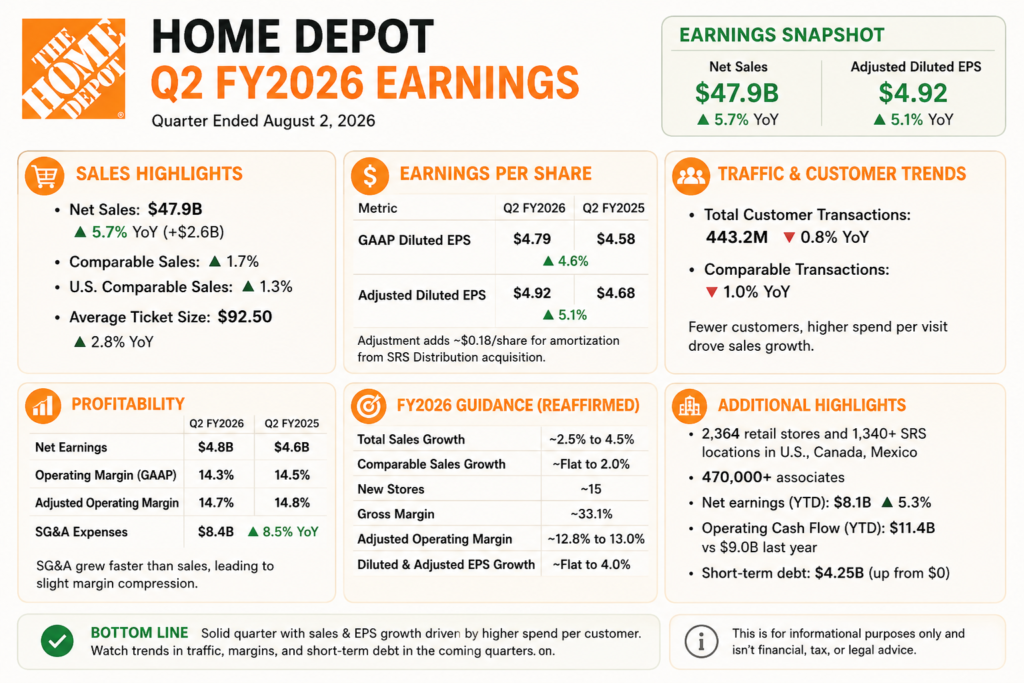
Home Depot Stock Earnings Snapshot for the Second Quarter
For the quarter ended August 2, 2026, Home Depot stock earnings came in stronger than the same period last year on almost every headline measure. Net sales reached $47.9 billion, up 5.7% year over year, an increase of $2.6 billion. Comparable sales rose 1.7%, with U.S. comparable sales up 1.3%.
Net earnings were $4.8 billion, up from $4.6 billion a year ago. That pushed diluted earnings per share to $4.79, compared with $4.58 in the second quarter of fiscal 2025. On an adjusted basis, diluted EPS was $4.92 versus $4.68 a year earlier. Anyone tracking Home Depot stock closely will recognize that both the GAAP and adjusted figures moved in the same direction, which is generally a healthier signal than one metric being propped up by accounting adjustments alone.
Why Home Depot Stock Climbed on Strong Sales Growth
The sales growth behind Home Depot stock this quarter came from a mix of factors. Management pointed to broad-based demand across the business, with customers continuing to take on smaller home projects rather than large renovations. That’s consistent with a housing market where existing-home sales have been sluggish, pushing homeowners toward maintenance and upgrades instead of buying new.
Average ticket size rose 2.8% to $92.50, which tells you customers spent more per visit even though fewer of them showed up. For a retailer the size of Home Depot, that’s a meaningful trend for anyone reading Home Depot stock earnings as a proxy for consumer spending habits in 2026.
Home Depot Stock Earnings Per Share: The Real Numbers
Breaking down Home Depot stock earnings per share a bit further: basic EPS was $4.79 on net earnings of $4.8 billion, up 4.4% from $4.59 a year ago. Diluted EPS, which accounts for potential share dilution, grew 4.6% to $4.79 from $4.58.
GAAP vs Adjusted Earnings for Home Depot Stock Explained
You’ll often see two EPS numbers reported for Home Depot stock, and it’s worth knowing the difference. GAAP EPS follows standard accounting rules exactly. Adjusted EPS strips out the effect of amortization tied to acquired intangible assets, mainly from the SRS Distribution acquisition. That adjustment added roughly $0.18 per share this quarter, bringing adjusted diluted EPS to $4.92, up 5.1% from $4.68 a year ago. Neither number is “wrong,” they just answer slightly different questions: one is the strict accounting result, the other strips out a specific non-cash cost so you can compare underlying operating performance year over year.
What Home Depot Stock Earnings Reveal About Store Traffic
Here’s the part that deserves attention if you’re evaluating Home Depot stock for the longer term. Total customer transactions fell 0.8% to 443.2 million, and comparable customer transactions declined 1.0%. In plain terms, fewer people walked through the doors this quarter than last year.
Sales still grew because each visit generated more revenue, not because more shoppers came in. That’s a pattern worth watching. It can reflect price increases, a shift toward bigger-ticket items, or professional contractors buying more per trip. It can also mean a company is relying on existing customers spending more rather than winning new ones. For Home Depot stock, this quarter leaned on the “spend more per visit” side of that equation.
On the cost side, selling, general and administrative expenses rose 8.5% to $8.4 billion, actually growing faster than the 5.7% sales increase. That’s part of why GAAP operating margin slipped slightly to 14.3% from 14.5%, and adjusted operating margin eased to 14.7% from 14.8%. Small margin compression alongside sales growth is a detail long-term holders of Home Depot stock should keep in view.
Home Depot Stock Guidance for the Rest of Fiscal 2026
The company reaffirmed its full fiscal 2026 guidance, which matters for anyone modeling Home Depot stock performance through the rest of the year. Management still expects:
| Metric | Fiscal 2026 Guidance |
|---|---|
| Total sales growth | ~2.5% to 4.5% |
| Comparable sales growth | ~Flat to 2.0% |
| New stores | ~15 |
| Gross margin | ~33.1% |
| Adjusted operating margin | ~12.8% to 13.0% |
| Diluted and adjusted EPS growth | ~Flat to 4.0% vs fiscal 2025 |
For the first six months of fiscal 2026, net sales rose 5.3% to $89.6 billion, and net earnings reached $8.1 billion. Operating cash flow for the six-month period jumped to $11.4 billion from $9.0 billion a year earlier, a strong sign of cash generation that supports both dividends and continued buybacks.
Is Home Depot Stock a Safe Bet After This Earnings Report
No single quarter answers that question on its own, but the data gives a fuller picture. Home Depot ended the quarter with 2,364 retail stores and more than 1,340 SRS locations across the U.S., Canada, and Mexico, backed by over 470,000 associates. Short-term debt did rise to $4.25 billion from essentially zero a year earlier, which is worth noting if you’re weighing balance sheet risk alongside Home Depot stock returns.
For long-term investors, this quarter shows a company still growing sales and earnings, still generating strong operating cash flow, and still guiding toward modest growth for the year, even with softer foot traffic. If you’re holding Home Depot shares inside a retirement account and want to see how dividend-paying stocks like this affect your long-term number, you can run your own projections with our Retirement Corpus Calculator.
Bottom Line
Q2 fiscal 2026 shows Home Depot stock earnings growing on higher spend per customer rather than more customers, with margins slightly thinner and guidance unchanged. It’s a solid quarter, not a spectacular one, and the details around traffic and short-term debt are worth watching into the back half of the year.
Please check our latest financial articles
This is for informational purposes only and isn’t financial, tax, or legal advice.

Raghu Shekar writes about personal finance, banking, Medicare, and retirement planning at SimpleUSAFinance. His goal is simple: break down the numbers people actually need — no jargon, no sales pitch — so readers can make their own decisions with confidence. When he’s not writing, he’s usually digging through the latest rate changes, tax brackets, or Medicare updates to keep the site’s calculators and guides current.