Social Security at 62 vs 67 vs 70 is the single biggest decision in most retirement plans, and it is also permanent. Once you lock in a claiming age, you cannot go back and choose a different one for that benefit. Claiming at 62 gives you money sooner but permanently reduces your monthly check. Claiming at 70 gives you the largest possible monthly check but means years without benefits. Claiming at 67, your full retirement age if you were born in 1960 or later, sits in the middle with no reduction and no bonus. This guide walks through Social Security at 62 vs 67 vs 70 with real numbers, so you can see the actual dollar tradeoff instead of just the age.
Social Security at 62 vs 67 vs 70: The Quick Answer
The short version comes down to one number, your full retirement age. Claim before it and your benefit is permanently reduced. Claim at it and you get your full Primary Insurance Amount. Claim after it, up to age 70, and you get a permanent bonus.
For anyone born in 1960 or later, full retirement age is 67. That is the reference point every other age in the 62 vs 67 vs 70 decision is measured against.
Claiming Social Security at 62: What You Give Up
Claiming at 62 is the earliest age allowed, and it comes with the steepest cost. Your monthly benefit is reduced by about 30 percent compared with your full retirement age amount, and that reduction is permanent for as long as you collect.
If you claim at 62 and keep working, you also run into the Social Security earnings test. In 2026, the SSA withholds $1 in benefits for every $2 you earn above $24,480 until you reach full retirement age. Those withheld amounts are not lost forever, they get recalculated back into your benefit once you hit full retirement age, but the cash-flow hit surprises a lot of early claimers. That tradeoff is the core of the 62 vs 67 vs 70 decision for anyone who plans to keep working past 62.
Claiming Social Security at 67: Your Full Retirement Age
Claiming at 67 gets you 100 percent of your Primary Insurance Amount, the number Social Security calculates from your 35 highest-earning years. There is no reduction and no bonus at this age.
Full retirement age is also the point where the earnings test disappears entirely. Once you are 67 or older for the whole year, you can earn any amount and keep every dollar of your Social Security check. That single change is a real factor in the 62 vs 67 vs 70 comparison for anyone still working part-time.
Claiming Social Security at 70: The Maximum Payout
Claiming at 70 gets you the largest possible monthly check. Between full retirement age and 70, your benefit grows by about 8 percent a year through delayed retirement credits, adding up to a 24 percent increase over your full retirement age amount.
Benefits stop growing once you turn 70, so there is no reason to wait past that birthday. In the 62 vs 67 vs 70 lineup, 70 is the ceiling, not a moving target.
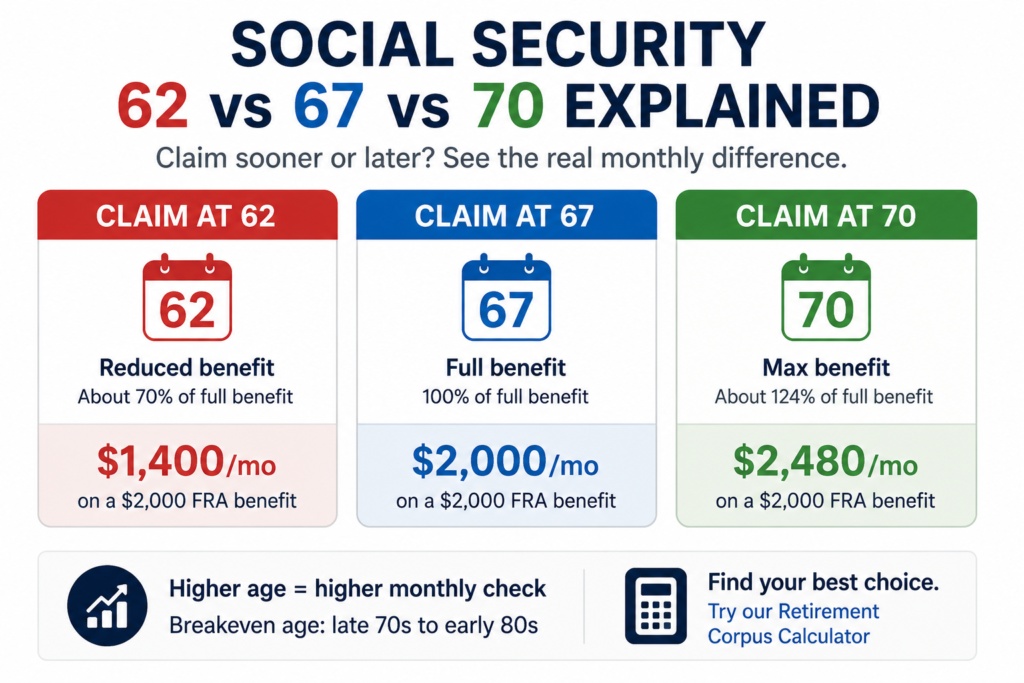
Social Security at 62 vs 67 vs 70 on a Real $2,000 Benefit
Numbers make this easier to compare than percentages alone. Here is what a $2,000 full retirement age benefit looks like at each claiming age.
| Claiming Age | Percent of Full Benefit | Monthly Amount (on a $2,000 FRA benefit) |
|---|---|---|
| 62 | 70% | $1,400 |
| 67 (FRA) | 100% | $2,000 |
| 70 | 124% | $2,480 |
The gap between the earliest and latest claiming age is $1,080 a month, or nearly $13,000 a year, and that gap is permanent for as long as you collect. That is the real dollar weight behind the 62 vs 67 vs 70 decision.
The Earnings Test: Why Social Security at 62 vs 67 vs 70 Matters More If You’re Still Working
If you plan to keep working, this decision changes shape. Claiming early while still earning a full-time income can mean a large share of your benefit gets withheld under the earnings test.
For 2026, the limit is $24,480 a year before full retirement age, and $65,160 a year in the calendar year you reach full retirement age, with a more generous $1-for-$3 withholding rate during that final year. If you are done working entirely, the earnings test does not apply and the decision comes down purely to longevity and cash flow needs.
Social Security at 62 vs 67 vs 70: Which Age Is Right for You
There is no single right answer here. It depends on your health, your other retirement income, and whether you expect to live a long time past your claiming age.
Claiming at 62 makes sense if you need the income now, have health concerns that shorten your expected timeline, or have other savings that make a smaller guaranteed check less risky. Claiming at 70 makes sense if you are healthy, can cover expenses from savings in the meantime, and want to maximize a guaranteed income stream that also grows with inflation every year. See how each scenario fits your broader plan with our Retirement Corpus Calculator before you lock in an age.
Breakeven Age: How Why Social Security at 62 vs 67 vs 70 Plays Out Over a Lifetime
The breakeven age is the point where total lifetime benefits from waiting catch up to and pass total lifetime benefits from claiming early. For most people comparing these three ages, that breakeven age lands somewhere in the late 70s or early 80s.
If you expect to live past your personal breakeven age, waiting pays off in total dollars, not just monthly dollars. If you expect a shorter retirement, claiming earlier can produce more total income even at a lower monthly amount.
Bottom Line: Social Security at 62 vs 67 vs 70 comes down to a permanent tradeoff between claiming sooner and claiming bigger. On a $2,000 full retirement age benefit, that is $1,400 a month at 62, $2,000 at 67, and $2,480 at 70, and the average retired worker collected about $2,071 a month in 2026 according to the SSA. Run your own numbers against your health, your savings, and how long you expect to need this income before you lock in an age.
This is for informational purposes only and isn’t financial, tax, or legal advice.

Raghu Shekar writes about personal finance, banking, Medicare, and retirement planning at SimpleUSAFinance. His goal is simple: break down the numbers people actually need — no jargon, no sales pitch — so readers can make their own decisions with confidence. When he’s not writing, he’s usually digging through the latest rate changes, tax brackets, or Medicare updates to keep the site’s calculators and guides current.