The 50/30/20 budget rule is one of the simplest ways to organize a paycheck: 50 percent to needs, 30 percent to wants, and 20 percent to savings and debt. It does not require an app, a spreadsheet formula, or tracking every coffee purchase, just three buckets and a calculator. This guide walks through the 50/30/20 budget rule with real dollar amounts on two different paychecks, so you can see exactly what it looks like instead of just the percentages.
The 50/30/20 Budget Rule: What Each Number Means
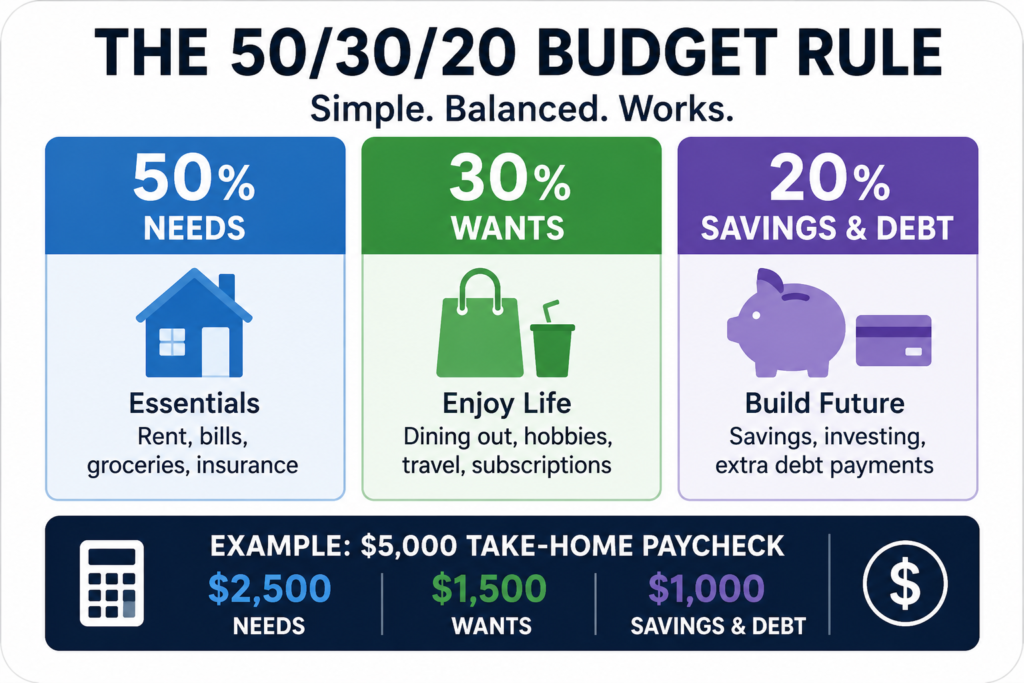
The 50/30/20 budget rule splits your after-tax income into three buckets. Fifty percent goes to needs, the bills you cannot skip. Thirty percent goes to wants, the spending that makes life enjoyable but is not required. Twenty percent goes to savings and debt payoff beyond the minimum.
The math is deliberately simple. You take your monthly take-home pay, multiply by each percentage, and that is your spending limit for that bucket for the month.
Needs: The 50 in the 50/30/20 Budget Rule
Needs are the expenses you would still pay even if your income dropped tomorrow. Rent or mortgage, utilities, groceries, minimum debt payments, insurance, and transportation to work all count as needs.
If your needs are eating up more than 50 percent of your paycheck, that is telling you something useful, either your fixed costs are too high for your income, or your income needs to grow. Neither is a personal failure, but it is worth noticing.
Wants: The 30 in the 50/30/20 Budget Rule
Wants are everything that makes life more comfortable but is not strictly necessary. Dining out, streaming subscriptions, hobbies, travel, and upgrading from a basic to a nicer version of something you need all fall into the wants bucket.
This is usually the easiest category to cut when money is tight, and the first place people look when the 50/30/20 rule shows they are overspending somewhere.
Savings and Debt: The 20 in the 50/30/20 Budget Rule
The last 20 percent covers savings, investing, and any debt payments above the minimum. This is the bucket that builds your emergency fund, grows your retirement accounts, and pays down credit cards or student loans faster than required.
If you are carrying high-interest debt, most of the 20 percent should go toward paying that down before it goes toward investing. The 50/30/20 rule does not tell you the order to prioritize within that 20 percent, just the total amount to set aside.
The 50/30/20 Budget Rule on a Real $5,000 Paycheck
Numbers make the 50/30/20 budget rule easier to picture than percentages alone. Here is what it looks like on a $5,000 monthly take-home paycheck.
| Bucket | Percent | Dollar Amount |
|---|---|---|
| Needs | 50% | $2,500 |
| Wants | 30% | $1,500 |
| Savings and debt | 20% | $1,000 |
On this paycheck, the 50/30/20 budget rule allocates $2,500 to rent, groceries, utilities, and other fixed costs, $1,500 to discretionary spending, and $1,000 a month toward savings and extra debt payments. Over a year, that 20 percent bucket alone adds up to $12,000.
Where the 50/30/20 Rule Breaks Down (and How to Adjust It)
The 50/30/20 budget rule assumes your needs actually fit inside 50 percent of your income, and in many high-cost cities, they do not. Rent alone can eat 40 or 50 percent of a paycheck before groceries or utilities are even counted.
When that happens, the rule still works as a framework, you just adjust the ratios. A 60/20/20 or even 65/15/20 split can be more realistic during a high-cost season, as long as you protect that last number for savings and debt.
Using the 50/30/20 Budget Rule on a Tighter $3,000 Paycheck
On a $3,000 monthly take-home paycheck, the standard 50/30/20 budget rule works out to $1,500 for needs, $900 for wants, and $600 for savings and debt.
If $1,500 does not cover your actual needs, that is the sign to shift the ratio rather than abandon the rule entirely. Even a smaller savings percentage, kept consistent every month, beats no plan at all.
Is the 50/30/20 Budget Rule Right for You?
The 50/30/20 budget rule works best as a starting point, not a rigid law. It gives you three simple buckets to check your spending against, rather than a category for every type of purchase like some budgeting methods require.
If you want something simpler to maintain long term, it is hard to beat. If you want tighter control over specific categories, like exactly how much you spend on groceries versus dining out, a more detailed budget might serve you better alongside it.
Bottom Line: The 50/30/20 budget rule splits your take-home pay into 50 percent needs, 30 percent wants, and 20 percent savings and debt, and on a $5,000 paycheck that works out to $2,500, $1,500, and $1,000 a month. Use it as written if your fixed costs fit inside 50 percent, or adjust the ratios if they do not, since a consistent adjusted version beats an unused perfect one.
Please check our calculators for taxation, savings & retirement planning
This is for informational purposes only and isn’t financial, tax, or legal advice.

Raghu Shekar writes about personal finance, banking, Medicare, and retirement planning at SimpleUSAFinance. His goal is simple: break down the numbers people actually need — no jargon, no sales pitch — so readers can make their own decisions with confidence. When he’s not writing, he’s usually digging through the latest rate changes, tax brackets, or Medicare updates to keep the site’s calculators and guides current.