Choosing between credit unions vs. banks feels like a small decision until you look at what it actually costs you over time. The two work differently under the hood, and those differences show up in your interest rate, your fees, and even who you’re allowed to bank with. Here’s what actually separates them.
Credit Unions vs Banks: The Core Difference
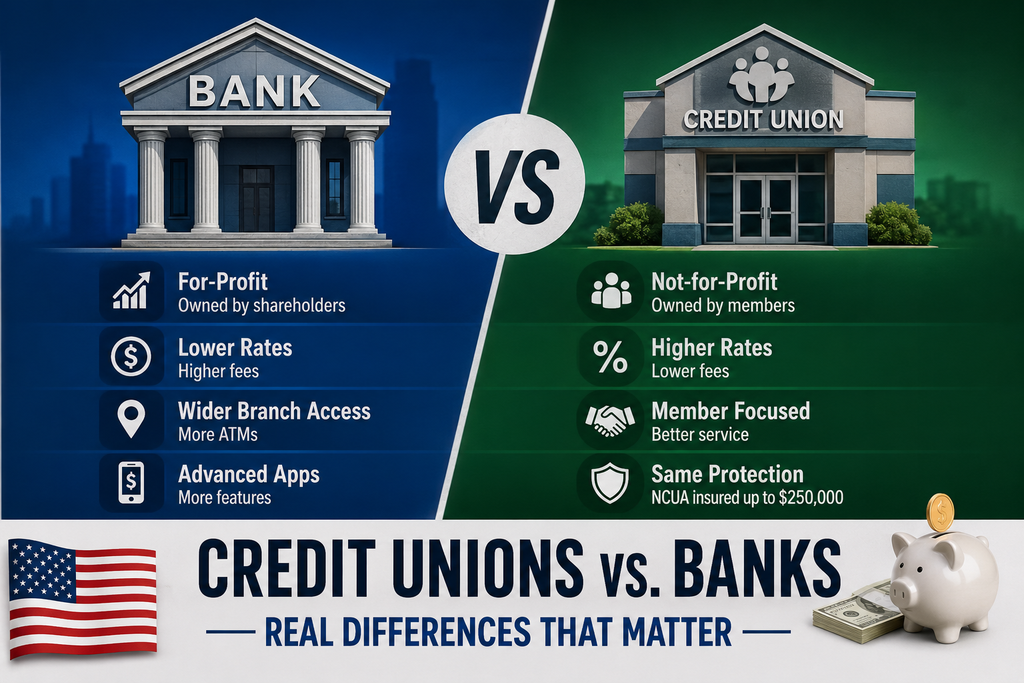
The core difference in credit unions vs banks comes down to ownership. A bank is a for-profit company, often publicly traded, answering to shareholders. A credit union is a not-for-profit cooperative, owned by its own members, so any profit gets returned to members as better rates or lower fees instead of dividends to outside investors.
That single structural difference is why credit unions vs banks so often land on opposite ends of the rate and fee comparison.
Interest Rates: Credit Unions vs Banks on Savings and CDs
This is where credit unions vs banks usually diverge the most in your favor if you pick right. As of December 2025, NCUA’s own quarterly rate comparison showed the average 1 year CD paying 2.29% APY at banks versus 2.95% APY at credit unions, both on a $10,000 deposit.
Here’s what that gap looks like on paper:
| Deposit | Bank 1 Year CD (2.29%) | Credit Union 1 Year CD (2.95%) |
|---|---|---|
| $10,000 | $229 in interest | $295 in interest |
| $25,000 | $572 in interest | $737 in interest |
Meanwhile, the FDIC’s national data put the average savings account rate at 0.38% to 0.39% in August 2026, a rate that large national banks in particular tend to sit near or below, while many credit unions post noticeably higher savings and CD rates.
Fees and Service: Credit Unions vs Banks Compared
Fee structure is another place where credit unions vs banks split. Because credit unions don’t need to generate shareholder profit, monthly maintenance fees and minimum balance requirements tend to be lower or waived entirely compared with many traditional banks.
Overdraft Fees: Credit Unions vs Banks
Overdraft and NSF fees follow the same pattern. Credit unions, on average, charge noticeably less per overdraft than banks do, and many credit unions offer more flexible grace periods or lower flat fees for members in good standing.
Deposit Insurance: Banks vs Credit Unions Explained
Safety is one area where banks vs credit unions are essentially identical. Bank deposits are insured by the FDIC up to $250,000 per depositor, per institution, per ownership category. Credit union deposits carry the same $250,000 protection through the NCUA’s National Credit Union Share Insurance Fund, which is backed by the full faith and credit of the U.S. government, confirmed directly on NCUA.gov.
Because the two insurance systems are separate, a saver with $250,000 at an FDIC bank and $250,000 at an NCUA credit union has $500,000 in total coverage, not $250,000.
Membership and Eligibility for Credit Unions vs Banks
This is the one real structural hurdle in credit unions vs banks. Anyone can walk into a bank and open an account. Credit unions require membership, tied to where you live, work, worship, or an employer or association you belong to.
Many large credit unions have widened this net considerably, letting you qualify through a small one time donation to an affiliated nonprofit, so the eligibility barrier is often smaller than it first appears.
Technology and Convenience: Credit Unions vs Banks
Big national banks generally win on app polish, ATM count, and international branch access. Credit unions vs banks looks different here because most credit unions participate in shared branching networks, giving members access to thousands of fee free ATMs and branches nationwide even though any single credit union is smaller than a national bank.
If you travel often or want the newest banking app features first, this is the tradeoff worth weighing against the better rates.
Choosing Between Credit Unions and Banks
There’s no universal winner between credit unions and banks. It depends on what you value most: the highest rate and lowest fees, or the widest branch network and single largest institution size.
A practical approach is to run your own credit unions vs banks numbers before deciding. You can plug your actual balance and expected rate into our CD Growth Calculator to see exactly how many extra dollars a credit union’s higher APY would put in your pocket over a 1 year or 5 year term compared with a bank offering the national average.
For many savers, the answer ends up being both: a credit union for savings and CDs, and a bank for the branch network or specific product a credit union doesn’t offer.
Bottom Line
When you weigh credit unions vs. banks side by side, the safety is identical, but the rates, fees, and membership rules are not, so the right choice comes down to whether you’d rather optimize for the best numbers or the widest convenience.
This is for informational purposes only and isn’t financial, tax, or legal advice.

Raghu Shekar writes about personal finance, banking, Medicare, and retirement planning at SimpleUSAFinance. His goal is simple: break down the numbers people actually need — no jargon, no sales pitch — so readers can make their own decisions with confidence. When he’s not writing, he’s usually digging through the latest rate changes, tax brackets, or Medicare updates to keep the site’s calculators and guides current.