You have probably asked yourself how online banks make money if they never charge you a monthly fee, never ask you to visit a branch, and still pay you a higher interest rate than the bank down the street. It feels like a trick. It is not. They earn money the same basic way every bank does, by lending out the money you deposit for more than it pays you to hold it, but the numbers work in your favor because the bank is not paying for buildings, tellers, or a parking lot.
That single difference, no physical branches, is the entire reason people ask how online banks make money in the first place. Once you see where the savings actually go, the rest of the picture falls into place.
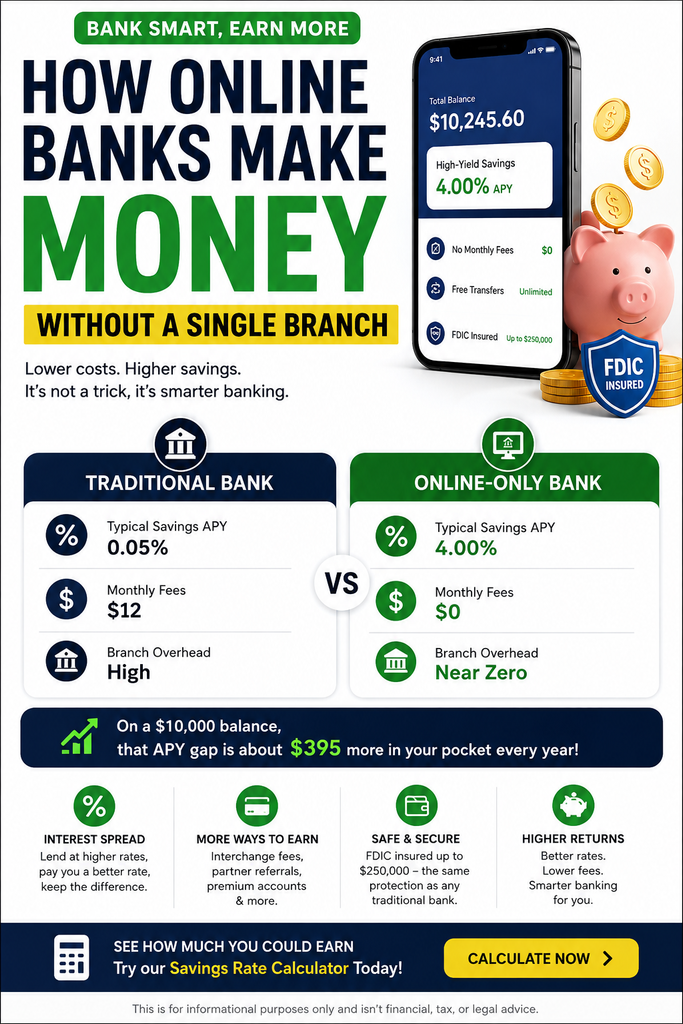
How Online Banks Make Money: The Short Answer
The short version of how online banks make money is this: they collect deposits, lend or invest most of that money at a higher rate, and pocket the difference, known as the interest rate spread. A traditional bank does the exact same thing. The difference is that a traditional bank has to spread its profit across thousands of branch leases, security guards, tellers, and paper statements first.
An online bank skips almost all of that. So when people wonder whether they are getting less value, the honest answer is no. They are simply spending less to deliver the same core service.
No Branches, Lower Costs: How Online Banks Make Money on Overhead
This is the part most people miss when they think about how online banks make money. A single branch of a national bank can cost several hundred thousand dollars a year to run once you count rent, staff, utilities, and security. Multiply that by a national branch network and the overhead becomes enormous, and someone has to pay for it.
Online banks avoid nearly all of that cost structure. No rent for storefronts. No large local staff. No cash vaults to insure and guard. That savings does not just disappear, it gets redirected into two places: better interest rates for customers, and profit margin for the bank. This overhead gap is the real starting point for how online banks make money more efficiently than branch based competitors.
A Simple Illustrative Comparison
Here is a rough, illustrative example (not current published rates, just to show the mechanics behind it):
| Traditional Branch Bank | Online-Only Bank | |
|---|---|---|
| Typical savings APY | 0.05 percent | 4.00 percent |
| Monthly maintenance fee | $12 | $0 |
| Branch overhead cost | High | Near zero |
On a $10,000 balance, that APY gap alone is roughly $395 a year in your pocket instead of the bank’s. That gap is a direct, visible answer to how online banks make money differently than the branch down the street, they simply keep less of the spread for themselves.
Interest Rate Spreads: How Online Banks Make Money on Your Deposits
Every deposit you make at an online bank gets put to work almost immediately. The bank lends it out as mortgages, auto loans, personal loans, or business credit, or invests it in safe instruments like Treasury securities. The rate the bank earns on those loans and investments is higher than the rate it pays you, and that gap, the net interest margin, is the single biggest way online banks make money.
Because online banks have lower costs to cover, they can afford to pay depositors a higher share of that spread and still turn a profit. That is not charity. It is math, and it is the cleanest explanation for why the rates look almost too good compared to a traditional savings account.
Fees, Interchange, and Partnerships: Other Ways Online Banks Make Money
Interest spread is the main engine, but it is not the only one. A full picture of how online banks make money should also include:
- Interchange fees. Every time you swipe a debit card, the merchant’s bank pays a small interchange fee to your bank. Multiply that across millions of transactions and it adds up fast.
- Premium account fees. Some online banks offer optional paid tiers with extra perks, and a portion of customers pay for the upgrade.
- Partner referrals. Many online banks earn a referral fee when they connect customers to a partner credit card, loan product, or investment account.
- Overdraft and out of network ATM fees. Even fee friendly online banks often still charge for these specific situations.
None of these are the main answer to how online banks make money, but together they add a meaningful, steady layer of revenue on top of the interest spread.
How Do Online Banks Make Money Compare to Traditional Banks?
If you line the two models up side by side, the mechanics of how online banks make money and how traditional banks make money are almost identical. Both rely on the deposit and lending spread as the core business. The real difference is cost structure, not business model.
A traditional bank has to justify branch expenses somehow, which usually shows up as lower savings rates, more monthly fees, or minimum balance requirements. An online bank routes that same money back to depositors instead, which is exactly why online savings rates so often beat brick and mortar competitors by a wide margin.
Is It Safe if You Understand How Online Banks Make Money?
Once you understand how online banks make money, the safety question gets easier to answer. A legitimate online bank is either a chartered bank itself or partners with one, and deposits are typically covered by FDIC insurance up to the standard limit, the same protection you would get at a branch based bank. You can verify a bank’s FDIC status directly through the FDIC’s BankFind tool before opening an account, and the Consumer Financial Protection Bureau has a plain language guide to comparing bank accounts if you want a second reference point.
The business model, lending deposits at a spread while running lean, is a normal, regulated banking practice, not a workaround. Understanding it should make you more comfortable with the idea, not less, as long as you confirm FDIC coverage first.
Bottom Line
Now you know how online banks make money: lower overhead, a healthy interest rate spread, and a handful of supporting fees, all without paying for branches you would never visit anyway. If you want to see the numbers for your own savings balance, run them through our Savings Rate Calculator to see how much a higher APY could add up to over a year.
This is for informational purposes only and isn’t financial, tax, or legal advice.

Raghu Shekar writes about personal finance, banking, Medicare, and retirement planning at SimpleUSAFinance. His goal is simple: break down the numbers people actually need — no jargon, no sales pitch — so readers can make their own decisions with confidence. When he’s not writing, he’s usually digging through the latest rate changes, tax brackets, or Medicare updates to keep the site’s calculators and guides current.