Medicare enrollment while working is one of the most confusing decisions people face at 65. Turning 65 does not automatically mean you must sign up right away. Whether Medicare enrollment while working makes sense for you now, or should wait, comes down to one number: how many people your employer has.
That single number decides your premiums, your penalties, and even whether your current job coverage will pay your medical bills at all.
Why Medicare Enrollment While Working Depends on Your Employer’s Size
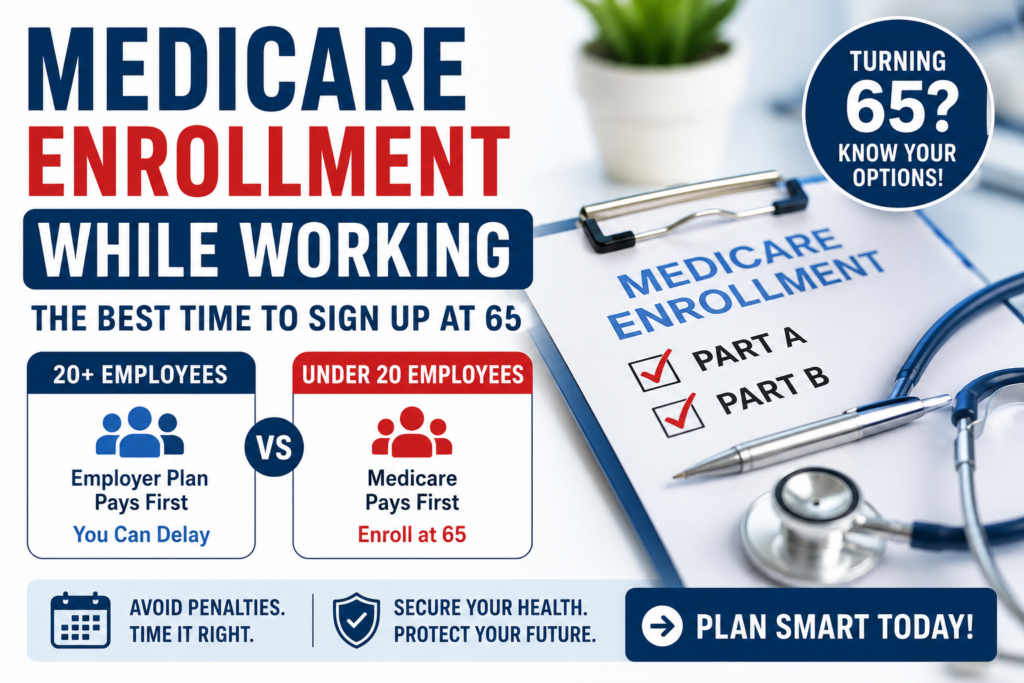
The rule that governs Medicare enrollment while working is the 20 employee threshold. If your employer has 20 or more employees, your group health plan pays first and Medicare pays second, so you can generally delay enrollment without a penalty.
If your employer has fewer than 20 employees, Medicare becomes your primary payer the moment you turn 65. In that case, delaying Medicare enrollment while working can leave real gaps, since your small employer plan is only designed to pay after Medicare, not instead of it.
This 20 employee count includes full time, part time, and seasonal workers across every location your employer operates, according to Medicare.gov’s guidance on working past 65. Confirming this number with your HR department is the very first step before deciding anything else.
Medicare Enrollment While Working for Large Employers (20+)
If you work for a large employer, Medicare enrollment while working can safely wait until you actually stop working or lose that coverage. You will not owe a late penalty as long as your employer plan counts as creditable coverage.
Once your job coverage ends, you get an 8 month Special Enrollment Period to sign up for Part A and Part B. That window starts the month after your job or coverage ends, whichever comes first, per the Social Security Administration’s rules on when to sign up for Medicare.
Many people in this situation still choose to enroll in Part A alone, since it’s premium free for most workers with at least 10 years of Medicare tax payments. That way, Medicare quietly backs up your employer plan at no extra cost.
Medicare Enrollment While Working for Small Employers (Under 20)
For a small employer, delaying Medicare enrollment while working is genuinely risky. Since Medicare pays first at 65, an employer plan built to pay second may simply refuse claims if you’re not enrolled in both Part A and Part B.
In this situation, sign up for Medicare during your Initial Enrollment Period, the seven month window that starts three months before your 65th birthday month. Missing it means waiting for the General Enrollment Period, with a possible coverage gap and a lasting Part B penalty.
| Employer Size | Who Pays First | Safe to Delay Medicare? |
|---|---|---|
| 20+ employees | Employer plan | Yes, usually |
| Under 20 employees | Medicare | No, enroll at 65 |
How Medicare Enrollment While Working Affects Your HSA
If you have a Health Savings Account, Medicare enrollment while working introduces one more wrinkle. The moment you enroll in any part of Medicare, including Part A alone, you can no longer make new HSA contributions.
This matters even if you’re not planning to enroll yet, because Part A coverage can be backdated up to six months once you do sign up. That retroactive window can turn recent HSA contributions into excess contributions, which the IRS taxes at 6% per year until corrected.
Timing Medicare Enrollment While Working Around HSA Contributions
To avoid that tax, stop HSA contributions six months before your planned Medicare start date, or before you apply for Social Security, whichever comes first. Claiming Social Security automatically enrolls you in Part A, so the two decisions are tied together.
If you want to keep contributing to your HSA for as long as possible, this is often the deciding factor in choosing later Medicare enrollment while working over signing up at 65 out of habit.
What Happens If You Delay Medicare Enrollment While Working Too Long
Delaying Medicare enrollment while working only stays penalty free while you’re covered by a large employer’s creditable plan. Once that coverage ends, the clock starts on your 8 month Special Enrollment Period, and it does not pause for COBRA or retiree coverage.
Missing that window means a Part B late enrollment penalty of 10% for each 12 month period you went without coverage, added to your premium for as long as you have Part B. For 2026, the standard Part B premium is $202.90 a month, so even one missed year adds roughly $20 a month permanently.
Medicare Enrollment While Working: A Quick Decision Table
| Your Situation | What to Do |
|---|---|
| Large employer, healthy budget | Delay Part B, take free Part A |
| Large employer, active HSA | Delay all parts, stop HSA contributions 6 months before enrolling |
| Small employer | Enroll in Part A and Part B at 65 |
| Just left a job at 65+ | Enroll within your 8 month SEP |
Before you lock in a decision either way, it helps to see the bigger financial picture. You can run your own numbers with our Retirement Corpus Calculator to see how delaying or accelerating Medicare enrollment while working shifts your overall retirement savings target.
Frequently Asked Questions
Do I have to enroll in Medicare at 65 if I’m still working?
Only if your employer has fewer than 20 employees. With 20 or more, Medicare enrollment while working can generally wait without penalty.
Will I be penalized for delaying Medicare enrollment while working?
No, as long as your employer coverage is creditable and counts as a large group plan. The penalty only applies once you miss your 8 month Special Enrollment Period after that coverage ends.
Can I keep my HSA if I delay Medicare?
Yes, but only if you delay every part of Medicare, including Part A, since enrolling in any part stops new HSA contributions immediately.
Bottom Line
Medicare enrollment while working comes down almost entirely to your employer’s size and, if you have one, your HSA plans. Confirm your employer’s headcount, check whether your coverage is creditable, and time your enrollment around any HSA contributions before you decide.
This is for informational purposes only and isn’t financial, tax, or legal advice.

Raghu Shekar writes about personal finance, banking, Medicare, and retirement planning at SimpleUSAFinance. His goal is simple: break down the numbers people actually need — no jargon, no sales pitch — so readers can make their own decisions with confidence. When he’s not writing, he’s usually digging through the latest rate changes, tax brackets, or Medicare updates to keep the site’s calculators and guides current.