The new standard deduction for seniors is one of the biggest tax changes retirees will see this filing season. It comes from the One Big Beautiful Bill Act, signed into law in July 2025, and it adds a temporary $6,000 deduction on top of what seniors already received. Here’s exactly what the new standard deduction for seniors means for your return, who qualifies, and how the income limits work.
What the New Standard Deduction for Seniors Actually Adds
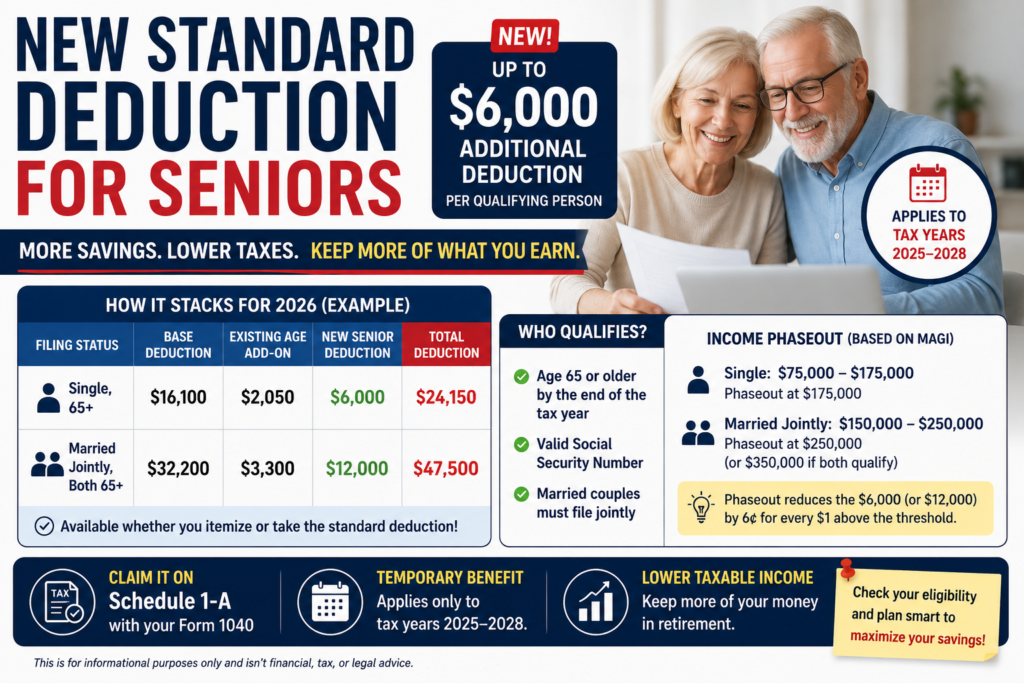
The new standard deduction for seniors is not a replacement for the existing senior tax break. It’s a separate, additional deduction of up to $6,000 per qualifying person, on top of both the regular standard deduction and the existing age based add on that seniors have claimed for years.
For a married couple where both spouses are 65 or older, that means up to $12,000 in combined new deduction, according to the IRS’s own eligibility page for the enhanced senior deduction. This new senior standard deduction is available whether you itemize or take the standard deduction, which makes it unusually flexible.
How the New Standard Deduction for Seniors Stacks With Existing Deductions
To understand the full impact of the new standard deduction for seniors, it helps to see all three layers together. For 2026, a single filer age 65 or older gets the $16,100 base standard deduction, plus the existing $2,050 age based add on, plus the new $6,000 deduction.
| Filing Status | Base Deduction | Existing Age Add On | New Senior Deduction | Total |
|---|---|---|---|---|
| Single, 65+ | $16,100 | $2,050 | $6,000 | $24,150 |
| Married jointly, both 65+ | $32,200 | $3,300 | $12,000 | $47,500 |
That $24,150 figure for single filers, confirmed by Kiplinger’s coverage of the 2026 senior deduction update, shows how much the new standard deduction for seniors can shelter from federal income tax before any other credits come into play.
Who Qualifies for the New Standard Deduction for Seniors
Eligibility for the new standard deduction for seniors is based on age and income, not on whether you’re still working or already retired. You must turn 65 by the last day of the tax year, and you must include a valid Social Security number on your return.
Married couples must file jointly to claim the new senior deduction on a joint return. If both spouses are 65 or older, each spouse can claim their own $6,000, but filing separately disqualifies both from this particular benefit.
The Income Phaseout on the New Standard Deduction for Seniors
The new standard deduction for seniors doesn’t apply at every income level. It begins phasing out once modified adjusted gross income passes $75,000 for single filers or $150,000 for joint filers, reducing by 6 cents for every dollar above that threshold.
For single filers, the new senior standard deduction disappears completely at $175,000 in MAGI. For married couples filing jointly, it phases out entirely at $250,000, or $350,000 if both spouses qualify for the full $12,000.
Calculating Your New Standard Deduction for Seniors If You’re Above the Threshold
If your income falls inside the phaseout range, the new standard deduction for seniors shrinks gradually rather than disappearing all at once. A single filer with $130,000 in MAGI, for example, is $55,000 over the $75,000 threshold, which reduces the deduction by $3,300, leaving a reduced $2,700 new senior deduction instead of the full $6,000.
This phaseout math applies only to the new $6,000 provision. The existing age based standard deduction add on has no income limit at all, so every senior keeps that portion regardless of earnings.
How Long the New Standard Deduction for Seniors Will Last
Unlike the regular standard deduction, the new standard deduction for seniors is temporary. It applies only to tax years 2025 through 2028, and unless Congress acts to extend it, this new senior deduction disappears starting with the 2029 tax year.
That makes now a good window for eligible seniors to take full advantage, particularly those close to the phaseout thresholds who might benefit from timing retirement account withdrawals to stay under the limit.
Since this new deduction interacts directly with how much retirement income you draw each year, it’s worth checking your full retirement plan against it. You can see how adjusting withdrawal timing affects your long term numbers with our Retirement Corpus Calculator.
Frequently Asked Questions
Do I need to itemize to get the new standard deduction for seniors?
No, the new standard deduction for seniors is available whether you itemize or take the standard deduction, which is different from most other tax deductions.
Does the new senior deduction eliminate taxes on Social Security?
Not directly. It doesn’t change how Social Security benefits are taxed, but by lowering overall taxable income it can reduce the portion of benefits subject to tax for many retirees.
What form do I use to claim the new standard deduction for seniors?
The IRS created Schedule 1-A specifically for this deduction, filed alongside your regular Form 1040.
Bottom Line
The new standard deduction for seniors adds a meaningful, though temporary, tax break worth up to $6,000 per person through 2028, on top of deductions seniors already received. Check your modified adjusted gross income against the phaseout thresholds each year to see how much of the new standard deduction for seniors you actually qualify for.
This is for informational purposes only and isn’t financial, tax, or legal advice.

Raghu Shekar writes about personal finance, banking, Medicare, and retirement planning at SimpleUSAFinance. His goal is simple: break down the numbers people actually need — no jargon, no sales pitch — so readers can make their own decisions with confidence. When he’s not writing, he’s usually digging through the latest rate changes, tax brackets, or Medicare updates to keep the site’s calculators and guides current.