If your checking account balance has ever dropped to zero right before a bill hit, you’ve probably seen the term overdraft protection pop up at your bank. Overdraft protection is a bank service that covers a transaction even when you don’t have enough money in your account, but it comes with fees and terms that many people don’t fully understand until the charge shows up. This guide breaks down exactly how overdraft protection works, what it actually costs, and when it makes sense to use it.
What Overdraft Protection Actually Does
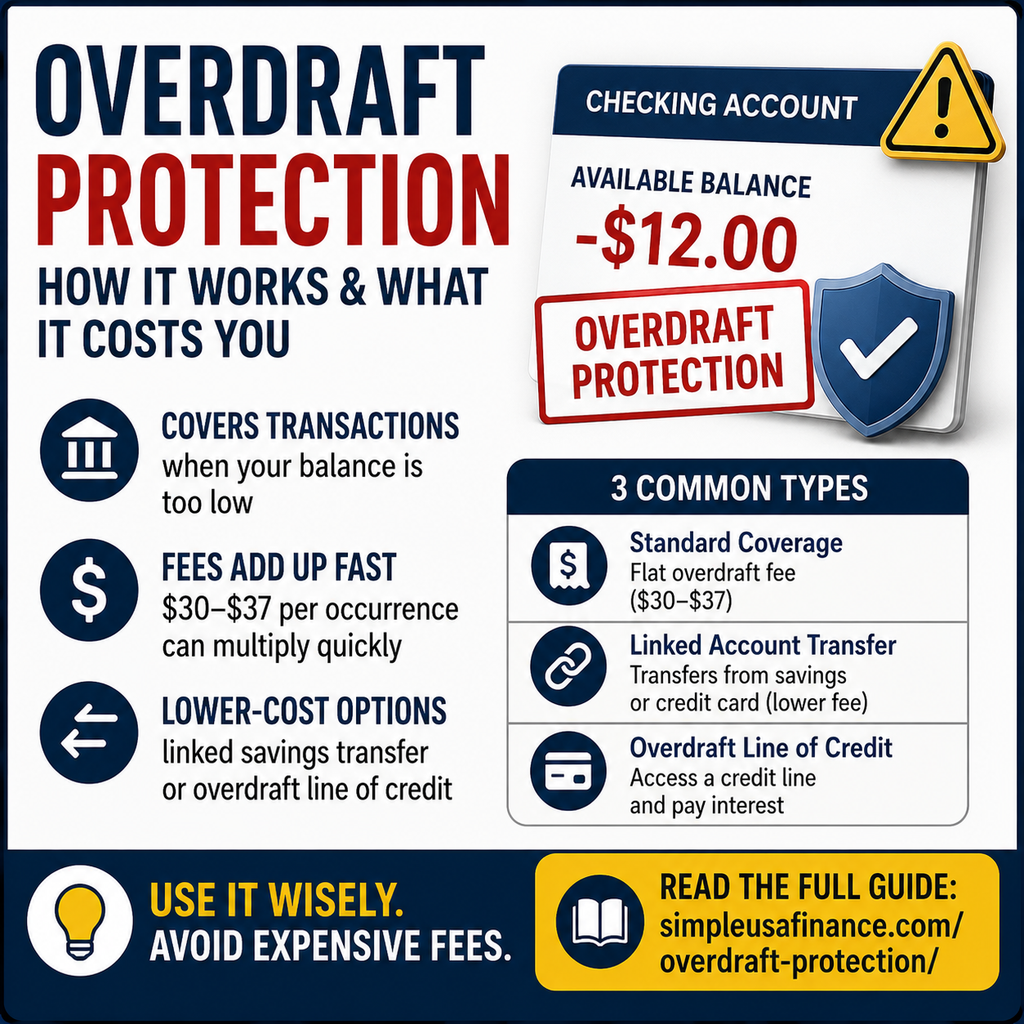
Overdraft protection kicks in when a withdrawal, check, or debit card purchase would take your balance below zero. Instead of the transaction bouncing outright, your bank covers the shortfall and lets the payment go through. Banks offer a few different forms of overdraft protection, and knowing which one applies to your account matters, because the cost and mechanics vary a lot between them.
The Three Common Types
- Standard OD coverage: the bank pays the transaction and charges a flat overdraft fee, often $30-$37 per occurrence.
- Linked account transfer: overdraft protection pulls funds automatically from a linked savings account or credit card, usually for a smaller transfer fee.
- Overdraft line of credit: the bank extends a small credit line tied to your checking account, charging interest instead of a flat fee.
How OD Protection Fees Add Up
This is where overdraft protection gets expensive fast if you’re not paying attention. A single overdraft protection fee might look manageable, but multiple overdrafts in the same week can multiply quickly.
Example: Say your balance drops to -$12 after a $40 debit card purchase, and two more small transactions post before you notice. At a typical $35 per-occurrence fee, that’s three overdraft protection charges in one day, $105 in fees to cover $12 of actual shortfall.
| Transaction | Amount | Overdraft Protection Fee | Running Total |
|---|---|---|---|
| Debit purchase | $40 | $35 | -$47 |
| Subscription charge | $15 | $35 | -$62 |
| Coffee shop charge | $6 | $35 | -$68 |
That table is the exact scenario that makes overdraft protection controversial. It solves the immediate embarrassment of a declined card, but the cost can outweigh the benefit if it happens more than once or twice a year.
Overdraft Protection vs. Letting a Transaction Decline
Without overdraft protection, a transaction that would overdraw your account is simply declined, or a check bounces. That comes with its own costs: a returned-item fee from your bank (usually similar to the overdraft fee itself) and, for bounced checks, a possible fee from the merchant or biller too. So overdraft protection isn’t necessarily worse than opting out, it depends on which situation costs you less given your typical spending pattern.
Opting In vs. Opting Out
Under federal rules, banks cannot automatically enroll you in overdraft protection for everyday debit card and ATM transactions, you have to opt in. Checks and recurring automatic payments are usually covered by default overdraft handling regardless of your debit card opt-in status, which surprises a lot of account holders. If you’ve never explicitly opted in, your debit card will simply decline at the register rather than trigger overdraft protection, while a check you wrote could still bounce or be covered depending on your bank’s standard policy.
Linked Account Transfers: The Cheaper Alternative
If your bank offers OD protection through a linked savings account, this is usually your lowest-cost option. Instead of a flat $35 fee, you might pay $10 or less per transfer, or nothing at all if your bank waives the fee for linked-account customers. Setting this up ahead of time, even with just $50-$100 sitting in a linked savings account, can turn a $35 overdraft protection charge into a $0-$10 transfer.
Common Mistakes People Make
Many people leave OD protection turned on for every account type without realizing checks and automatic bill payments were never something they could opt out of in the first place, they can only control the debit card and ATM portion. Others don’t realize that a linked-account transfer option even exists at their bank and default straight into the higher-fee standard coverage. A third common mistake is assuming OD protection is one-size-fits-all across banks, when fee amounts and transfer thresholds differ significantly by institution.
When Overdraft Protection Makes Sense
Overdraft protection is worth keeping on if you occasionally run tight on cash flow and would rather pay a fee than have a rent check bounce or a card decline in front of a cashier. It makes less sense if you’re overdrawing regularly, since the fees compound fast and often signal a deeper budgeting gap that a linked savings cushion or a tighter spending plan would fix more permanently. If you want to see exactly how a savings cushion could change your numbers, run your own numbers with our Emergency Fund Calculator to see what a small buffer account could save you in OD protection fees over a year.
According to the Consumer Financial Protection Bureau, overdraft and non-sufficient-funds fees remain one of the most common sources of consumer complaints tied to checking accounts, which is part of why several major banks have reduced or eliminated standard overdraft protection fees in recent years. It’s worth checking your own bank’s current fee schedule directly, since policies have been shifting.
Frequently Asked Questions
Can I turn off overdraft protection completely?
You can opt out of overdraft protection for debit card and ATM transactions at any time by contacting your bank, though checks and certain automatic payments may still be handled under your bank’s standard overdraft policy.
Does OD protection affect my credit score?
Standard overdraft protection fees don’t get reported to credit bureaus, but an overdraft line of credit that goes unpaid can eventually affect your credit.
Is OD protection the same at every bank?
No, fee amounts, transfer thresholds, and daily fee caps vary significantly by bank, so it’s worth comparing your bank’s specific OD protection terms.
Bottom Line
Overdraft protection can prevent the embarrassment and extra fees of a declined transaction or bounced check, but it isn’t free, and the cost adds up quickly if you overdraft more than occasionally. Check whether your bank offers a lower-cost linked-account transfer option, and consider a small savings cushion as a longer-term alternative to relying on overdraft protection at all.
This is for informational purposes only and isn’t financial, tax, or legal advice.

Raghu Shekar writes about personal finance, banking, Medicare, and retirement planning at SimpleUSAFinance. His goal is simple: break down the numbers people actually need — no jargon, no sales pitch — so readers can make their own decisions with confidence. When he’s not writing, he’s usually digging through the latest rate changes, tax brackets, or Medicare updates to keep the site’s calculators and guides current.