Retiring early sounds like the goal until you look closely at the plan most people build their finances around. That standard plan assumes you work until somewhere in your sixties, and several of its rules simply do not work the same way if you stop sooner. Below, we walk through exactly what breaks when you are retiring early and what to do instead.
Why Retiring Early Breaks the Standard Plan’s Assumptions
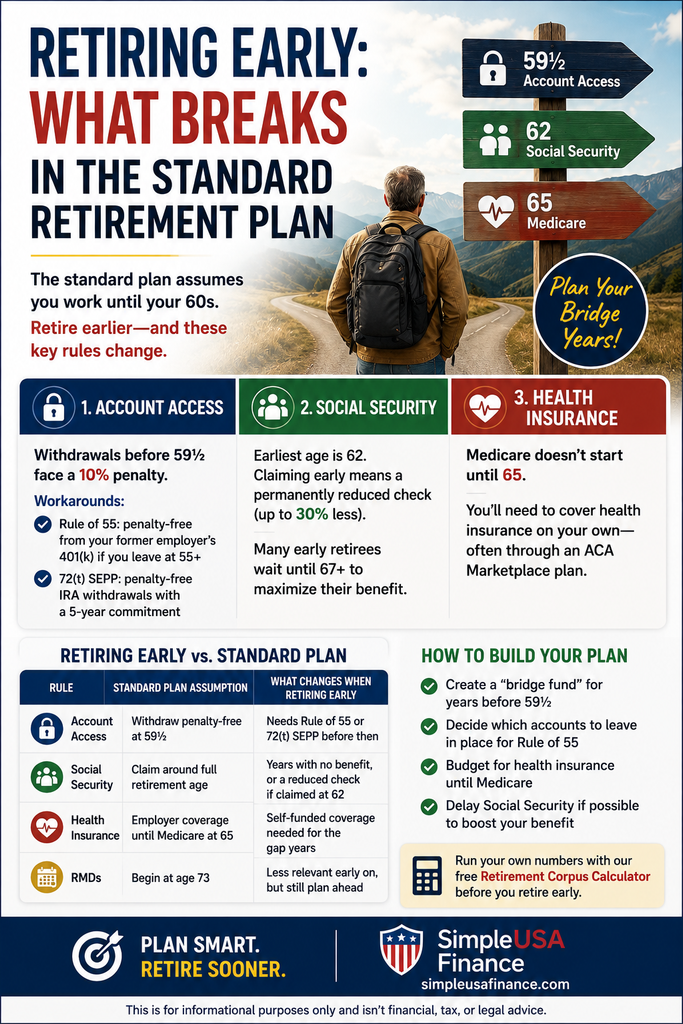
The standard retirement plan leans on three ages: 59½ for penalty-free retirement account withdrawals, 62 for the earliest Social Security benefits, and 65 for Medicare. Stepping away from a paycheck early usually means walking away before at least one, and often all three, of those ages.
That gap between when you stop working and when those benefits become available is sometimes called the bridge years. Retiring early without a plan for the bridge years is the single biggest reason otherwise well funded retirements run into trouble.
What Breaks First When Retiring Early: Account Access
Most 401(k) and IRA withdrawals before age 59½ trigger a 10% early withdrawal penalty on top of ordinary income tax. Stopping work at 50 or 55 puts you well ahead of that age, so this is usually the first thing to plan around.
Two common workarounds exist:
- The rule of 55: if you leave your job in or after the year you turn 55, you can take penalty-free withdrawals from that specific employer’s 401(k). This only applies to the plan from the job you just left, and it disappears the moment you roll that account into an IRA.
- 72(t) substantially equal periodic payments (SEPP): these let you withdraw from an IRA at any age without the penalty, but you must commit to the schedule for five years or until age 59½, whichever is longer.
People in this situation frequently make the mistake of rolling every old 401(k) into an IRA right away, which quietly closes off the rule of 55 for money that could have covered the first few years.
A Retiring Early Example, With Real Numbers
Say you are 55, leaving your job well ahead of schedule, and need $40,000 a year until other income sources start. If you leave $200,000 in your former employer’s 401(k) instead of rolling it over immediately, you can withdraw that $40,000 a year penalty-free under the rule of 55 for five years, paying only ordinary income tax. Rolling that same $200,000 into an IRA first would add a 10% penalty on every withdrawal, roughly $4,000 a year in unnecessary tax, or $20,000 over five years.
What Breaks Second When Retiring Early: Social Security Timing
Social Security’s earliest claiming age is 62, so stopping work at 50 or 55 still means several years with no benefit at all. Claiming as soon as you turn 62 also locks in a permanently reduced check, since full retirement age for most people is 67, and claiming early can reduce your benefit by as much as 30% for life.
Retiring early does not require claiming early. Many people in this position draw down savings first and delay Social Security to age 67 or later, which increases the eventual monthly benefit for the rest of their life.
What Breaks Third When Retiring Early: Health Insurance
Medicare does not start until 65, which is often the largest financial surprise for anyone leaving the workforce well before that age. Losing employer coverage means covering health insurance entirely on your own, typically through an ACA marketplace plan, until Medicare eligibility begins.
This gap can run a full decade for someone who stops working at 55, and marketplace premiums plus out of pocket costs deserve their own line item in any early retirement budget, not an afterthought.
Retiring Early vs the Standard Plan: A Quick Comparison
| Rule | Standard Plan Assumption | What Changes When Retiring Early |
|---|---|---|
| Retirement account access | Withdraw penalty-free at 59½ | Needs rule of 55 or 72(t) SEPP before then |
| Social Security | Claim around full retirement age | Years with no benefit, or a reduced check if claimed at 62 |
| Health insurance | Employer coverage until Medicare at 65 | Self-funded coverage needed for the gap years |
| Required minimum distributions | Begin at 73 | Less relevant early on, but still worth planning around |
How to Build a Plan Around Retiring Early
None of this means retiring early is a bad idea, only that the standard plan needs adjusting. A workable version usually includes a dedicated bridge fund for the years before 59½, a clear decision about which accounts to leave in place for the rule of 55, and a real number for health insurance instead of a guess.
If you want to see how your own numbers hold up, you can run your own retiring early scenario with our free Retirement Corpus Calculator before you give notice. For the exact rules and current thresholds, the IRS page on exceptions to early distribution penalties is worth reading directly rather than relying on secondhand summaries.
Bottom Line
Retiring early works financially, but only if you plan around the three ages the standard retirement plan assumes you will still be working past. Build a bridge for account access, health insurance, and Social Security timing before you leave your paycheck behind.
This is for informational purposes only and isn’t financial, tax, or legal advice.

Raghu Shekar writes about personal finance, banking, Medicare, and retirement planning at SimpleUSAFinance. His goal is simple: break down the numbers people actually need — no jargon, no sales pitch — so readers can make their own decisions with confidence. When he’s not writing, he’s usually digging through the latest rate changes, tax brackets, or Medicare updates to keep the site’s calculators and guides current.