Social Security spousal benefits let a married or divorced spouse collect a monthly payment based on their partner’s earnings record instead of their own. If you never worked, worked part time, or earned far less than your spouse over your career, Social Security spousal benefits can end up being worth more than anything your own record would pay.
This guide breaks down Social Security spousal benefits in plain language: who qualifies, how the amount is calculated, what claiming age does to your check, and how the rules change if you’re divorced.
How Social Security Spousal Benefits Actually Work
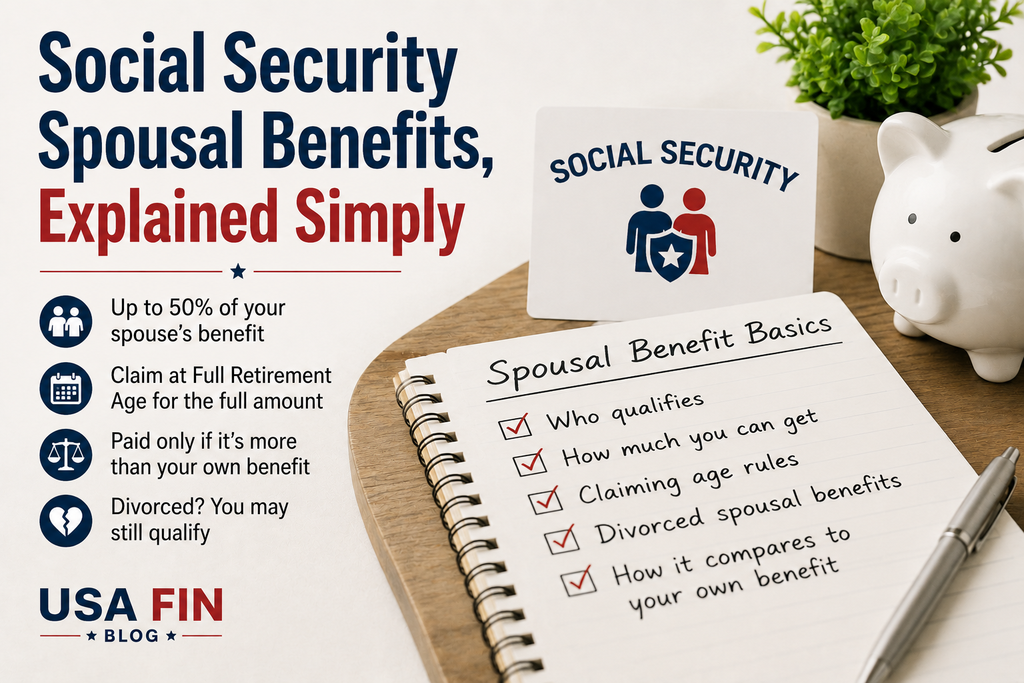
Social Security spousal benefits pay a spouse up to 50% of the working partner’s Primary Insurance Amount, which is the benefit that partner would receive at their own Full Retirement Age. This is separate from your own retirement benefit, and the Social Security Administration automatically pays you whichever amount is higher, not both combined.
For most workers today, Full Retirement Age is 67, since it applies to anyone born in 1960 or later. Social Security spousal benefits are tied directly to this age; claim earlier and the amount shrinks permanently, with no way to earn it back later. This is different from your own retirement benefit, which does eventually stop shrinking once you reach Full Retirement Age and can even grow larger if you delay it further.
It’s worth repeating because it trips people up so often: these benefits and your own retirement benefit follow different rules once Full Retirement Age passes. One keeps growing with delay, the other doesn’t move at all.
Who Qualifies for Social Security Spousal Benefits
To qualify for Social Security spousal benefits as a married spouse, the couple generally needs to have been married at least one year, and the higher earning spouse must already be receiving their own retirement benefit. You also need to be at least 62 years old to claim, even if your spouse started collecting earlier.
There’s one more requirement people often miss: Social Security spousal benefits are only available if your own retirement benefit, based on your own work record, would be smaller than the spousal amount. If your own benefit is already higher, you simply keep your own benefit instead. The Social Security Administration checks this automatically at the time you file, so you won’t accidentally end up with less than you’re entitled to.
One year of marriage is the minimum for a currently married couple, but there’s no maximum length requirement and no requirement that the marriage be your first. Remarrying someone new later, after their own qualifying marriage, resets the clock for benefits tied to that new spouse’s record rather than an old one.
How Much Are Social Security Spousal Benefits Worth
The math behind Social Security spousal benefits is simple at Full Retirement Age: up to 50% of your spouse’s Primary Insurance Amount. Claim before that age and the percentage drops on a sliding scale, and unlike your own retirement benefit, Social Security spousal benefits never grow past Full Retirement Age no matter how long you wait.
That last point surprises a lot of people. Delaying your own retirement benefit past Full Retirement Age earns you delayed credits, but delaying a spousal claim past Full Retirement Age gets you nothing extra. There’s no financial reason to wait beyond your own Full Retirement Age to file for Social Security spousal benefits, and doing so only costs you months of payments you’ll never get back.
Sample Social Security Spousal Benefit Reduction Table
| Claiming age | Spousal benefit reduction | Percent of worker’s PIA received |
|---|---|---|
| 62 | 35% reduction | 32.5% |
| 64 | 25% reduction | 37.5% |
| 67 (Full Retirement Age) | No reduction | 50% |
This table shows why claiming age matters so much for Social Security spousal benefits. Waiting from 62 to 67 can add roughly 17.5 percentage points of your spouse’s Primary Insurance Amount to your own monthly check, permanently.
Claiming Age and Your Social Security Spousal Benefit Amount
Because Social Security spousal benefits are reduced for early claiming but never increased for late claiming, the ideal filing age is almost always exactly Full Retirement Age, not earlier and not later. This is one of the few areas of Social Security spousal benefits where the optimal strategy is genuinely simple once you know the rule.
There’s also an earnings test to consider if you’re still working before Full Retirement Age. In 2026, the Social Security Administration withholds $1 in benefits for every $2 you earn above $24,480 if you’re under Full Retirement Age and claiming Social Security spousal benefits while still employed. Those withheld amounts aren’t lost forever; your benefit is recalculated upward once you reach Full Retirement Age to credit back the months that were reduced.
Social Security Spousal Benefits for Divorced Spouses
Divorced individuals can also claim Social Security spousal benefits under a different set of rules. The marriage must have lasted at least 10 years, and you must currently be unmarried to qualify. If you remarry, your eligibility for spousal benefits on your ex’s record generally ends, though you may then qualify for spousal benefits on your new spouse’s record instead.
Unlike married couples, a divorced spouse doesn’t need their ex to have already filed for Social Security spousal benefits. As long as you’ve been divorced for at least two years and your ex is eligible for retirement benefits, you can claim on their record even if they haven’t claimed yet. Your ex doesn’t need to consent, and claiming on their record has no effect on the amount they receive.
If your ex has remarried, that doesn’t block your claim either, as long as you yourself haven’t remarried. Both you and your ex’s new spouse can independently draw Social Security spousal benefits on the same work record at the same time, since one person’s claim doesn’t reduce what anyone else receives.
Social Security Spousal Benefits vs. Your Own Retirement Benefit
Many people confuse Social Security spousal benefits with survivor benefits, but the two work very differently. A spousal benefit tops out at 50% of the worker’s Primary Insurance Amount while the worker is alive. A survivor benefit, paid after the worker’s death, can reach up to 100% of what the worker was receiving.
If you qualify for both a retirement benefit on your own record and Social Security spousal benefits on your spouse’s record, the Social Security Administration pays you the larger of the two automatically. You don’t need to calculate this yourself or choose between them; the agency compares both amounts and applies whichever pays more. Run your own Social Security spousal benefits numbers with our Social Security calculator to see how your claiming age and your spouse’s record affect your total monthly amount.
Bottom Line: Social Security Spousal Benefits
Social Security spousal benefits can pay up to 50% of your spouse’s benefit at Full Retirement Age, less if you claim early, and never more if you wait past it. Whether you’re married or divorced, understanding these rules before you file is the best way to avoid a permanent reduction you didn’t need to accept.
This is for informational purposes only and isn’t financial, tax, or legal advice.

Raghu Shekar writes about personal finance, banking, Medicare, and retirement planning at SimpleUSAFinance. His goal is simple: break down the numbers people actually need — no jargon, no sales pitch — so readers can make their own decisions with confidence. When he’s not writing, he’s usually digging through the latest rate changes, tax brackets, or Medicare updates to keep the site’s calculators and guides current.