The 401(k) vs IRA question sounds like you have to pick a side, but for most people the real answer is both. Each account has its own rules, its own tax treatment, and its own contribution limit, and using them together is how many savers build a bigger retirement nest egg than either account could produce alone.
This guide walks through the 2026 numbers for 401(k) vs IRA contributions, how the tax treatment differs, and a simple order of operations for funding both without overcomplicating things or leaving free money on the table.
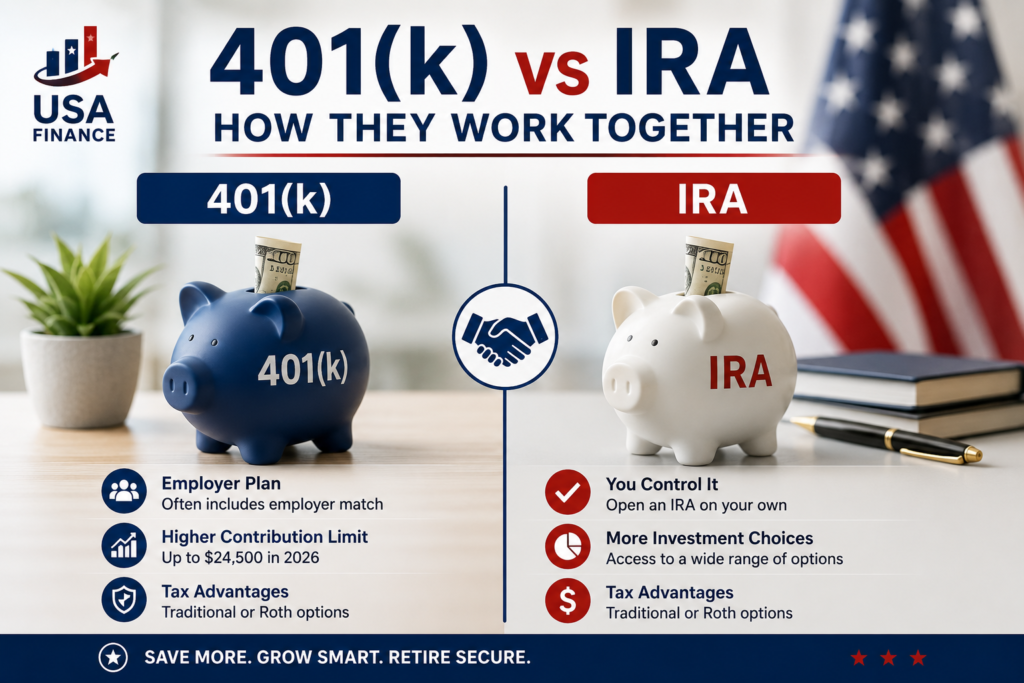
What 401(k) vs IRA Really Means for Your Savings
A 401(k) is a retirement account offered through your employer, funded through payroll deductions before you ever see the money. An IRA, or individual retirement account, is one you open yourself at a brokerage or bank, completely separate from any employer.
That structural difference drives most of the practical distinctions between the two. A 401(k) usually has a limited menu of investment choices picked by your employer, while an IRA gives you access to nearly any stock, bond, or fund the brokerage offers.
Contributing to a workplace plan does not limit your ability to contribute to an IRA in the same year, and vice versa. That is the core of why 401(k) vs IRA is rarely a true choice between the two.
401(k) vs IRA Contribution Limits for 2026
The IRS raised both limits for 2026, which changes the math on how much you can put toward retirement across a 401(k) and IRA combined.
For 2026, the 401(k) employee contribution limit is $24,500, up from $23,500 in 2025. Workers age 50 and older can add a catch up contribution of $8,000, bringing their total to $32,500. Those aged 60 through 63 get an even larger catch up of $11,250 instead.
The IRA limit for 2026 is $7,500, up from $7,000. The IRA catch up contribution for those 50 and older rose to $1,100, bringing their total IRA limit to $8,600. These limits apply across traditional and Roth IRAs combined, not to each separately.
401(k) vs IRA Example: Maxing Out Both
Here is what the 401(k) vs IRA numbers look like side by side for someone under 50 who maxes out both accounts in 2026.
| Account | 2026 Limit | Under 50 |
|---|---|---|
| 401(k) | $24,500 | $24,500 |
| IRA | $7,500 | $7,500 |
| Combined total | $32,000 | $32,000 |
A worker who maxes out both accounts could shelter $32,000 from current income tax in a single year, well beyond what either account allows on its own.
401(k) vs IRA Tax Treatment Compared
The tax rules are where 401(k) vs IRA choices get more personal, since both come in traditional and Roth versions.
A traditional 401(k) or traditional IRA reduces your taxable income now, with withdrawals taxed as ordinary income in retirement. A Roth 401(k) or Roth IRA works the opposite way: no upfront deduction, but qualified withdrawals in retirement are tax free.
One key difference in the comparison is income limits. Roth IRA contributions phase out between $153,000 and $168,000 for single filers in 2026, and between $242,000 and $252,000 for married couples filing jointly. A Roth 401(k) has no such income limit, so high earners who want Roth style savings sometimes lean more heavily on the workplace option.
Traditional IRA deductions have their own income phase outs if you or a spouse is covered by a workplace plan, ranging from $81,000 to $91,000 for single filers in 2026. A traditional 401(k) deduction, by contrast, is not affected by your income at all, since contributions come out of your paycheck before tax regardless of how much you earn.
Why 401(k) vs IRA Isn’t Really an Either Or Choice
Framing 401(k) vs IRA as a competition misses how the two accounts complement each other in practice.
A 401(k) offers higher contribution limits and, often, an employer match. An IRA offers a wider range of investment choices and, in the traditional version, a deduction that is not tied to your employer at all. Using both lets you capture the strengths of each.
For many households, the practical approach is contributing enough to the 401(k) to get any employer match, then using an IRA for additional savings, and returning to the 401(k) if there is room left in the budget to save more.
Employer Match: The Biggest 401(k) vs IRA Advantage
If your employer offers a 401(k) match, that is usually the deciding factor in how you sequence 401(k) vs IRA contributions.
An employer match is essentially free money added to your retirement savings, on top of whatever you personally contribute. Skipping it to fund an IRA first means leaving part of your compensation on the table, even if the IRA otherwise looks more appealing.
Once you have captured the full match, shifting extra savings into an IRA can make sense, particularly if your 401(k) plan charges higher fees or offers a narrower set of investment options than an IRA would. This is often where the 401(k) vs IRA decision becomes less about rules and more about which account actually serves your goals better.
How to Prioritize 401(k) vs IRA Contributions
A simple order of operations helps most people navigate 401(k) vs IRA decisions without needing a financial degree.
- Contribute enough to your 401(k) to get the full employer match, since this is the highest guaranteed return available to most savers.
- Max out an IRA next, taking advantage of the wider investment menu and, if eligible, the traditional IRA deduction.
- Return to the 401(k) for additional savings once the IRA is maxed out, up to the full $24,500 limit for 2026.
You can run your own 401(k) vs IRA numbers with our Retirement Savings Calculator, plugging in your income, employer match, and savings goals to see how much you could accumulate using both accounts together.
Your exact order might shift depending on your situation. Someone without access to an employer match, for instance, might prioritize an IRA from the start, while someone in a high tax bracket today might lean toward maxing out a traditional 401(k) before touching an IRA at all.
Bottom Line on 401(k) vs IRA
401(k) vs IRA is not really a competition, since the two accounts are built to work side by side rather than replace each other. Capture your full employer match first, then split additional savings between both accounts based on the investment options, fees, and tax treatment that fit your situation best.
This is for informational purposes only and isn’t financial, tax, or legal advice.

Raghu Shekar writes about personal finance, banking, Medicare, and retirement planning at SimpleUSAFinance. His goal is simple: break down the numbers people actually need — no jargon, no sales pitch — so readers can make their own decisions with confidence. When he’s not writing, he’s usually digging through the latest rate changes, tax brackets, or Medicare updates to keep the site’s calculators and guides current.