Estimated quarterly taxes catch a lot of people off guard the first year they freelance, start a side business, or pick up rental income. Unlike a W-2 job, nobody withholds tax from that money automatically, so the IRS expects you to send in payments yourself, four times a year.
The good news is that figuring out whether you actually owe estimated quarterly taxes is more straightforward than it sounds, even if the IRS paperwork around it looks intimidating at first glance. This guide covers who is required to pay, the 2026 due dates, and how the penalty works if you skip a payment.
What Estimated Quarterly Taxes Actually Are
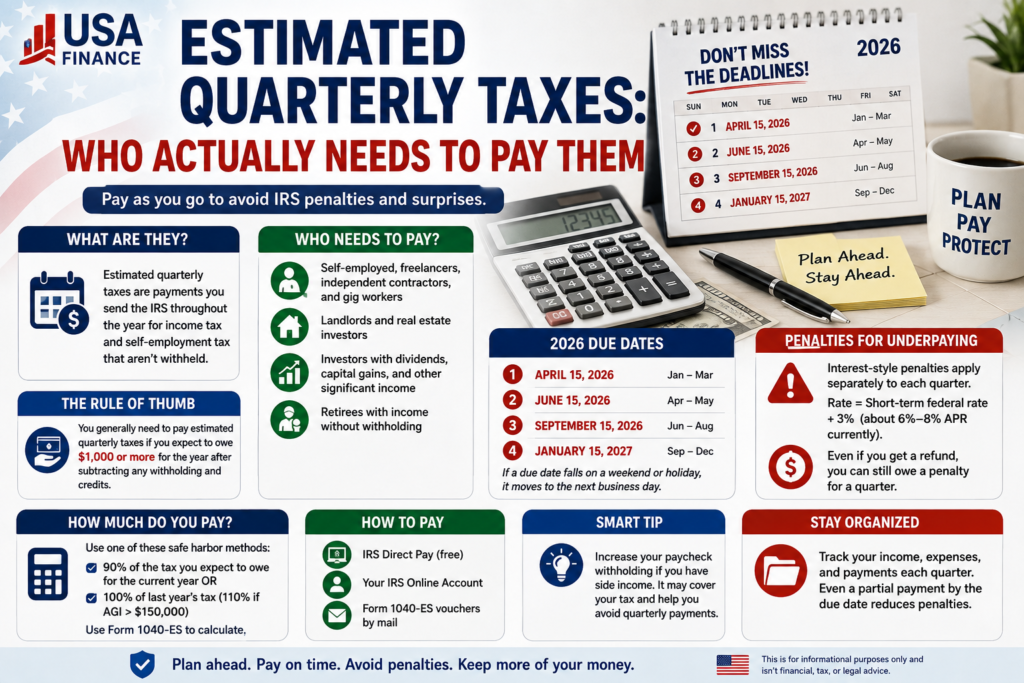
Estimated quarterly taxes are payments you send the IRS throughout the year to cover income tax and self employment tax that nobody withholds for you. They exist because the US tax system runs on a pay as you go basis, not a pay once a year basis.
For a typical employee, your employer withholds tax from every paycheck, so the government collects steadily all year. Freelancers, business owners, and anyone with significant income outside a paycheck do not have that automatic withholding, which is exactly the gap estimated quarterly taxes are meant to fill.
Despite the name, these payments do not each cover exactly three months of income. The four periods are uneven, so it helps to think of them as four IRS imposed deadlines rather than four equal calendar quarters.
Who Has to Pay Estimated Quarterly Taxes
The IRS rule is simple in concept: you generally need to make estimated quarterly taxes if you expect to owe $1,000 or more for the year after subtracting any withholding and credits.
This typically applies to self employed individuals, freelancers, independent contractors, and gig workers, since none of that income has tax withheld at the source. It also applies to landlords, investors with significant dividends or capital gains, and retirees living on income without automatic withholding.
Multiple income sources can also push someone over the threshold even when each one looks small on its own. A part time consulting gig, a bit of interest income, and a small rental property might each seem minor, but added together they can easily clear the $1,000 owed mark that triggers the requirement.
If you have a W-2 job and simply pick up a small amount of side income, you may be able to avoid separate quarterly payments entirely by increasing your paycheck withholding instead. That single adjustment can cover the extra tax without you having to track four separate payment dates.
Estimated Quarterly Taxes Due Dates for 2026
The 2026 deadlines for estimated quarterly taxes follow the standard IRS schedule, and none of them move even if you live or work abroad.
- April 15, 2026 – covers income earned January through March
- June 15, 2026 – covers income earned April and May
- September 15, 2026 – covers income earned June through August
- January 15, 2027 – covers income earned September through December
If any date falls on a weekend or federal holiday, the deadline shifts to the next business day. Missing even one of these dates can trigger a penalty, even if you plan to pay everything in full when you file.
How Much You Owe in Estimated Quarterly Taxes
Calculating estimated quarterly taxes comes down to picking one of two safe harbor methods, using IRS Form 1040-ES to do the math.
You can base your payments on 90 percent of what you expect to owe for the current year, or on 100 percent of what you owed last year, whichever is smaller. If your adjusted gross income was above $150,000 last year, that second option rises to 110 percent instead of 100 percent.
Estimated Quarterly Tax Payment Example
Say a freelancer expects to owe $12,000 in total tax for 2026, with no withholding from any other source. Using the safe harbor approach, they would divide that estimate into four payments of $3,000 each, due on the dates above.
If their income is uneven throughout the year, they can instead use the annualized income method, which adjusts each payment based on what was actually earned in that period rather than splitting the total evenly.
What Happens If You Skip Estimated Quarterly Taxes
Missing estimated quarterly taxes does not carry a flat fee. Instead, the IRS charges interest style penalties on the underpaid amount, calculated separately for each of the four periods.
The penalty rate is tied to the federal short term interest rate plus 3 percentage points, and it resets every quarter. Recent rates have landed in the 6 to 8 percent annual range, so the cost of skipping a payment adds up faster than many people expect.
One detail surprises a lot of filers: even if your return shows a refund overall, you can still owe a penalty for a specific quarter. The IRS evaluates each of the four estimated quarterly taxes deadlines on its own, so overpaying later in the year does not erase an earlier shortfall.
Making even a partial payment by each due date still reduces the penalty compared to paying nothing at all, so it is rarely worth skipping a deadline entirely just because you cannot cover the full amount owed.
How to Pay Estimated Quarterly Taxes
The IRS offers several ways to submit estimated quarterly taxes, and none of them require mailing a check if you prefer not to.
- IRS Direct Pay, which lets you pay straight from a bank account for free.
- Your IRS Online Account, which tracks your payment history so you can confirm each quarter was received.
- Form 1040-ES vouchers, if you would rather mail a paper check with each payment.
You can run your own estimated quarterly taxes numbers with our Self Employment Tax Calculator, entering your expected income and deductions to see what each of the four payments should be.
Bottom Line on Estimated Quarterly Taxes
Estimated quarterly taxes apply mainly to people whose income is not already covered by paycheck withholding, and the $1,000 owed threshold is the simplest test for whether you need to start paying them. Mark the four 2026 due dates now, since even a single missed payment adds a penalty that a bigger refund later in the year will not undo.
This is for informational purposes only and isn’t financial, tax, or legal advice.

Raghu Shekar writes about personal finance, banking, Medicare, and retirement planning at SimpleUSAFinance. His goal is simple: break down the numbers people actually need — no jargon, no sales pitch — so readers can make their own decisions with confidence. When he’s not writing, he’s usually digging through the latest rate changes, tax brackets, or Medicare updates to keep the site’s calculators and guides current.