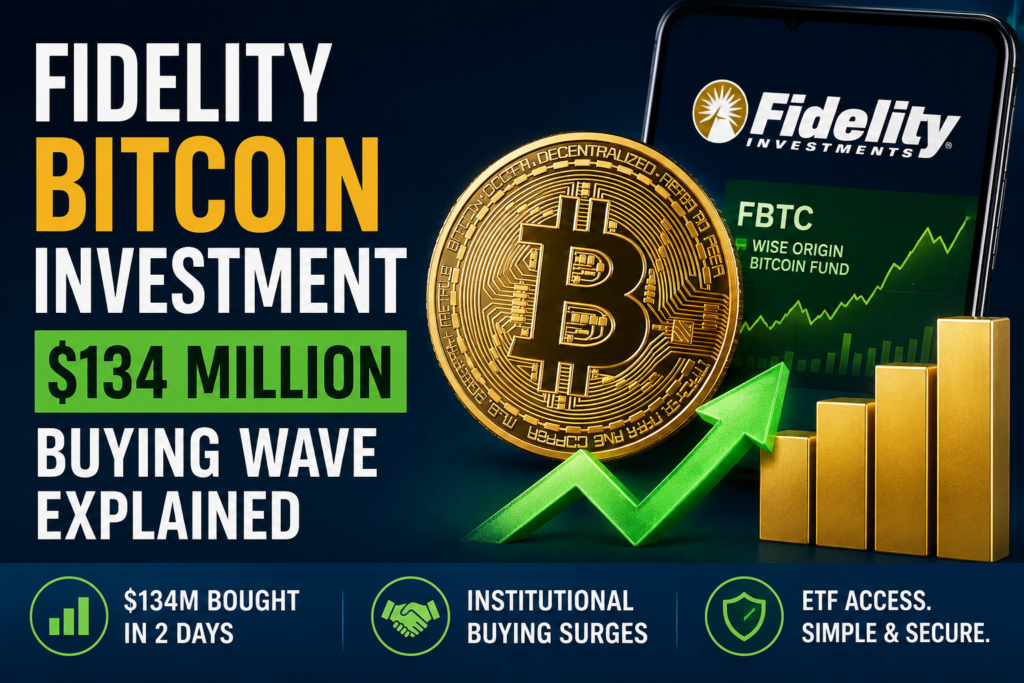
Fidelity bitcoin investment activity just made headlines again. Fidelity clients bought $134 million worth of bitcoin in only two days, even as the broader market went unusually quiet. If you’ve been wondering whether now is a strange time or a smart time to look at bitcoin investment through Fidelity, this article breaks down exactly what happened and what it means for an everyday investor.
What Just Happened With Fidelity Bitcoin Investment Activity
On August 19, 2026, reports from AMBCrypto and market data aggregators showed that bitcoin’s volatility had dropped below 98.5% of its historical range. Spot trading volume hit its lowest point since 2019. Markets were, in plain terms, unusually calm.
Despite that calm, or maybe because of it, institutional buyers including Fidelity clients purchased $134 million in bitcoin over just two trading days. That is a meaningful fidelity bitcoin investment signal, because big buyers tend to move quietly when they expect prices to rise later.
At the same time, the wider spot bitcoin ETF market showed a net outflow of roughly 102,000 BTC across 2026. So the picture is mixed. Some money is leaving the category overall, while Fidelity-linked buying picked up during the quiet stretch.
Why Fidelity Bitcoin Investment Flows Jumped in a Quiet Market
Low volatility periods often attract patient, longer-term buyers rather than short-term traders. When price swings shrink, big institutions can build positions without moving the market against themselves.
That pattern showed up clearly in Fidelity’s own ETF numbers. On August 18, 2026, Fidelity’s Wise Origin Bitcoin Fund, ticker FBTC, pulled in $111.9 million, which made up 81.5% of that day’s entire $137.3 million spot bitcoin ETF inflow. The next day, FBTC added another $23.9 million, though that smaller figure only offset about half of the prior selling pressure in the fund.
This is a common feature of bitcoin investment cycles. One strong day rarely proves a trend by itself, but a pattern of repeated Fidelity-led inflows during a quiet stretch is worth watching.
How the Fidelity Bitcoin Investment Fund (FBTC) Actually Works
FBTC is a spot bitcoin exchange traded fund, meaning it holds actual bitcoin rather than futures contracts. When you buy shares of FBTC through a brokerage account, you get price exposure to bitcoin without managing a crypto wallet, private keys, or an exchange account yourself.
As of early August 2026, FBTC held roughly $11.08 billion in assets, making it one of the largest bitcoin funds in the country behind BlackRock’s IBIT. Since spot bitcoin ETFs launched in January 2024, the entire category has drawn more than $51.8 billion in cumulative net inflows.
For everyday investors, this structure is the easiest entry point into fidelity bitcoin investment exposure. You do not need to touch crypto exchanges at all.
Fidelity Bitcoin Investment vs. the Rest of the ETF Market
Fidelity is not acting alone. BlackRock’s IBIT has consistently pulled in the largest single share of new money across the category, and on some sessions the two firms together have accounted for more than 90% of daily inflows.
Trading firm Jane Street also disclosed spot bitcoin ETF positions worth more than $1 billion, with roughly $828 million sitting in IBIT and the remainder spread across Fidelity and Grayscale products. That kind of disclosure adds weight to the idea that professional trading desks, not just retail traders, are treating bitcoin investment as a normal allocation now.
Still, the category is not one directional. During the week of August 10 to 14, 2026, bitcoin ETFs lost $389.7 million overall, with FBTC alone shedding $153.2 million. Fidelity bitcoin investment flows can swing hard in both directions within the same month.
Should You Follow Institutions Into Bitcoin Investment Through Fidelity
Seeing institutions buy is not the same as a personal recommendation. Institutions have different time horizons, risk tolerances, and reasons for buying than a typical household investor building a retirement plan.
That said, a fidelity bitcoin investment allocation through an ETF like FBTC is a lower-friction way to add small, controlled crypto exposure inside a normal brokerage or retirement account, if you decide it fits your plan at all.
How to Size a Bitcoin Investment Inside a Retirement Plan
Most financial planners who are comfortable with crypto exposure suggest keeping it to a small slice of a portfolio, often in the low single digits as a percentage of total savings. The exact number depends entirely on your time horizon, other holdings, and comfort with sharp price swings.
Before adding anything volatile like bitcoin to your mix, it helps to know your full retirement number first. You can run your own numbers with our Retirement Corpus Calculator to see how a small bitcoin investment allocation would shift your overall target, before you decide how much, if any, makes sense for you.
Risks Every Fidelity Bitcoin Investment Buyer Should Know
Bitcoin remains far more volatile than most traditional assets. The same week that produced $389.7 million in outflows also came with a Bitcoin price drop of over 20% across a three month stretch, according to fund performance data.
ETF structure also matters. FBTC and similar funds track bitcoin’s price, but they carry their own management fees and do not let retail shareholders redeem for actual coins. You are buying price exposure, not ownership of the underlying asset in the way a direct crypto wallet would give you.
Finally, remember that one strong buying week, even one led by Fidelity, does not guarantee a lasting trend. The data shows inflows and outflows have swung by hundreds of millions of dollars within the same month more than once in 2026.
Bottom Line
Fidelity bitcoin investment activity has been a real and closely watched signal in 2026, with clients buying $134 million during a historically quiet stretch and FBTC pulling in the majority of daily ETF inflows on several sessions. But the same fund also saw heavy outflows just days earlier, so treat any single wave of buying as one data point, not a guarantee, and size your own exposure based on your full financial picture.
This is for informational purposes only and isn’t financial, tax, or legal advice.

Raghu Shekar writes about personal finance, banking, Medicare, and retirement planning at SimpleUSAFinance. His goal is simple: break down the numbers people actually need — no jargon, no sales pitch — so readers can make their own decisions with confidence. When he’s not writing, he’s usually digging through the latest rate changes, tax brackets, or Medicare updates to keep the site’s calculators and guides current.