Understanding tax filing deadlines and extensions comes down to one distinction most people miss: some extensions happen the moment you qualify, and others only happen if you file a specific form on time. Mixing up which is which is one of the most common ways taxpayers end up with an avoidable penalty. Here is a plain English breakdown of tax filing deadlines and extensions for the current filing season, including exactly what requires action from you.
Tax Filing Deadlines and Extensions for the 2025 Tax Year
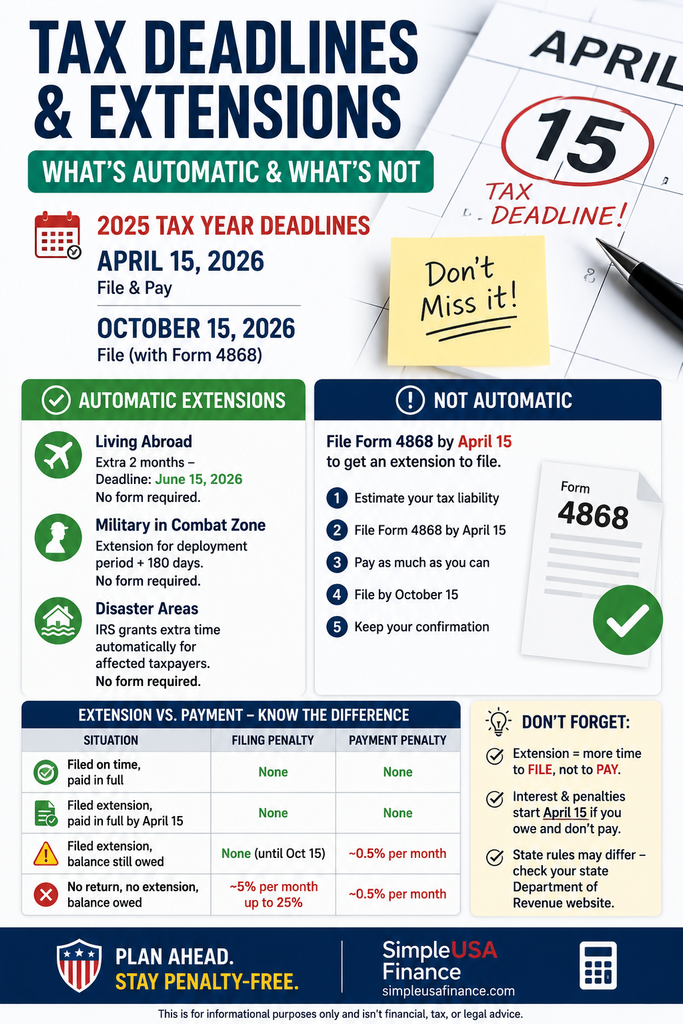
For the 2025 tax year, the standard filing and payment deadline was April 15, 2026. If you filed Form 4868 by that date, your extended filing deadline is October 15, 2026. That single form covers most of what people mean when they talk about tax filing deadlines and extensions each spring.
It is worth repeating because so many people get this wrong: the October date only moves your deadline to file. Your payment deadline and tax extensions are two separate things, and the payment deadline stayed at April 15, 2026 regardless of whether you requested more time to file.
What Is Automatic in Tax Filing Deadlines and Extensions
A few situations get extra time without submitting any paperwork at all:
- U.S. citizens or residents living abroad on the regular due date automatically receive an extra two months, moving their deadline to June 15, with no form required.
- Members of the military serving in a combat zone receive an automatic extension tied to the length of their deployment, plus 180 days after leaving the combat zone.
- Taxpayers in federally declared disaster areas typically receive automatic relief announced by the IRS, which can push both filing and payment deadlines back for affected counties.
These automatic tax filing deadlines and extensions apply without any application. You do not file a form to get them. The IRS applies the extension based on your address of record, military status, or the disaster declaration covering your area.
What Is Not Automatic in Tax Filing Deadlines and Extensions
Everything else requires you to take action before the original deadline. The standard six month extension, moving your filing date from April 15 to October 15, requires filing Form 4868 on or before April 15.
Filing this form is straightforward, and the IRS does not ask why you need the extra time. But if you miss the April 15 deadline without filing the form, you do not get the extension. This is the part of tax filing deadlines and extensions that trips people up most: they assume the extension exists automatically for everyone, when it actually depends on filing that one form by the original date.
Filing Form 4868: Tax Filing Deadlines and Extensions, Step by Step
Here is how to secure the non automatic extension correctly:
- Estimate your total tax liability for the year as accurately as you can.
- File Form 4868 electronically through IRS Free File, tax software, or a tax professional, or mail a paper copy, by April 15.
- Pay as much of your estimated balance due as possible with the extension request.
- File your completed return by the new October 15 deadline.
- Keep your confirmation, since it is your proof that you requested the extension on time.
Tax Filing Deadlines and Extensions vs Payment Deadlines
This distinction deserves its own section because it causes the most expensive mistakes. Tax filing deadlines and extensions only change when your paperwork is due. They do not change when your money is due.
If you owe money and pay nothing by April 15, interest and a failure to pay penalty of about 0.5% per month start accruing immediately, even if you filed a valid extension. If you also fail to file anything by October 15, a much steeper failure to file penalty of about 5% per month, up to 25% of the unpaid balance, applies on top of that.
| Situation | Filing Penalty | Payment Penalty |
|---|---|---|
| Filed on time, paid in full | None | None |
| Filed extension, paid in full by April 15 | None | None |
| Filed extension, balance still owed | None (until October 15) | ~0.5% per month |
| No return, no extension, balance owed | ~5% per month, up to 25% | ~0.5% per month |
If a large capital gain or one-time income event is part of why you expect to owe money this year, you can run your own numbers with our free Capital Gains Calculator before April 15 so your extension payment is closer to accurate.
State Tax Filing Deadlines and Extensions
Federal tax filing deadlines and extensions do not automatically cover your state return. Some states automatically honor a federal extension and require nothing extra. Others require you to file a separate state extension form, and a handful set their own deadlines that do not match the federal calendar at all.
Before assuming your state followed the same rules, check your state’s official Department of Revenue website or the IRS extension page linked above, since getting this wrong can leave your state return unprotected even when your federal one is fine.
What Happens If You Miss Tax Filing Deadlines and Extensions
Missing both the original date and the extension deadline does not mean you have no options. You can still file late, and if the IRS owes you a refund, there is no penalty for filing after the deadline, only a three year window to claim that refund.
If you owe money and missed every deadline, filing as soon as possible still stops the failure to file penalty from growing further. Understanding tax filing deadlines and extensions ahead of time is the best way to avoid this situation, but even after a missed date, acting quickly limits the damage.
Bottom Line
Tax filing deadlines and extensions boil down to two categories: a small number of automatic extensions for specific situations, and the standard six month extension that only applies if you file Form 4868 by April 15. Mark both dates, and remember that an extension buys you time to file, not time to pay.
This is for informational purposes only and isn’t financial, tax, or legal advice.

Raghu Shekar writes about personal finance, banking, Medicare, and retirement planning at SimpleUSAFinance. His goal is simple: break down the numbers people actually need — no jargon, no sales pitch — so readers can make their own decisions with confidence. When he’s not writing, he’s usually digging through the latest rate changes, tax brackets, or Medicare updates to keep the site’s calculators and guides current.