If you can’t pay your tax bill by April’s deadline, the good news is that missing a payment isn’t the disaster it feels like in the moment. The IRS has a whole system built around people who can’t pay your tax bill in full, and understanding it now can save you real money in penalties later. This guide walks through exactly what happens when you can’t pay your tax bill on time, what it costs, and what options actually help.
Filing vs. Paying: Two Separate Problems
The first thing to understand if you can’t pay your tax bill is that filing your return and paying what you owe are two completely separate obligations. Always file your return on time, or file for an extension, even if you can’t pay a cent. The penalty for not filing is far steeper than the penalty for not paying, so the worst move is to skip filing because you can’t pay your tax bill in full.
Why This Distinction Matters
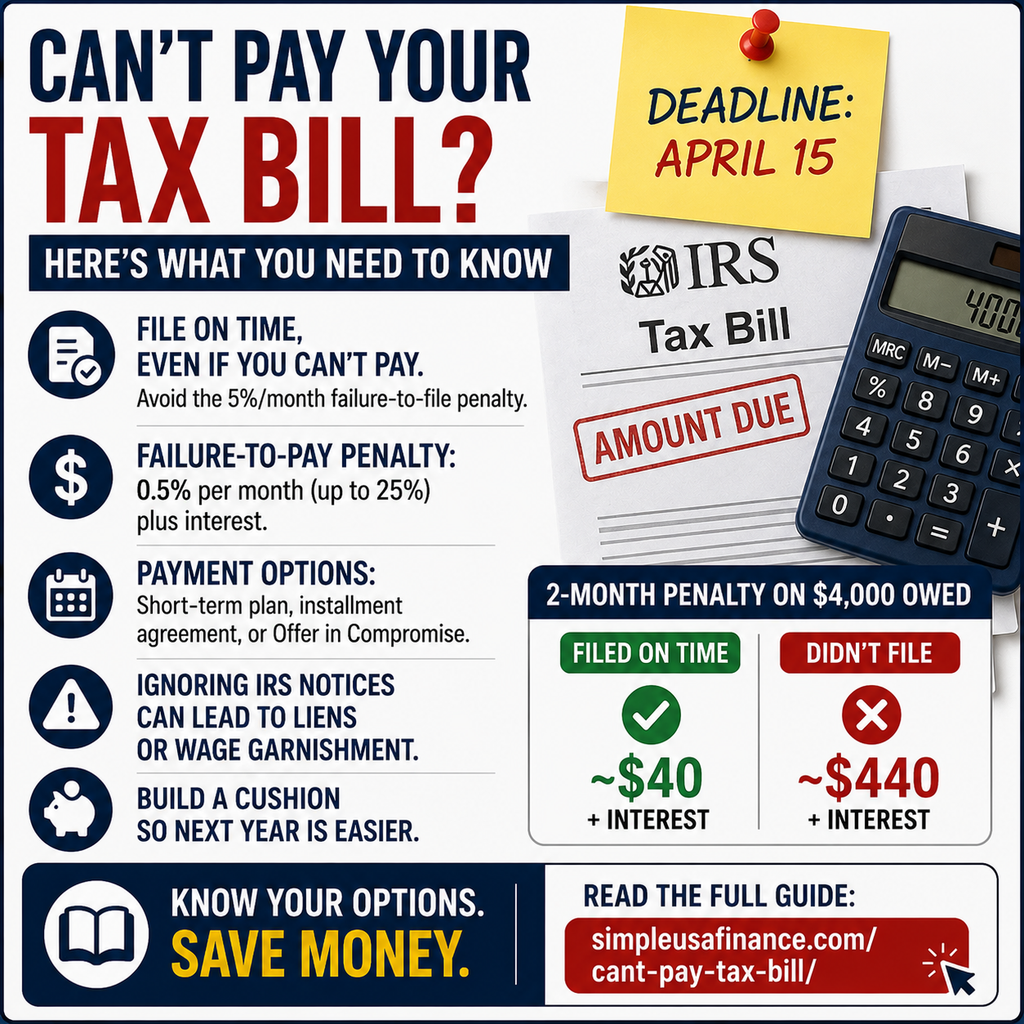
- Failure-to-file penalty: 5% of unpaid tax per month, up to 25%.
- Failure-to-pay penalty: 0.5% of unpaid tax per month, up to 25%.
- Filing on time even without payment cuts your monthly penalty by a factor of ten.
What the IRS Actually Charges You
When you can’t pay your tax bill by the deadline, two separate costs start accruing: the failure-to-pay penalty and interest on the unpaid balance.
Example: Say you owe $4,000 and can’t pay your tax bill by the April deadline, but you file on time. After two months, your failure-to-pay penalty is 1% ($40), plus interest at the current IRS rate (typically adjusted quarterly, so check the current published rate rather than assuming last year’s figure). That’s meaningfully cheaper than the failure-to-file penalty, which on the same $4,000 balance would run $400 over the same two months if you hadn’t filed at all.
| Scenario | Filed on Time? | 2-Month Penalty on $4,000 |
|---|---|---|
| Can’t pay, but filed | Yes | ~$40 + interest |
| Can’t pay, didn’t file | No | ~$440 + interest |
What Happens After the Deadline Passes
Once you can’t pay your tax bill and the deadline passes, the IRS sends a notice showing your balance, penalties, and accruing interest. This isn’t usually an immediate collections action, it’s a bill. Ignoring it is the actual danger, since continued non-response can eventually lead to a federal tax lien or, in more serious and prolonged cases, wage garnishment.
Payment Options When You Can’t Pay in Full
If you can’t pay your tax bill in one lump sum, the IRS offers several structured ways to handle the balance instead of just letting it sit unpaid.
- Short-term payment plan: up to 180 days to pay in full, generally no setup fee.
- Long-term installment agreement: monthly payments over a longer period, with a setup fee that’s often reduced for lower-income applicants.
- Offer in Compromise: settles the debt for less than owed, but only approved in specific financial-hardship cases.
Should You Use a Credit Card or Loan Instead?
Some people consider paying with a credit card when they can’t pay your tax bill through the IRS directly, but this usually costs more overall once processing fees and card interest are factored in, since IRS installment plan interest rates are typically lower than most credit card APRs. A personal loan at a lower fixed rate can sometimes beat both options, but only if you’re confident you can meet the new payment schedule.
Common Mistakes People Make
A common mistake is assuming that not paying and not filing carry the same penalty; they don’t, and the gap is large enough that it should change your decision. Another mistake is ignoring IRS notices entirely, which removes your ability to negotiate a manageable plan before enforcement action becomes more likely. People also sometimes drain an emergency fund entirely to pay a tax bill in full, when a short-term IRS payment plan at a lower effective cost might have preserved that cushion instead.
Building a Cushion So This Doesn’t Repeat
If this is the first time you can’t pay your tax bill, it’s worth setting aside a small buffer going forward so next year’s bill doesn’t catch you the same way. Run your own numbers with our Emergency Fund Calculator to see how a modest monthly set-aside could cover a tax bill of this size before the next deadline arrives.
According to the IRS‘s own published guidance, taxpayers who file on time and set up a payment plan avoid the steeper failure-to-file penalty entirely, even if the full balance isn’t paid immediately, which is why filing remains the single most important step regardless of your ability to pay.
Frequently Asked Questions
What happens immediately if you can’t pay your tax bill?
Nothing dramatic happens the day of the deadline itself, the IRS begins charging the failure-to-pay penalty and interest, and will mail a notice showing your balance.
Can the IRS take money directly from my bank account if I can’t pay?
Only after a formal collection process, which typically follows unpaid notices and unaddressed correspondence over an extended period, not immediately after the deadline.
Is there a penalty-free way to handle it if you can’t pay your tax bill?
Filing on time and setting up an IRS payment plan avoids the failure-to-file penalty and keeps the failure-to-pay penalty at its lowest possible rate.
Bottom Line
If you can’t pay your tax bill by the deadline, the single most important move is to file anyway and set up a payment plan rather than avoiding the situation. The failure-to-file penalty is far more expensive than the failure-to-pay penalty, and the IRS has structured options built for exactly this situation.
This is for informational purposes only and isn’t financial, tax, or legal advice.

Raghu Shekar writes about personal finance, banking, Medicare, and retirement planning at SimpleUSAFinance. His goal is simple: break down the numbers people actually need — no jargon, no sales pitch — so readers can make their own decisions with confidence. When he’s not writing, he’s usually digging through the latest rate changes, tax brackets, or Medicare updates to keep the site’s calculators and guides current.