Cashier’s check vs money order: it sounds like a small decision, but picking the wrong one can cost you extra fees or slow your payment down at the worst possible time. This guide breaks down what each one actually is, what it costs, how a wire transfer compares, and which one fits your situation.
What Is a Cashier’s Check?
A cashier’s check is drawn on the bank’s own funds, not yours, so the recipient knows the money is guaranteed the moment they cash it. Banks usually require you to have the funds available in your account before they’ll issue one. Because of that guarantee, cashier’s checks are the go-to choice in the cashier’s check vs money order decision whenever someone needs proof the payment won’t bounce, like a down payment or a car purchase.
What Is a Money Order?
A money order works similarly to a cashier’s check but on a smaller scale. You can buy one at a bank, post office, or even a grocery store, and you don’t need a bank account to get one. In the cashier’s check vs money order comparison, money orders are the budget-friendly option for smaller payments like rent or a mailed bill.
What Is a Wire Transfer?
A wire transfer moves money electronically, bank to bank, and it’s the fastest of the three. There’s no physical document involved, which makes it the practical pick when speed matters more than a paper trail, especially for large or international payments that need to land the same day.
Cashier’s Check vs Money Order: Fees and Limits (and Where Wire Transfers Fit)
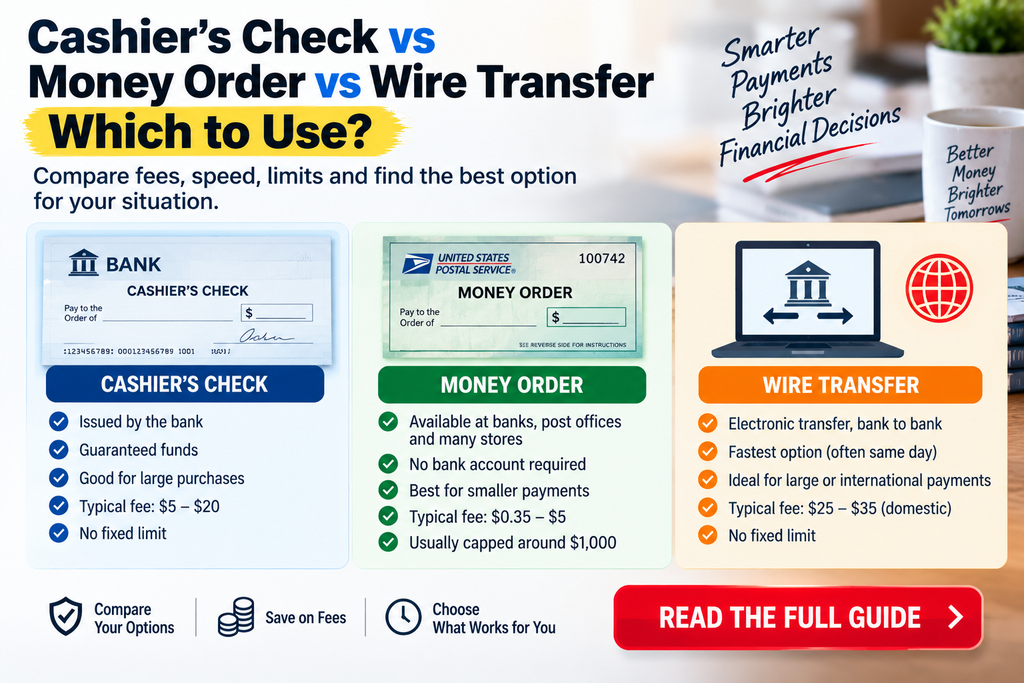
Fees vary by bank, but the pattern is consistent: money orders cost the least, cashier’s checks sit in the middle, and wire transfers cost the most, especially for international transfers.
Typical Fees for Each Payment Method – Cashier’s Check vs Money Order
Here’s a rough sense of what you’ll pay, based on current bank fee schedules:
| Method | Typical Fee | Typical Limit |
|---|---|---|
| Money Order | $0.35–$5 | Usually capped around $1,000 |
| Cashier’s Check | $5–$20 | No standard cap, bank-dependent |
| Domestic Wire Transfer | $25–$35 outgoing | No standard cap |
| International Wire Transfer | $35–$50 outgoing | No standard cap, currency conversion fees may apply |
These are typical ranges reported across major banks and credit unions as of 2026; always confirm the exact fee with your own bank before sending money, since pricing can vary by account type and whether you request the transfer online or in a branch.
A Real-World Example: Sending $2,500 Three Different Ways (Cashier’s Check vs Money Order vs Wire Transfer )
Numbers make the comparison easier. Say you need to send a $2,500 down payment to a seller.
- Money order: Not practical here, since most money orders cap out around $1,000 — you’d need multiple orders, which adds fees and hassle.
- Cashier’s check: One check, roughly $5–$20 in fees, guaranteed funds, but the seller has to wait for it to arrive and clear.
- Wire transfer: Costs more upfront, typically $25–$35, but the money can land the same business day with no physical document to lose or mail.
For a payment this size, the cashier’s check vs money order choice usually comes down to whether the seller needs the money instantly (favoring a wire) or is fine waiting a day or two for a mailed check.
Cashier’s Check vs Money Order: Speed and Safety
Speed is where these three separate the most. A money order and a cashier’s check both take time to mail or hand deliver, and the recipient still has to deposit or cash them. A wire transfer, once sent, typically lands the same business day.
On safety, all three beat sending cash. But a money order doesn’t show your bank account number the way a cashier’s check can, which makes it a better choice if privacy matters to you. Wire transfers are secure but harder to reverse once sent, so double-check the recipient’s account details before confirming.
What Happens If One Gets Lost or You Need to Cancel
Replacing a lost money order usually involves bringing your receipt to the issuer and requesting a trace, which can take a couple of weeks. A lost cashier’s check typically requires a written affidavit and a waiting period, often 90 days, before the bank reissues funds. Wire transfers are the hardest to undo once sent, since the money can reach the recipient’s account within hours — this is exactly why double-checking account details matters more with a wire than with the other two.
Which One Should You Use? Cashier’s Check vs Money Order?
The right answer in the cashier’s check vs money order question — and whether a wire transfer beats both — comes down to three things: how much you’re sending, how fast it needs to arrive, and whether the recipient needs a paper guarantee.
- Sending under $1,000 with no bank account needed: a money order.
- Making a large purchase where the seller wants guaranteed funds: a cashier’s check.
- Sending money urgently, especially internationally: a wire transfer.
If you’re setting money aside for one of these larger purchases rather than sending it right away, it’s worth running the numbers with our CD Growth Calculator to see what your funds could earn while you wait. And if the payment you’re planning is really about building a safety net rather than a one-time purchase, our Emergency Fund Calculator can help you figure out how much to keep liquid before you send anything at all.
Frequently Asked Questions – Cashier’s Check vs Money Order
Can a cashier’s check bounce? It’s extremely rare, since the bank guarantees the funds up front. The main risk is a forged or counterfeit cashier’s check, which is why large sellers often wait for it to fully clear before releasing goods.
Is a money order traceable? Yes. Keep your receipt — it has a serial number the issuer can use to trace or replace the money order if it’s lost or stolen.
Do wire transfers work internationally? Yes, and international wires are generally the fastest way to send money abroad, though they come with higher fees and sometimes currency conversion costs on top of the base fee.
Which option is cheapest for a small payment? A money order is almost always the cheapest choice for smaller amounts, typically under $5 in fees compared to $5–$20 for a cashier’s check or $25 and up for a wire transfer.
Bottom Line
There’s no single winner in the cashier’s check vs money order comparison — and a wire transfer beats both when speed matters more than cost. The right pick depends on the amount, the timeline, and how much of a paper trail you want. For most everyday payments a money order or cashier’s check will do the job; save the wire transfer for when speed is worth paying extra for.
This is for informational purposes only and isn’t financial, tax, or legal advice.

Raghu Shekar writes about personal finance, banking, Medicare, and retirement planning at SimpleUSAFinance. His goal is simple: break down the numbers people actually need — no jargon, no sales pitch — so readers can make their own decisions with confidence. When he’s not writing, he’s usually digging through the latest rate changes, tax brackets, or Medicare updates to keep the site’s calculators and guides current.