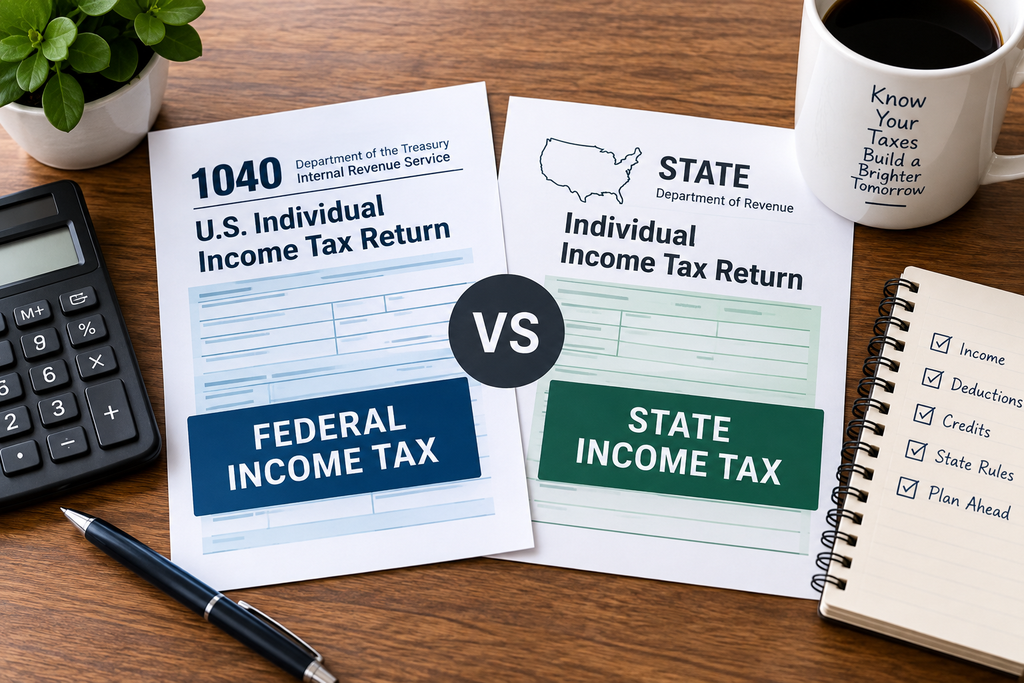
State income tax and federal income tax are calculated completely separately, use different brackets, and in nine states, one of them doesn’t exist at all. Understanding how state income tax works alongside your federal return helps you avoid surprises at filing time. Here’s exactly how the two systems differ, what they mean for your total tax bill, and how to check where your own state stands.
Federal Income Tax Is the Same Everywhere
Federal income tax follows one set of rules no matter where you live. For 2026, there are seven federal brackets — 10%, 12%, 22%, 24%, 32%, 35%, and 37% — and the standard deduction is $16,100 for single filers and $32,200 for married couples filing jointly, according to the IRS 2026 inflation adjustments. The top 37% rate applies only to income above $640,600 for single filers.
This federal structure is fixed regardless of your address. State income tax, by contrast, is decided entirely by each state legislature, which is why two people earning the same salary in different states can owe very different totals once it’s factored in.
Why State Income Tax Varies So Much by Location
State income tax isn’t a single system; it’s fifty different ones, plus Washington D.C. Some states charge nothing at all, some charge one flat rate, and others use progressive brackets similar to the federal model but with their own thresholds and rates.
The Three Types of State Income Tax Systems
Here’s a simple breakdown of how state income tax is structured across the country in 2026:
| State Income Tax Type | Example States | How It Works |
|---|---|---|
| No income tax | Alaska, Florida, Texas, Nevada, Wyoming, Washington, South Dakota, Tennessee, New Hampshire | Wages aren’t taxed at the state level at all |
| Flat rate | Colorado, Illinois, Michigan, Georgia | One single rate applies to all taxable income |
| Progressive brackets | California, New York, New Jersey | Rate increases in steps as income rises, similar to federal tax |
Nine states currently have no broad-based income tax at the state level, so residents there only deal with the federal system on their paychecks. Everyone else pays some form of state income tax on top of federal tax.
A Real-World Example: Same Salary, Two States
Numbers make this easier to picture. Say two single filers each earn $80,000 in wages in 2026 and each take the federal standard deduction of $16,100.
- Filer A, Texas (no state income tax): Pays federal tax only. No state return, no state withholding, no state liability at all.
- Filer B, a flat-rate state at 4.95%: Pays the same federal tax as Filer A, plus roughly $3,168 in state income tax on $64,000 of taxable income (assuming a similar state standard deduction).
Same job, same federal bracket, same paycheck before taxes — but a difference of over $3,000 a year once this tax enters the picture. This is the core reason cost-of-living comparisons between states always need to include it, not just rent and grocery prices.
State Income Tax Deductions Don’t Match Federal Ones
Even when a state does charge income tax, its deductions and exemptions rarely mirror the federal standard deduction. Many states set their own standard deduction amount, and some don’t offer one at all, instead using a flat exemption or credit system.
This means your federal taxable income and your state taxable income can be two different numbers on the same return. A deduction that lowers your federal bill, like certain retirement contributions, may or may not reduce your state income tax the same way, depending on your state’s rules. Some states also fully or partially exempt Social Security and pension income from this tax even though the federal government taxes a portion of it, which matters a lot for retirees comparing states.
Why You Can Owe State Income Tax Even With a Federal Refund
It’s entirely possible to get a federal refund and still owe state income tax, or the reverse. That’s because withholding, brackets, and deductions are calculated independently for each system. Your employer typically withholds separately for federal and state taxes, and the two never automatically balance each other out.
If you’ve moved between states during the year, this becomes even more important to track. Some states tax based on residency, others tax based on where income was earned, and a few can tax both under certain conditions, which can mean two separate state returns in a single year.
What This Means If You Move or Work Remotely
State income tax rules get complicated fast for remote workers and people who relocate mid-year. Moving from a high-tax state to one with none doesn’t automatically erase your obligation for income earned while you still lived in the old state. The Tax Foundation’s guide to state individual income taxes is a good starting point for checking your specific state’s current rules before you file.
Because state tax law changes fairly often — several states cut rates again for 2026 — it’s worth checking your state department of revenue site each filing season rather than relying on last year’s numbers. A handful of neighboring states also have reciprocity agreements that let commuters pay tax only where they live rather than where they work, but these agreements are limited to specific state pairs and don’t apply everywhere.
If you’re also weighing capital gains from investments as part of your overall tax picture, our Capital Gains Calculator can help you see how those gains interact with both your federal and state obligations.
Frequently Asked Questions
Does everyone pay state income tax? No. Nine states currently have no broad-based tax on wages at the state level, so residents there owe federal tax only.
Can my state income tax rate change during the year? Yes, though it’s uncommon mid-year. Most rate changes take effect at the start of a new tax year, so it’s worth checking for updates each January.
Do I still file a state return if I moved states? Usually yes, and often two partial-year returns — one for each state — depending on how long you lived in each and each state’s residency rules.
Is state income tax the same for every type of income? Not always. Some states tax wages but exempt or partially exempt Social Security, pensions, or retirement account withdrawals, which can meaningfully change your total bill in retirement.
Bottom Line
State income tax and federal income tax are separate systems with their own brackets, deductions, and rules, so a good outcome on one return doesn’t guarantee the same on the other. Knowing which type of system you live under, and how it treats your specific income sources, helps you plan more accurately all year, not just at filing time.
This is for informational purposes only and isn’t financial, tax, or legal advice.

Raghu Shekar writes about personal finance, banking, Medicare, and retirement planning at SimpleUSAFinance. His goal is simple: break down the numbers people actually need — no jargon, no sales pitch — so readers can make their own decisions with confidence. When he’s not writing, he’s usually digging through the latest rate changes, tax brackets, or Medicare updates to keep the site’s calculators and guides current.