Renting vs buying is not a question of which one is smarter in general. It is a question of which one wins the math for your specific city, income, and timeline right now. Here is the honest breakdown of what actually goes into that decision at today’s rates, including the breakeven math and the tax angle most comparisons skip.
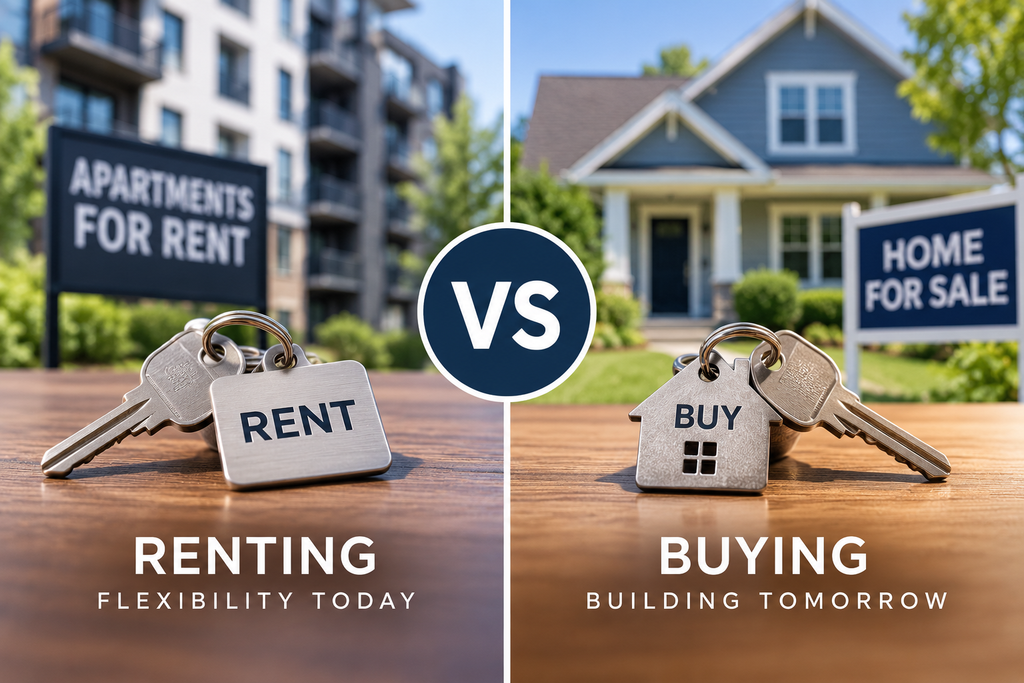
Why Renting vs Buying Looks Different Today Than It Did a Few Years Ago
Renting vs buying used to lean harder toward buying when mortgage rates sat near 3%. That environment is gone. As of September 2026, Freddie Mac’s weekly survey puts the average 30 year fixed mortgage rate at 6.71%, and daily lender pricing has been running even higher, closer to 6.8%, according to Freddie Mac’s Primary Mortgage Market Survey.
At that rate, the same loan amount that cost a certain monthly payment a few years ago now costs noticeably more. That single change is the biggest reason renting vs buying math has shifted so much for a lot of buyers.
The Real Cost of Buying Goes Beyond the Mortgage Payment
Anyone doing the renting vs buying comparison honestly has to include more than just principal and interest. Property taxes, homeowners insurance, private mortgage insurance if your down payment is under 20%, and ongoing maintenance all add real monthly cost on top of the loan payment itself.
A Simple Monthly Comparison
Here is a simplified look at how renting vs buying can compare on a $400,000 home with a 20% down payment, using a 6.71% rate on a $320,000 loan.
| Cost Category | Renting | Buying |
|---|---|---|
| Base monthly payment | Rent amount, varies by market | Roughly $2,070 principal and interest |
| Property taxes | Not applicable | Varies by county, often $300 to $500 per month |
| Insurance | Renters insurance, roughly $15 to $25 | Homeowners insurance, often $100 to $200 |
| Maintenance | Landlord’s responsibility | Typically 1% of home value per year |
| Upfront cost | Security deposit, usually one month’s rent | Down payment plus closing costs, often 2% to 5% of price |
Renting vs buying tends to favor renting in the short term simply because the upfront cost is so much lower, while buying’s advantage tends to build gradually as equity grows over time.
The Breakeven Point: When Does Buying Start to Win?
A useful way to cut through the renting vs buying debate is to find your personal breakeven point, the number of years it takes for buying’s cumulative cost (after accounting for equity built) to fall below renting’s cumulative cost. On the $400,000 example above, factoring in typical appreciation of 3% annually and closing costs of about 3% on both purchase and eventual sale, the breakeven point often lands somewhere between years 4 and 6. Stay shorter than that, and renting usually comes out ahead financially; stay longer, and buying typically wins. Your specific breakeven shifts earlier with lower rates or higher rent, and later with higher rates or a smaller rent gap.
How Long You Plan to Stay Changes the Math Completely
The renting vs buying decision is heavily influenced by your expected time horizon. Closing costs and the upfront cost of selling a home, often 8% to 10% of the sale price combined, mean buying rarely makes financial sense if you plan to move again within two or three years.
If you expect to stay in one place for five years or longer, the renting vs buying math starts shifting toward buying, since you have more time to recover those upfront costs through built up equity and any home price appreciation.
The Tax Angle Most Comparisons Skip
Renting vs buying comparisons often leave out the mortgage interest deduction, which can meaningfully change the after-tax cost of owning for some buyers. If you itemize deductions rather than taking the standard deduction, mortgage interest on loans up to $750,000 is generally deductible, along with property taxes up to the $10,000 SALT cap. For many households, especially those with a large mortgage balance in the early years when interest makes up most of the payment, this can lower the effective monthly cost of buying by a meaningful amount. That said, with the standard deduction now at $16,100 for single filers and $32,200 for joint filers in 2026, many homeowners no longer benefit enough from itemizing to make this a deciding factor, so it’s worth running your own numbers rather than assuming the deduction applies.
Opportunity Cost Is the Part People Forget
A fair renting vs buying comparison also has to account for what your money could earn elsewhere. If renting is meaningfully cheaper each month, the difference invested consistently in a retirement account or index fund can grow substantially over years, which is a real cost of buying that spreadsheets sometimes skip.
At the same time, a mortgage payment builds forced savings through equity, while rent payments build no ownership stake at all. Renting vs buying is really a comparison between building equity in a home versus building a separate investment portfolio, and the better answer depends on your discipline with the second option as much as the math itself.
Renting vs Buying at Today’s Rates: What Actually Tips the Decision
A few concrete factors tend to tip renting vs buying one way or the other right now. A stable job and a clear plan to stay put for five plus years favors buying, even with rates near 6.71%. A shorter timeline, an uncertain job situation, or a market where rent is significantly cheaper than a comparable mortgage payment tends to favor renting.
It also helps to run your own numbers rather than relying on national averages, since renting vs buying can look completely different in a high cost coastal city compared with a smaller metro area with lower home prices. In expensive coastal markets, the price-to-rent ratio can be high enough that renting remains cheaper even over a decade, while in many mid-sized metro areas, buying can pull ahead within just a few years.
Before you commit either way, it’s worth checking what a realistic monthly payment actually looks like for your target price range. Our Mortgage Affordability Calculator can help you see the full picture, including taxes and insurance, before you decide between renting vs buying.
Frequently Asked Questions
Does a bigger down payment always make buying the better choice? Not automatically. A larger down payment lowers your monthly payment and interest cost, but it also ties up more cash that could otherwise be invested or kept as an emergency cushion, so it shifts the renting vs buying math rather than settling it outright.
How much does mortgage rate really matter in the renting vs buying decision? Significantly. A one percentage point difference in rate on a $320,000 loan changes the monthly payment by roughly $200, which can shift your personal breakeven point by a year or more in either direction.
Is renting really “throwing money away” the way people often say? Not entirely. Renting pays for housing and flexibility without ownership risk or maintenance responsibility, and the money you save versus a larger mortgage payment can be invested instead of lost, so the “throwing money away” framing oversimplifies a genuine trade-off.
Bottom Line
Renting vs buying comes down to your timeline, your upfront cash, and what you would do with the money if you did not buy, not a blanket rule that applies to everyone. Running the real numbers for your own situation, including your personal breakeven point, is the only way to know which side of renting vs buying actually wins for you.
This is for informational purposes only and isn’t financial, tax, or legal advice.

Raghu Shekar writes about personal finance, banking, Medicare, and retirement planning at SimpleUSAFinance. His goal is simple: break down the numbers people actually need — no jargon, no sales pitch — so readers can make their own decisions with confidence. When he’s not writing, he’s usually digging through the latest rate changes, tax brackets, or Medicare updates to keep the site’s calculators and guides current.