A fixed pension pays you the same dollar amount every month for the rest of your life, and that is exactly the problem. While your payment stays flat, prices keep climbing, which means a fixed pension buys a little less every single year. Here is the real math behind that erosion, how it compares across different inflation scenarios, and what you can actually do about it.
Why a Fixed Pension Loses Value Even Though the Payment Never Changes
A fixed pension is designed for stability, not growth. Most traditional pensions pay a set monthly amount based on your salary and years of service, and that number is locked in at retirement. Unlike Social Security, a fixed pension typically has no built in cost of living adjustment, so the SSA’s official 2.8% COLA for 2026 gives you a sense of how much prices are rising annually, even though your fixed pension itself will not move at all.
That gap is the entire story. Inflation does not need to spike dramatically to cause damage. Even a modest, steady inflation rate compounds year after year, and a fixed pension has no mechanism to keep pace with it.
The Math Behind a Shrinking Fixed Pension
A Simple Example Over 20 Years
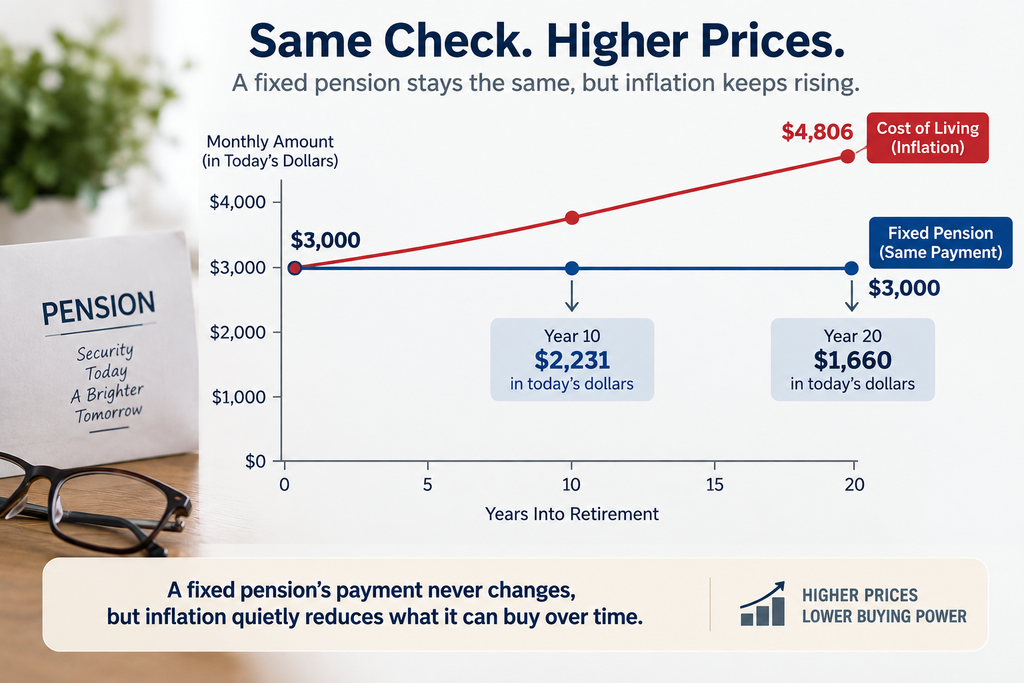
Assume a fixed pension pays $3,000 per month at retirement, and inflation averages 3% per year, which is close to the long run historical average. Here is what that pension is actually worth in today’s dollars over time.
| Years Into Retirement | Fixed Pension Payment | Real Buying Power (Today’s Dollars) |
|---|---|---|
| Year 0 | $3,000 | $3,000 |
| Year 10 | $3,000 | Roughly $2,231 |
| Year 20 | $3,000 | Roughly $1,660 |
The dollar amount of the fixed pension never changes in this example, but its real purchasing power drops by nearly half over two decades. That is the quiet part of inflation: nothing looks wrong on the pension statement, yet the same check buys noticeably less every year.
How the Erosion Changes at Different Inflation Rates
The 3% example above is a reasonable long run average, but actual inflation swings year to year. Here’s the same $3,000 fixed pension’s real value after 20 years under different average inflation assumptions:
| Average Annual Inflation | Real Value of $3,000 After 20 Years |
|---|---|
| 2% | Roughly $2,015 |
| 3% | Roughly $1,660 |
| 4% | Roughly $1,369 |
Even the “mild” 2% scenario, which is the Federal Reserve’s long run target, still cuts a fixed pension’s real buying power by about a third over two decades. There is no inflation rate low enough to fully protect an unadjusted fixed pension over a full retirement.
Why This Hits Retirees Harder Than Working People
Working people usually get raises that at least partially track inflation over time. A fixed pension offers no such adjustment, which means retirees relying heavily on one can fall behind steadily without any single dramatic event causing it.
This effect compounds with rising healthcare costs specifically, since medical expenses have historically outpaced general inflation. A retiree living mostly on a fixed pension may find that healthcare alone eats a growing share of a budget that itself is not growing at all.
Social Security’s COLA Highlights the Gap
Comparing a fixed pension against Social Security makes the erosion easier to see. Social Security includes an annual cost of living adjustment specifically to protect against this problem; the Social Security Administration’s official 2026 COLA fact sheet confirms a 2.8% increase for benefits starting in January 2026.
A pension has no equivalent adjustment built in. Over a 20 or 30 year retirement, that missing annual increase is the single biggest structural difference between the two income sources, even when they start out paying similar monthly amounts.
What About Pensions With a Partial COLA?
Not every pension is completely fixed. Some government and union pensions include a capped cost of living adjustment, often limited to 1% to 3% annually regardless of actual inflation. A capped COLA softens the erosion but doesn’t eliminate it: if inflation runs at 5% in a given year and your pension’s COLA cap is 2%, you still lose 3 percentage points of real purchasing power that year, even though your check technically went up. It’s worth checking your specific pension plan documents to see whether any COLA provision exists and, if so, what the cap is.
What You Can Do to Offset a Fixed Pension’s Erosion
You cannot change how your fixed pension is structured, but you can build a broader retirement plan around its limitation. A few practical strategies help offset the gap.
- Delay claiming Social Security if possible, since waiting increases your monthly benefit, and that benefit does adjust with inflation.
- Keep a portion of your retirement savings invested rather than entirely in cash, since cash alone also loses purchasing power to inflation over time.
- Build a separate inflation buffer using investments like Treasury Inflation Protected Securities, which are specifically designed to track inflation.
- Review your budget periodically rather than assuming your pension will always cover the same expenses it did at retirement.
None of these fully replace what an automatic cost of living adjustment would provide, but together they can meaningfully soften how much a pension’s erosion affects your day-to-day life.
Planning Around a Fixed Pension That Will Not Grow
The most important step is simply recognizing the problem early. A fixed pension that looks perfectly comfortable in year one can feel noticeably tighter by year fifteen, purely from inflation working in the background the entire time. According to the Bureau of Labor Statistics’ inflation data, even modest annual inflation compounds significantly over a typical retirement length.
If you are still working toward retirement and want to see how a pension compares against taking a lump sum instead, our Lump Sum vs Annuity Calculator can help you weigh a guaranteed pension against a lump sum you could invest and manage yourself.
Frequently Asked Questions
Do all pensions lack a cost of living adjustment? No. Many federal government pensions (like CSRS) include a full COLA tied to inflation, while many private-sector and some state pensions offer no adjustment at all or a capped one. It depends entirely on your specific plan.
Is a lump sum better than a fixed pension because of inflation risk? Not automatically. A lump sum shifts the inflation and investment risk onto you instead of the pension provider, which can work out better or worse depending on how you invest it and how long you live. It’s a trade-off, not a clear win.
Can I ask my pension provider to add a COLA after I’ve already retired? Generally no. The COLA terms, if any exist, are set by the plan itself and typically cannot be added or negotiated individually after you’ve already started receiving payments.
Bottom Line
A fixed pension provides valuable, guaranteed income, but without any cost of living adjustment, inflation quietly reduces what that income can actually buy every single year. Planning around a fixed pension’s limitation early, rather than discovering it a decade into retirement, is the difference between a comfortable retirement and a tight one.
This is for informational purposes only and isn’t financial, tax, or legal advice.

Raghu Shekar writes about personal finance, banking, Medicare, and retirement planning at SimpleUSAFinance. His goal is simple: break down the numbers people actually need — no jargon, no sales pitch — so readers can make their own decisions with confidence. When he’s not writing, he’s usually digging through the latest rate changes, tax brackets, or Medicare updates to keep the site’s calculators and guides current.