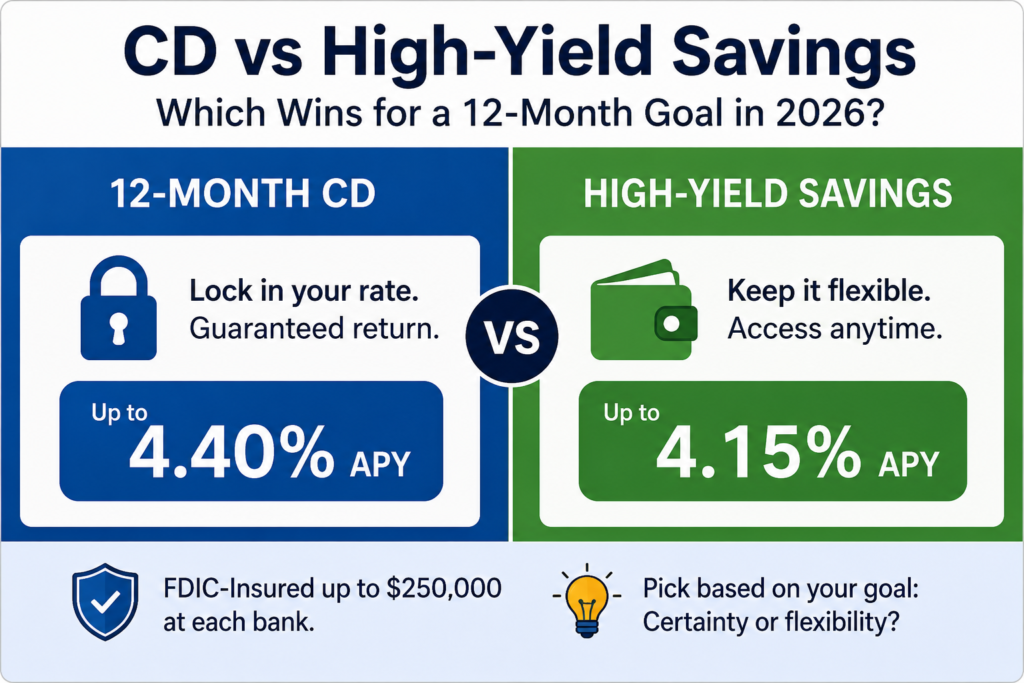
If you have a lump sum you need in exactly 12 months, a wedding, a down payment, a tax bill, the CD vs high-yield savings decision comes down to one trade: a locked rate against a flexible one. As of mid August 2026, the best 12-month CDs pay up to about 4.40% APY, while the best high-yield savings accounts pay up to roughly 4.15% APY, so the gap in CD vs high-yield savings returns is smaller than it has been in past years. This guide compares the real numbers, the fine print, and how to decide between CD vs high-yield savings for money you cannot afford to lose access to for very long.
CD vs High-Yield Savings: The Quick Answer for 12 Months
For most people saving toward a fixed 12-month goal, CD vs high-yield savings comes down to certainty versus access. A 12-month CD locks in today’s rate for the full year, even if rates drop. A high-yield savings account keeps your money accessible any time, but the rate can change without notice.
Right now the two options pay close to the same amount, so the choice depends more on whether you might need the money early than on the interest rate alone.
How a 12-Month CD Works (CD vs High-Yield Savings, Side One)
A 12-month certificate of deposit pays a fixed interest rate for one year in exchange for leaving your money on deposit until maturity. As of mid August 2026, top 12-month CD rates reach about 4.40% APY, well above the national average 12-month CD rate of 1.68% APY.
If you withdraw your money before the 12 months are up, most banks charge an early-withdrawal penalty, typically around 90 days of interest. That penalty is the main cost of choosing a CD over the more flexible side of CD vs high-yield savings.
Your CD is FDIC-insured up to $250,000 per depositor, per bank, the same protection that applies to savings accounts.
How High-Yield Savings Accounts Work (CD vs High-Yield Savings, Side Two)
A high-yield savings account pays a variable interest rate that can move up or down at any time, and you can add or withdraw money whenever you want. As of mid August 2026, the best high-yield savings accounts pay around 4.15% APY, compared with the national average traditional savings rate of just 0.38%.
Because the rate is variable, a high-yield savings account can lose its edge in CD vs high-yield savings if the Federal Reserve cuts rates during your 12-month window. So far in 2026 the Fed has kept its benchmark rate unchanged, but that can shift.
Like a CD, a high-yield savings account is FDIC-insured up to $250,000 per depositor, per bank.
CD vs High-Yield Savings: Comparing the Numbers on $10,000
Numbers make the CD vs high-yield savings decision easier to picture than percentages alone. Here is what $10,000 earns over 12 months at today’s top rates.
| Account | Top APY (Aug 2026) | Interest on $10,000 over 12 months |
|---|---|---|
| 12-month CD | 4.40% | About $440 |
| High-yield savings | 4.15% | About $415 |
The CD comes out about $25 ahead on $10,000, assuming you never touch the money and the high-yield savings rate stays flat for the full year. That second assumption is the catch. If your high-yield savings rate drops partway through the year, the real gap in CD vs high-yield savings could grow wider in the CD’s favor.
High-Yield Savings or CD: What You Give Up Either Way
Every choice in CD vs high-yield savings involves giving something up. With a CD, you give up access. Your money is locked for the full term, and pulling it out early costs you real interest.
With high-yield savings, you give up certainty. Today’s rate is not guaranteed tomorrow, and if rates fall, your return for the year could end up lower than a CD you could have locked in now.
Neither trade off is wrong. It depends on how confident you are that you will not need the money before your 12-month goal arrives.
CDs vs High-Yield Savings Accounts: Which Fits a 12-Month Goal
For a goal with a firm date, like a wedding deposit or a car purchase next summer, a 12-month CD is usually the simpler pick in CD vs high-yield savings, since you already know you will not touch the money until the date arrives.
For a goal that could move, like an emergency fund or a flexible house down payment, high-yield savings usually wins the CD vs high-yield savings comparison, because you keep access if your plans change.
Splitting the Difference: Using Both a CD and a High-Yield Savings Account
You do not have to pick only one side of CD vs high-yield savings. Many savers split their money, keeping part in a high-yield savings account for flexibility and locking the rest in a 12-month CD for a guaranteed return.
Keeping 40% liquid in high-yield savings and locking 60% in a CD gives you a partial hedge against both risks, rate drops and the need for early access. It is a reasonable middle ground for anyone who is not fully sure which side of CD vs high-yield savings fits their situation.
Bottom Line: For a firm 12-month goal, CD vs high-yield savings comes down to whether you value a locked-in guaranteed return or the flexibility to pull your money out early. As of August 2026, top CD rates and top high-yield savings rates are close enough that either choice earns a solid return, so pick based on how likely you are to need the money before the year is up.
For more ways to compare CD vs high-yield savings and other account types, browse our full Banking section as we add more guides & check our calculators
This is for informational purposes only and isn’t financial, tax, or legal advice

Raghu Shekar writes about personal finance, banking, Medicare, and retirement planning at SimpleUSAFinance. His goal is simple: break down the numbers people actually need — no jargon, no sales pitch — so readers can make their own decisions with confidence. When he’s not writing, he’s usually digging through the latest rate changes, tax brackets, or Medicare updates to keep the site’s calculators and guides current.