If you are new to Medicare, Medicare Part A vs Part B vs Part D can feel like three separate insurance policies you have to piece together on your own, and in a way, it is. Each part pays for a different slice of your care, and none of them cover everything. Part A handles hospital stays, Part B handles doctor visits and outpatient care, and Part D handles prescription drugs, and understanding how Medicare Part A vs Part B vs Part D fit together is the difference between a smooth retirement budget and a surprise bill. By the end, Medicare Part A vs Part B vs Part D will feel less like alphabet soup and more like a simple three part system.
Medicare Part A vs Part B vs Part D: The Quick Breakdown
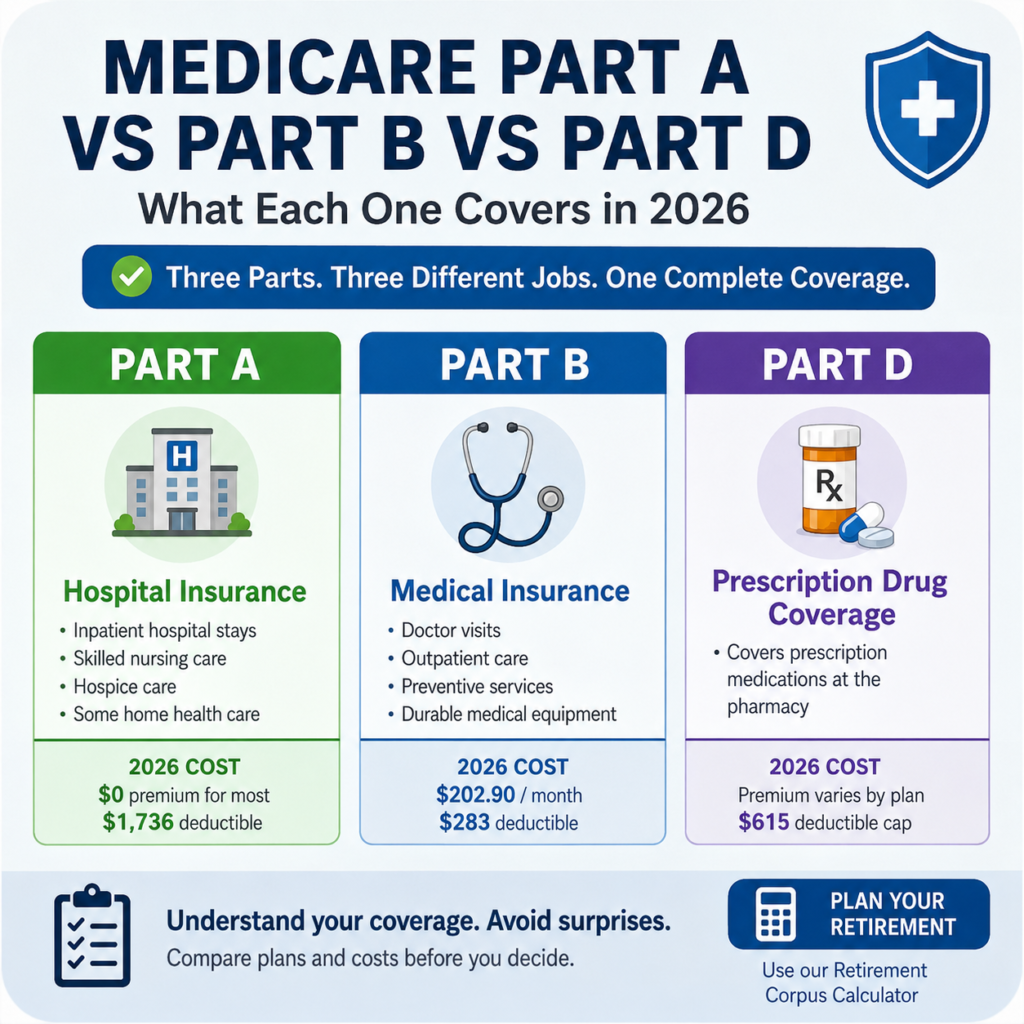
Here is the short version. Medicare Part A vs Part B vs Part D breaks down like this: Part A is hospital insurance, Part B is medical insurance for outpatient care, and Part D is prescription drug coverage. Together, Part A and Part B make up what is called Original Medicare. Part D is a separate add on that most people buy through a private insurer.
Most people get Part A for free because they paid Medicare taxes for at least 10 years. Part B and Part D both carry a monthly premium, and both premiums usually come straight out of your Social Security check.
What Medicare Part A Covers (Part A vs Part B vs Part D, Piece One)
Medicare Part A covers inpatient hospital stays, skilled nursing facility care after a hospital stay, hospice care, and some home health care. It does not cover long-term custodial care, like help with bathing or dressing on an ongoing basis.
In 2026, Part A is premium-free for most people. If you or your spouse worked and paid Medicare taxes for at least 40 quarters, roughly 10 years, you pay nothing for the Part A premium. If you have 30 to 39 quarters, the premium is $311 a month. With fewer than 30 quarters, it jumps to $565 a month.
You do still owe a deductible. The Part A inpatient hospital deductible is $1,736 per benefit period in 2026, and a benefit period can repeat more than once a year if you are hospitalized more than once. That deductible is one of the three separate costs you are tracking across Medicare Part A vs Part B vs Part D.
What Medicare Part B Covers (Part A vs Part B vs Part D, Piece Two)
Medicare Part B covers doctor visits, outpatient procedures, preventive screenings, durable medical equipment, and some home health services. This is the part of Medicare that pays for the everyday, non hospital side of your care.
The standard Part B premium in 2026 is $202.90 a month, and the annual deductible is $283. After you hit the deductible, Medicare typically pays 80 percent of the approved amount for covered services, and you pay the remaining 20 percent as coinsurance.
If your income is above a certain threshold, you pay more than the standard premium through an income-related surcharge called IRMAA, based on your tax return from two years earlier. Combined with your Part A costs, this is the second piece of the Medicare Part A vs Part B vs Part D puzzle.
What Medicare Part D Covers (Part A vs Part B vs Part D, Piece Three)
Medicare Part D covers prescription drugs through private insurance plans that Medicare approves. Neither Part A nor Part B pays for the medications you pick up at a pharmacy, which is exactly why Part D exists.
For 2026, the standard Part D deductible is capped at $615, and the out-of-pocket cap for covered drugs is $2,100. Once you hit that cap, your covered drug costs drop to $0 for the rest of the year. Actual plan premiums vary by insurer and by which drugs you take, so there is no single 2026 number that applies to everyone. That rounds out the three way comparison of Medicare Part A vs Part B vs Part D on cost alone.
Here is the split in dollar terms:
| Part | What It Pays For | 2026 Standard Cost |
|---|---|---|
| Part A | Hospital stays, skilled nursing, hospice | $0 premium for most; $1,736 deductible |
| Part B | Doctor visits, outpatient care | $202.90/month; $283 deductible |
| Part D | Prescription drugs | Premium varies by plan; $615 deductible cap |
Medicare Part A vs Part B: The Line People Mix Up Most
The most common confusion is not between drug coverage and everything else. It is between Part A and Part B. People assume a hospital bill for something like a same-day procedure falls under Part A, when it is often billed under Part B instead.
The rule of thumb is simple. If you are formally admitted to the hospital as an inpatient, Part A is billing you. If you are getting outpatient care, even inside a hospital building, including same-day surgery or an emergency room visit that does not lead to admission, Part B is billing you. Getting this wrong is the single biggest mix up in Medicare Part A vs Part B vs Part D.
Part B vs Part D: Why You Might Need Both
Part B and Part D solve two completely different problems. Part B keeps your doctor visits and outpatient care affordable. Part D keeps your prescription costs affordable. Skipping either one does not save you money long term, it just shifts the bill.
If you delay enrolling in Part B or Part D when you first become eligible and do not have other creditable coverage, you can face a late enrollment penalty that follows you for as long as you have that coverage. That penalty risk is one more reason to get your Medicare Part A vs Part B vs Part D enrollment timing right.
Medicare Part A vs Part B vs Part D — Picking What You Actually Need
There is no universal right answer for Medicare Part A vs Part B vs Part D, because the right combination depends on your health, your budget, and the doctors you want to keep. Some people stick with Original Medicare, Part A and Part B, and add a standalone Part D plan plus a supplement policy. Others choose a Medicare Advantage plan that bundles hospital, medical, and often drug coverage into one card.
Before you decide, it helps to see the full retirement budget picture, not just the Medicare piece. You can run your own numbers with our Retirement Corpus Calculator to see how Part A, Part B, and Part D premiums fit alongside your other retirement income and expenses.
Original Medicare (Part A and Part B) vs Medicare Advantage, and Where Part D Fits
Original Medicare, meaning Part A and Part B together, gives you broad access to any doctor or hospital that accepts Medicare, and you add Part D separately for drug coverage. Medicare Advantage plans usually include Part D built in, but they limit you to a network, similar to how a regular health insurance plan works.
Neither path is wrong. The comparison that matters is not really Part A vs Part B vs Part D on paper, it is how those parts work together under whichever path you pick. Whichever path you choose, revisit your Medicare Part A vs Part B vs Part D choices every year during open enrollment, since costs and needs both change.
Bottom Line: Medicare Part A vs Part B vs Part D covers three different slices of your healthcare, hospital stays, outpatient care, and prescription drugs, and in 2026 the standard costs are $202.90 a month for Part B, a $283 Part B deductible, a $1,736 Part A deductible, and a $615 Part D deductible cap. Knowing which part is billing you, and when, is what keeps a normal medical bill from turning into a surprise one.
Check more on medicare
This is for informational purposes only and isn’t financial, tax, or legal advice.

Raghu Shekar writes about personal finance, banking, Medicare, and retirement planning at SimpleUSAFinance. His goal is simple: break down the numbers people actually need — no jargon, no sales pitch — so readers can make their own decisions with confidence. When he’s not writing, he’s usually digging through the latest rate changes, tax brackets, or Medicare updates to keep the site’s calculators and guides current.