A lender can tell you the maximum loan you qualify for, but that number and how much house you can afford are often two very different things. Approval is based on your income and debt ratios. It says nothing about your other goals, your job stability, or how you actually want to live. This guide walks through how to figure out how much house you can afford on your own terms, with a real example you can copy.
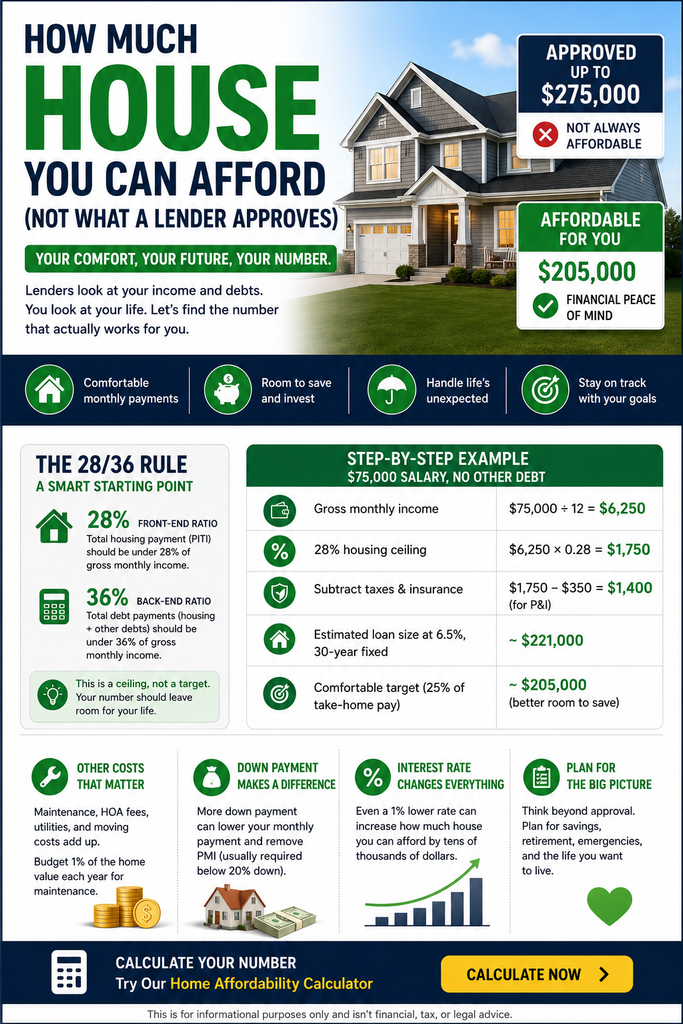
The gap between a lender’s maximum and how much house you can afford matters because that gap is where financial stress quietly builds. Getting approved is not the same as being comfortable.
How Much House You Can Afford: The Short Answer
The short answer to how much house you can afford is this: it is the monthly payment that still lets you save, cover emergencies, and handle a bad month without panic, not the largest payment a bank thinks you can technically carry. Lenders look backward at your current debts. You need to look forward at your full financial picture.
That distinction is the entire point of this guide. Everything below builds toward a number you set for yourself, not one a loan officer sets for you.
Why Lender Approval Isn’t How Much House You Can Afford
Lenders approve you based on debt-to-income ratios and your credit profile. They do not know about your planned career break, your childcare costs, your retirement savings goals, or how much you value having cash on hand. That is why the approved amount and how much house you can afford can differ by tens of thousands of dollars.
Most lenders will approve a monthly housing payment up to around 28 percent of your gross monthly income, and total debt payments up to around 36 percent, a benchmark known as the 28/36 rule. The Consumer Financial Protection Bureau’s guide to affordability walks through how lenders apply this ratio in practice. That is a ceiling, not a target, and it is only the first input into figuring out how much house you can afford for your own life.
The 28/36 Rule: How Much House You Can Afford Based on Income
The 28/36 rule is a useful starting point for how much house you can afford, even though it is not the final word. Here is what it means in practice:
- 28 percent front-end ratio. Your total housing payment, including principal, interest, taxes, and insurance, should stay under 28 percent of gross monthly income.
- 36 percent back-end ratio. All debt payments combined, housing plus car loans, student loans, and credit cards, should stay under 36 percent of gross monthly income.
Many lenders will stretch these ratios higher for well qualified borrowers, which is exactly why relying on lender approval alone can push you past how much house you can actually afford comfortably.
Step by Step: How Much House You Can Afford on a $75,000 Salary
Let’s walk through the math using a household with $75,000 in gross annual income and no other debt.
- Gross monthly income: $75,000 divided by 12 equals $6,250
- 28 percent housing ceiling: $6,250 multiplied by 0.28 equals $1,750 a month
- Subtract taxes and insurance: Estimate $350 a month for property taxes and insurance, leaving $1,400 for principal and interest
- Estimated loan size: At a 6.5 percent 30-year fixed rate, $1,400 a month supports a loan of roughly $221,000
- Comfortable target: Many financial planners suggest capping housing costs closer to 25 percent of take home, not gross, pay, which for this household lands closer to $1,300 a month and a loan nearer $205,000
That last step is the real answer to how much house you can afford, a number noticeably below the lender’s ceiling, but one that leaves room for savings, retirement contributions, and an emergency fund.
Other Costs That Change How Much House You Can Afford
The mortgage payment is rarely the whole story. Maintenance, HOA fees, utilities, and moving costs all affect how much house you can afford in practice. A good rule of thumb is to budget 1 percent of the home’s value per year for maintenance alone.
Closing costs, typically 2 percent to 5 percent of the purchase price, also reduce the cash you have left over after moving in, which is one more reason how much house you can afford should account for more than just the monthly payment. HUD’s housing counseling resources are a free way to get a second opinion on your full budget before you commit.
Down Payment and Rate: How Much House You Can Afford Changes With Both
Your down payment and your mortgage rate both swing how much house you can afford by a wide margin. A larger down payment lowers your monthly payment and can remove the need for private mortgage insurance, typically required below 20 percent down. A lower rate stretches your budget further for the exact same monthly payment.
Even a one-point difference in rate can change how much house you can afford by tens of thousands of dollars in loan size, so it is worth shopping multiple lenders before you set your target price range.
Bottom Line
Now you know how much house you can afford is a number you calculate yourself, starting from your real budget, not the largest figure a lender is willing to approve. If you want to plug in your actual income and debts, try our Home Affordability Calculator before you start touring listings.
This is for informational purposes only and isn’t financial, tax, or legal advice.

Raghu Shekar writes about personal finance, banking, Medicare, and retirement planning at SimpleUSAFinance. His goal is simple: break down the numbers people actually need — no jargon, no sales pitch — so readers can make their own decisions with confidence. When he’s not writing, he’s usually digging through the latest rate changes, tax brackets, or Medicare updates to keep the site’s calculators and guides current.