Turning 73 triggers one of the biggest shifts in retirement account rules you will face: required minimum distributions at 73 become mandatory, not optional. Under the SECURE 2.0 Act, the IRS requires most retirement account owners born between 1951 and 1959 to start withdrawing a set minimum amount from tax deferred accounts starting the year they turn 73. This guide breaks down what changes, how the math works, and what happens if you miss one.
Understanding required minimum distributions at 73 now, before your first deadline hits, gives you time to plan withdrawals in a way that does not blow up your tax bracket for the year.
Required Minimum Distributions at 73: The Short Answer
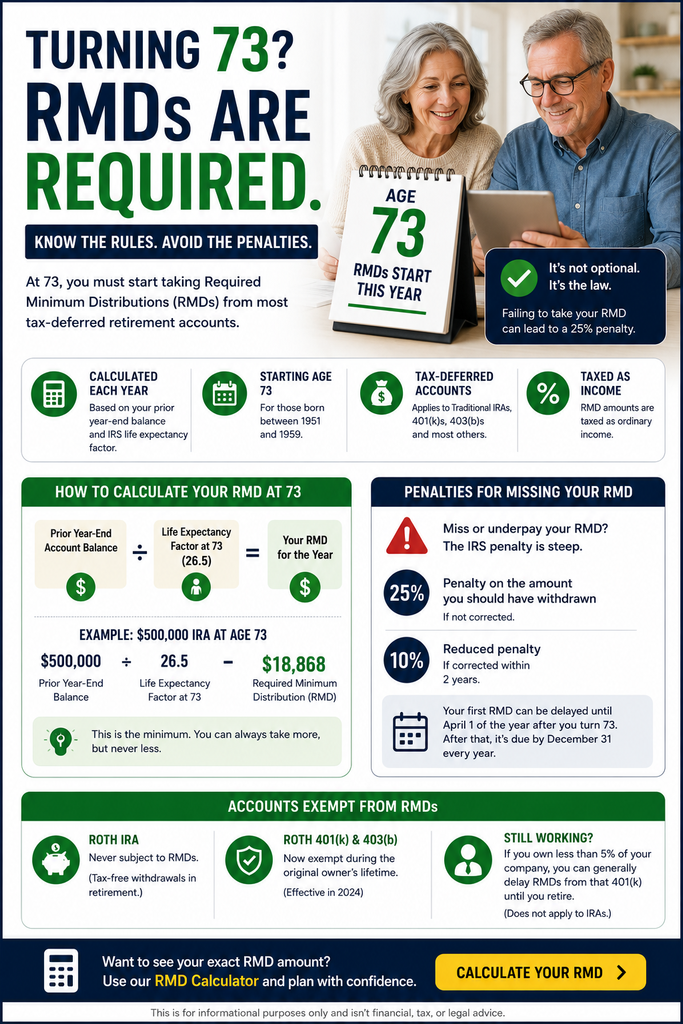
Here is the short version: required minimum distributions at 73 are the smallest amount you must withdraw each year from accounts like a traditional IRA, 401(k), or 403(b), calculated by dividing your prior year-end balance by an IRS life expectancy factor. You can always withdraw more, but never less, without facing a penalty.
The rule exists because the government gave you a tax break when you contributed. Required minimum distributions at 73 are how the IRS eventually collects tax on that money.
Why Required Minimum Distributions at 73 Start Then, Not at 72 or 75
The starting age has moved twice in recent years, which is why the timing confuses people. The original SECURE Act, passed in 2019, raised the age from 70 and a half to 72. The SECURE 2.0 Act, passed in 2022, pushed it further, to 73 for anyone born between 1951 and 1959, and to 75 for anyone born in 1960 or later, starting in 2033.
If you were born in that 1951 to 1959 window, required minimum distributions at 73 apply directly to you. If you were born earlier, you were already required to start at 70 and a half or 72 under the older rules and should already be taking them.
How to Calculate Required Minimum Distributions at 73
Required minimum distributions at 73 use a simple two-step formula based on the IRS Uniform Lifetime Table:
- Take your account balance as of December 31 of the prior year.
- Divide it by your life expectancy factor for the age you turn that year.
At age 73, the current IRS life expectancy factor is 26.5, taken from the IRS Uniform Lifetime Table. Every additional traditional IRA and 401(k) balance has its own required minimum distribution, though IRA amounts can be combined and withdrawn from one account, while 401(k) balances generally must be withdrawn separately from each plan.
Step by Step: Required Minimum Distributions at 73 on a $500,000 IRA
Let’s put a real balance behind required minimum distributions at 73.
| Item | Amount |
|---|---|
| Prior year-end IRA balance | $500,000 |
| Life expectancy factor at 73 | 26.5 |
| Required minimum distribution | $500,000 divided by 26.5, or about $18,868 |
That $18,868 is the floor, not the ceiling. You can withdraw more if you need the cash, but withdrawing less than that figure triggers a penalty, which is the core risk built into required minimum distributions at 73.
Penalties for Missing Required Minimum Distributions at 73 or Later
Missing or underpaying required minimum distributions at 73 comes with a real cost. Per IRS guidance on the excise tax for missed RMDs, the agency charges 25 percent on the amount you should have withdrawn but did not. If you catch the mistake and correct it within two years, that penalty drops to 10 percent.
Your very first required minimum distribution can be delayed until April 1 of the year after you turn 73, but every distribution after that must be completed by December 31 of that calendar year. Delaying the first one means you could owe two distributions in the same tax year, which is worth planning around carefully.
Which Accounts Are Exempt From Required Minimum Distributions at 73
Not every account is affected the same way. Roth IRAs have never been subject to required minimum distributions at 73 or any other age, since contributions were already taxed. Thanks to SECURE 2.0, Roth 401(k) and Roth 403(b) accounts are now exempt during the original owner’s lifetime as well, a change that took effect in 2024.
There is also a still-working exception: if you are still employed and own less than 5 percent of the company sponsoring your 401(k), you can generally delay required minimum distributions at 73 from that specific plan until you actually retire. This exception does not apply to IRAs.
Bottom Line
Required minimum distributions at 73 are not optional once you hit that age, and getting the calculation wrong can cost you real money through IRS penalties. Use our RMD Calculator to plug in your own account balances and see your required minimum distributions at 73 in dollars before your first deadline arrives.
This is for informational purposes only and isn’t financial, tax, or legal advice.

Raghu Shekar writes about personal finance, banking, Medicare, and retirement planning at SimpleUSAFinance. His goal is simple: break down the numbers people actually need — no jargon, no sales pitch — so readers can make their own decisions with confidence. When he’s not writing, he’s usually digging through the latest rate changes, tax brackets, or Medicare updates to keep the site’s calculators and guides current.