Getting your withdrawal order in retirement right can save you tens of thousands of dollars in taxes over a twenty or thirty year retirement, while getting it wrong can push you into a higher tax bracket or trigger penalties you did not see coming. The good news is that the standard withdrawal order in retirement is not complicated once you understand why each step exists.
This guide walks through the typical sequence, where required minimum distributions change the plan, and when it makes sense to deviate from the standard approach.
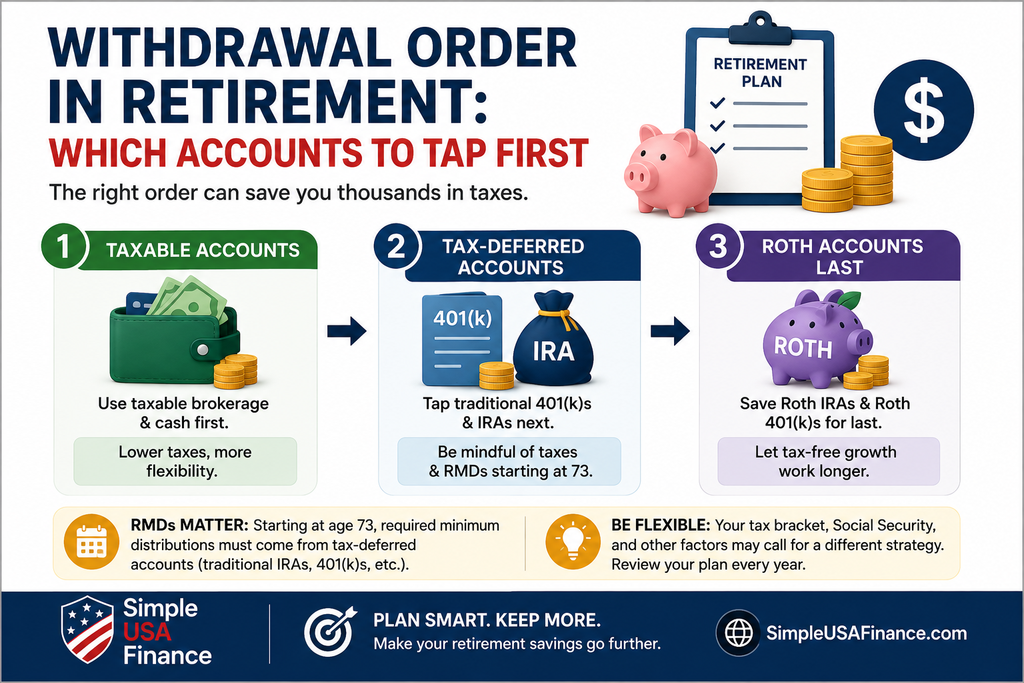
Withdrawal Order in Retirement: The Standard Rule of Thumb
The commonly recommended withdrawal order in retirement runs in three broad stages. First, spend down taxable brokerage accounts and cash. Second, draw from tax deferred accounts like traditional 401(k)s and traditional IRAs. Third, save Roth IRA and Roth 401(k) withdrawals for last.
This sequence exists to let tax advantaged money keep growing as long as possible. A textbook withdrawal order in retirement is a starting point, not a rigid rule, since your specific tax bracket, Social Security timing, and required distributions all shape the best plan for you. Most financial planning tools default to this same withdrawal order in retirement before adjusting for your personal situation.
Withdrawal Order in Retirement: Why Taxable Accounts Usually Come First
Taxable brokerage accounts get pulled first because their tax treatment is already relatively favorable. You only owe tax on capital gains and dividends, not on your full withdrawal, and long term capital gains rates are often lower than ordinary income tax rates. Spending this money first also gives your tax deferred and Roth accounts more time to compound.
This step of the withdrawal order in retirement also gives you flexibility. Since there is no early withdrawal penalty tied to age on a regular brokerage account, you can draw from it at any point in retirement without worrying about the rules that apply to retirement specific accounts.
Withdrawal Order in Retirement: Where Required Minimum Distributions Fit In
Required minimum distributions can override any withdrawal order in retirement you planned on paper. Once you reach RMD age, the IRS requires you to withdraw a minimum amount from traditional IRAs, 401(k)s, and similar accounts each year, whether or not you actually need the cash.
According to the IRS, you generally must start taking RMDs from traditional IRA, SEP IRA, SIMPLE IRA, and workplace retirement accounts at age 73. Roth IRAs, and designated Roth accounts inside a 401(k) or 403(b), have no RMD requirement during the original owner’s lifetime.
Withdrawal Order in Retirement: What Happens at Age 73
At age 73, your RMD amount is calculated by dividing your prior year end account balance by a life expectancy factor from the IRS Uniform Lifetime Table. That amount must come out whether or not it fits your planned withdrawal order in retirement for that year.
Missing an RMD carries a real cost. The IRS confirms the penalty for a missed RMD is 25% of the amount not withdrawn, reduced to 10% if you correct the mistake within two years.
Withdrawal Order in Retirement: When Roth Accounts Should Move Up the List
The standard withdrawal order in retirement saves Roth accounts for last, but that is not always optimal. If a large traditional withdrawal would push you into a higher tax bracket or trigger a Medicare IRMAA surcharge, pulling a smaller amount from a Roth account instead can keep your taxable income lower for that year.
Some retirees also use a blended withdrawal order in retirement on purpose, taking a little from taxable, tax deferred, and Roth accounts each year to manage their tax bracket rather than fully draining one bucket before touching the next.
Withdrawal Order in Retirement: A Sample Sequence
Say a 74 year old retiree needs $60,000 a year and has $10,000 in Social Security, a $300,000 traditional IRA subject to an RMD of roughly $11,300, a $150,000 taxable brokerage account, and a $100,000 Roth IRA. The RMD comes out first because it is required, covering $11,300 of the need.
| Source | Amount | Reason |
|---|---|---|
| Social Security | $10,000 | Fixed income, already scheduled |
| Traditional IRA (RMD) | $11,300 | Required by the IRS at age 73 |
| Taxable brokerage | $38,700 | Covers the remaining need |
| Roth IRA | $0 | Left untouched to keep growing |
The remaining $38,700 needed comes from the taxable brokerage account, since that keeps the Roth IRA growing tax free for later years or for heirs. This kind of concrete math is exactly what a withdrawal order in retirement plan should account for, since the RMD is not optional but the rest of the sequence usually is.
You can run your own withdrawal order in retirement numbers through our Retirement Withdrawal Calculator to see how different sequences affect your taxes over time.
Withdrawal Order in Retirement: When to Break the Standard Order
A few situations call for a different approach. Early retirees who stop working before 59 and a half often need taxable and Roth contribution withdrawals to bridge the gap, since early withdrawals from tax deferred accounts can trigger a 10% penalty. Retirees expecting to be in a higher tax bracket later in retirement sometimes convert traditional funds to Roth accounts during low income years instead of following the standard order at all.
Social Security taxation adds another wrinkle. Withdrawing more from a traditional IRA in a given year can make a larger share of your Social Security benefit taxable, while a Roth withdrawal in that same year does not count toward that calculation at all. Coordinating the two often matters more than sticking to any single formula.
Your specific withdrawal order in retirement should reflect your own tax bracket, health, and legacy goals rather than a one size fits all formula.
Bottom Line
The standard withdrawal order in retirement, taxable accounts first, then tax deferred, then Roth last, works well for most people, but required minimum distributions and your own tax bracket can and should change the plan. Review your sequence every year rather than setting it once and forgetting it.
This is for informational purposes only and isn’t financial, tax, or legal advice.

Raghu Shekar writes about personal finance, banking, Medicare, and retirement planning at SimpleUSAFinance. His goal is simple: break down the numbers people actually need — no jargon, no sales pitch — so readers can make their own decisions with confidence. When he’s not writing, he’s usually digging through the latest rate changes, tax brackets, or Medicare updates to keep the site’s calculators and guides current.